Tuesday, November 29, 2011

Pathologic: Day Twelve, in which it will become apparent what all this was for (PART I)

At 7am:

The morning of the twelfth day has come.
Infected in the past 24 hours: 378 ppl.
Died in the past 24 hours: 648 ppl.
Gone missing: 122 ppl.
Number of dead at the moment: 7776
Number of infected: 512 ppl.

This day is the last. Less than fourteen hours remain to make a worthy decision.

Today's Forecast: Clear, with a 40% chance of artillery fire.
I walk outside and find the streets deserted. Everything has gone: the rats, the dirtied sheets, the plague clouds and leprous robed figures. The bandits have been exterminated. Every single district of the town has swept clean of any trace of the plague, save for the now-useless scarecrows which were once stationed at the entrance to each zone. I've received panicked requests from both the Haruspicus and the Devotress: their adherents are sick, and I'm the only one with enough panaceas to cure them.

First, however, I'd like to share some thoughts.

The decision I make today should be impartial: I've spent twelve days in this hell-hole of a town gathering information, making observations of its squabbling inhabitants, running errands, watching men die in the streets. Nobody is beyond judgment here. Yet I have a gnawing feeling in the pit of my stomach. Maria (or Nina?) Kain's little diatribe yesterday did nothing to strengthen my resolve. Did I really call her "Dark Mistress"? And, really, have I been playing into the Kains' hand all along? They want the Polyhedron to construct a Utopia. They want the town destroyed as much as I--though they want it destroyed so that they can birth a new town, a new Utopia, on the other bank of the Gorkhon. Victor Kain tells me the new town will be larger, better, birthed from the cocoon of the Polyhedron. 


I'm sick of hearing everyone else's drivel about how the Polyhedron is unnatural. It's a tool. We have been making tools since we crept down from the trees: we made fire, cut stone, burrowed holes. These things are not "natural"--but it doesn't make them intrinsically evil. It's how they are used that determines that. The question all along has been this: what is the Polyhedron's use?


Despite the ominous colour scheme, I insist this thing is as harmless as a kitchen knife.
If the knife were in the hands of little kid.
The Polyhedron was created to preserve. It's more than a tomb. It revolutionizes our idea of the tomb: it turns our tombs into brief waypoints, regurgitates our consciousness, refracts the breath and light of the human spirit and pours old wine into new skins. Is this evil? I don't know if it is. The reality of all this, however, is that like any tool, the Polyhedron has been misused. It was thrust, unceremoniously, into the heart of the earth. And from this, one of two things may have happened: either the wound became infected, sending the Sand Plague upward through the man-made tunnels beneath the city, or the puncture stirred up a restless poison.


I am more inclined to believe the latter. The Sand Plague has struck before. It has been here from the beginning. If the architect had any knowledge of this, he might have chosen a better place to make the puncture. Is the Sand Plague a judgment? A fizzing antibody? It's pure science--a manageable result of a routine operation. We might find a harmless plot of land near the capitol, conduct some research, do some digging, and plug in a dozen more Polyhedrons with no repercussions. All this was nothing more than an experiment. We could do it better next time.


The Polyhedron is not evil. But after my chilling conversation with Maria yesterday, I am conflicted. It comes to this: The Polyhedron or the Town. Destroy the Town and a legion of Kains will build their own version of "paradise" no different from the current madhouse on the other side of the river. Destroy the Polyedron and the residents of this god-forsaken little hamlet will go on with their pagan practices: the children will grow into quibbling men and women. They will abuse the earth, pour poisoned blood and tar into the ground, and go on killing and expiring and expending.


In the end, nothing will truly change. So what does my decision matter?


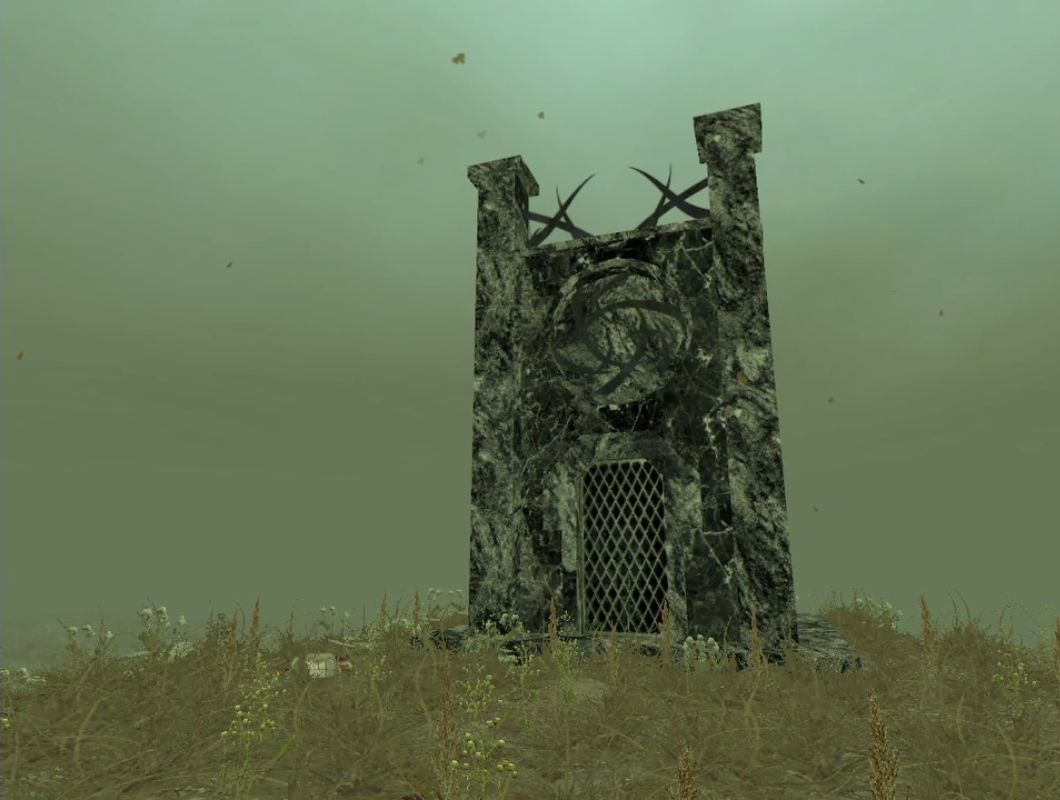
This sculpture at the Kains' makes much more sense in light of Kevin's map.
I have enough panacea to save just one set of Adherents: either the Haruspicus' children or the Devotress' corrupt ones. It might as well be the children. I find, after administering several doses to the last of the sick, that I suddenly have a letter from the Authorities. It's cryptic and mildly passive aggressive, and for the better part of the day I pay it no heed. The General will need my decision at 7pm, promptly, at the Cathedral. 


However, at the apex of the Polyhedron, the door has opened again. I step inside, into the inner sanctum, and trace my way down the steps, deeper and deeper, to the very base. After a brief head-swimming blackout, I am greeted with this strange scene:


It's two kids in a garden standing behind a sandbox in which they have crudely modeled their own version of the Town and the Polyhedron. I've gone on and on about finding a "true adversary". And in the end, I don't believe it was ever the plague. Here, at the base of the Polyhedron, I may have found my adversary.

Thursday, November 17, 2011

Pathologic: Day Eleven, in which the Haruspicus falls into a trap, discovering that his dilemma connects two incompatible truths

(or, in which Kevin learns that he really needs to stop making assumptions)

The morning of the eleventh day has come.

Infected in the past 24 hours: 334 people
Died in the past 24 hours: 621 people
Gone missing: 127 people
Number of dead total: 6831 people
Number of infected: 570 people

Tomorrow everything will be over


Welcome to "Martha Stewart Living," Pathologic edition. Up next, we prepare a lovely quiche made
from spider eggs that hatch inside your mouth.
"Tomorrow everything will be over." Ominous words, but I can't help but feel relief when I read them. By now I, the player, have spent at least 40 hours in this hellhole of a town, struggling not to let the game wear me down. I have teetered on the brink of irrational frustration with it more than once. And I have been at the controls as my character has done the unthinkable. I've killed the guilty and the innocent. I've dragged myself in threadbare clothing through neighborhoods buzzing with the Plague. Frankly, I am exhausted. If one of Ice Pick Lodge's goals was to evoke in me a physical and emotional response analogous to what my in-game avatar is feeling, they have succeeded with flying colors. No other game has ever made me feel this hopeless.

I am determined to save this town, no matter the cost. The Haruspicus does not compromise. Yet the Bachelor, with his talk of wiping the town off the map, is not crazy. He too has witnessed the Sand Plague's devastation. Whether tomorrow brings salvation or annihilation, it will be a mercy.

The town is in the final stages of collapse, with the Sand Plague saturating every district. Even the thin veneer of civilization has fallen away. Food and medicine prices are astronomical; starving citizens on the street beg me for money, but I literally have none to give them. The infected seem to sense that society is crumbling and now attack other people with abandon, often in groups. Near the theater I witness a soldier running from a pack of infected. They chase him down and overwhelm him. Military discipline is breaking down—everywhere I see soldiers breaking ranks and fleeing from their guard posts. General Blok has finally lost control of his army.

... which means I get treated to the following sight when I arrive at the Bone Pillar to save the bull that was there yesterday.


Nothing but a blackened hunk of charcoal remains of it. I can't believe my eyes. Do these imbeciles have any idea how much panacea I could have made from that bull's blood? The nearest disinfector, impassive in his haz-mat suit, tells me to take it up with a low-ranking officer called "Captain Patroclus," who commands a mutinous band of soldiers that has taken control of the military's armory near the trainyards. Patroclus, in turn, says that he was only following orders to destroy whatever possible vectors of infection he found. Whose orders? I ask. Not the General's, surely. No, Patroclus says. The Bachelor gave the instructions.

Of course he would. Seething, I confront him about it, only to hear the same old routine about the importance of the Polyhedron. Apparently the Kains have convinced him that Simon Kain is not even dead but has transferred his soul into the Polyhedron. At best, this is superstition—I've seen the body, and he looked pretty dead to me. At worst—given my epiphany from last night—this is an abomination against nature. The Bachelor won't budge, though. The panacea doesn't seem to matter anymore to him. The Polyhedron is our only hope, he says.

Sure, whatever. I leave him with his microscope and misconceptions and strike out to pay my daily doctor's visits.

More Executors have appeared around town, holding vigil over ill Adherents. Fortunately, they are all the Bachelor's and Devotress's, not mine, but I still feel responsible for them. They are people, after all, and deserve to live. For the past two days I've been giving them antibiotics to keep them alive, making the rounds every day. With time running out, my supplies getting short, and my fatigue increasing, I decide to start healing some of them outright. I don't want to spend any of my precious panaceas in case I need them for some dire emergency on the final day, but I do have a couple of medicinal powders made by the town's children. Even the Executors seems shocked when I propose giving doses to the Adherents. It will destroy the patient, they warn. The medicine will burn the Plague right out of their veins, but it will take some of the veins along with it.

I shrug. Petr Stamatin, the Polyhedron's creator, should count himself lucky to make it out of this epidemic as a cripple. I feel a small stab of pity as I dose him with the powder, but only a small one.

While making my rounds, I begin hearing rumors surrounding Elder Oyun and the trial he has planned for me. First I receive a letter from the Devotress, who calls me to the cemetery to meet with her. She warns me that the Elder is going to try to kill me with this final task. Honestly, this doesn't seem like such a big deal to me; he's practically killed me with the last two trials too. The Devotress seems to think this time will be different, though, and she offers to help me out—in return for a favor on the final day. I immediately turn down her offer. Whatever favor she might want from me, I think, it can't be anything good. She accepts my refusal coolly, making me wonder briefly if I should not have been so hasty.

After this, I call on Young Vlad to make sure he's not bleeding from his eyes or something. He seems agitated to hear that I'm meeting with Elder Oyun later. He says I should be careful. After all, Oyun is the one who murdered my father.

Wait, what? I thought he died of the Plague! Young Vlad just shakes his head and tells me to ask the Elder myself. Then he, too, advises me to watch my back during the third task.

Back in the Abattoir, Elder Oyun tells me that it's time to enter "the belly of Suok"—that is, descend into the depths of the earth—and indicates the deep pit outside his personal chamber. Once I know the secrets of the earth, I will ascend to the status of hierophant within the Order. Despite my simmering anger at the Elder, I have to admit that I'm madly curious to discover what happens down there. On Day Five I saw some crazy things just by climbing down a 15-foot-deep well. What's going on in the darkness beneath the Abattoir?


Here I must apologize to you, faithful readers. Because I never find out.

Seriously, doesn't anyone in this town know what a rope is?
Apparently my paranoia in refusing the Devotress's assistance screwed me over. I die instantly when I jump down the hole, and no amount of creative thinking can reveal an alternate path. The belly of Suok, the strange place where the living earth feeds on the Order's sacrificial blood, will be a mystery to me forever.

Suddenly enraged, I return to the Elder's chamber. I'm sick of his arrogance and his murderously impossible quests. This guy has been a thorn in my side for long enough. It's time for a reckoning. You are responsible for my father's death, I tell him. Explain yourself.

Oyun doesn't try to lie. He admits to killing Isidor Burakh, having stabbed him to death with the sharpened horn of a bull. He's not sorry, either. Isidor Burakh was colluding with the Kains in their Polyhedron project, trying to pour old blood into new veins. He was betraying the Order. Oyun says he would do it again without hesitation. I coldly tell him to put up his fists and prepare to die, but a small grain of misgiving has settled into the back of my mind. My father was involved with the Polyhedron, too? Why?

The scene suddenly changes, and I find myself in a part of the Abattoir I've never seen before. In the center of the room is a bull, and torches line the walls. My weapons have vanished, leaving me with only my fists to defend myself. Then the Elder storms into the chamber, and the fight is on.


He looks pretty intimidating, what with his sheer size and the bull's-head helm, but I'm surprised to find that he's not terribly challenging. Maybe I shouldn't be: after all, I've spent the last week and a half scrabbling to survive among infected citizens, lunatics, and murderers in the world beyond the Abattoir's doors. Compared to that ordeal, it's practically therapeutic to vent a little righteous rage on a single target. It's the first time in this game that I've faced a straightforward videogame trope: the one-on-one boss battle.


The Elder, with his long reach and crushing strength, beats me down a few times, but I eventually succeed in exacting my revenge. I have to admit, it feels pretty good. I ignore the new entry in my diary that says that the Elder's death is "a disproportionate sacrifice." By now I've killed dozens of people in this town, with fists, guns, and knives. One more hardly seems to matter at this point, especially considering the sorts of things of which the Elder is guilty.

I spend the rest of the day running minor errands for Kapella, who is solidifying alliances with the other children in preparation for their forging of a new society birthed from the ashes. On a whim I check in with Ospina (one of the Devotress's Adherents) to make sure she hasn't fallen ill. When she hears that I've eliminated Elder Oyun, she hails me as the new Elder of the Abattoir. "I, Us-Pae-Nah, bend my knee to you," she says, apparently using her real name for the first time. I have finally come into my birthright as the head of the Order of Bulls. I have blood on my hands, but perhaps that is fitting. In that moment I feel unabashedly victorious.

My sense of triumph wears off as night falls. Brewing up the last of my panacea in my father's old laboratory, I remember what Oyun told me about Isidor Burakh's complicity in the creation of the Polyhedron. Where once I was so sure of my path, I now have a seed of doubt. Even my father seems to have been convinced of the Polyhedron's importance. How could he do that, though, with the knowledge of what it does? Were the Kains manipulating him in their pursuit of "utopia"? Was the Elder lying to me? Or did my father—the most respected member in the Order—know something that I don't?

Sunday, November 13, 2011

Pathologic: Day Eleven, in which the Bachelor will discover the truenature of the Kain family

At 7am:

The morning has come.
Infected in the past 24 hours: 371 ppl.
Died in the past 24 hours: 618 ppl.
Gone missing: 131 ppl.
Number of dead at the moment: 6798
Number of infected: 552 ppl.

Tomorrow everything will be over.

[I lost my map screenshot for today. The town is completely plagued or burnt out.]

Base of the Miracle
The Inquisitor needs a more in-depth look at the Polyhedron's architectural plans. She believes the structure—unnatural as it is—has somehow caused the epidemic. Perhaps something in the base will tell us more. This is preposterous, of course. I’ve been inside. It’s a wonder—a testament to human ingenuity. It shields from plague; it doesn’t spread it.

Andrey has the plans, so I head to the tavern. Of course he’s not there. He’s purportedly been arrested for his renegade hero routine yesterday. However, when I ask General Blok to recall his arrest, he tells me no such order was issued. A large faction of soldiers have staged a coup, and is leading Andrey to his death down at the southernmost part of the train tracks, just at the edge of town.

I follow the tracks to find a swarm of soldiers, all pointing their rifles at me. Unfazed, I walk through the ranks to the very end and address the officer in command. He’s some haughty everyman, and he believes I am the architect. I’m sentenced to death, he says; he’s taking control now. My pleas don’t matter, so I stall fortime by asking for a final smoke. He promptly knocks me out, and the world goes black.

Dude, you get the puppet avatar. There's no way you're getting out of this alive.
When I come to,I’m standing in front of a burning pyre out in the middle of the cemetery, stripped of all my weapons and medicine, shivering in the rain. I’ve only just oriented myself when several snarling attack dogs emerge from behind the graves and try to bite me. I jump onto the pyre, skirting the flames, and beat each dog’s brains in, then head to the gravekeeper’s house at the edge of the cemetery. After some convincing, the little girl Laska gives me some tourniquets and a butcher knife.

Two guards are stationed at the cemetery’s entrance. I stab one in the back, silently, then the other, take their rifles, and march cold-blooded back to the train yard. Everyone in this entire town—even the military—is an idiot. I shoot each soldier in the head before he can fire a single shot, then run to the patrol leader and shoot him squarely between the eyes. I take back every single thing he stole from me, then walk back to the Tavern in hopes that I might hear some news regarding Andrey.

The sop is waiting for me there. He tells me he’s surprised I didn’t ask about the base earlier. It turns out the Polyhedron is supported on a spring—a three hundred meter-long shaft, about five and a half meters in diameter, was drilled into the earth beneath the foundations of the town: a crystalline rose sprouted froma metal stalk. A sort of lever, weighted down by the foundations of the town itself.


The Inquisitor is convinced that this is the instrument which has stirred up the plague. Through some shift, the stalk punctured the clot at the heart of the town,which has sent plague up from the soil itself. This makes sense to her. But it isn’t good enough to me. Yes, the wound has stirred up the disease, but the disease has been there from the beginning. I have very good reason to suspect the Steppe folks and their pagan practices in the Abattoir. They thirst for blood. The worms always tell me they never have enough blood to feed the earth.

Who’s to say that the excess of sacrifice—the poisoned meat, the putrid flesh fed by these steppe barbarians—is not what originally created the plague? The Polyhedron was the one prick that revealed the infection: it was there all along. With modernization—with systematic and permanent housing, with wells digging into theground—the once-harmless practices of the natives, repeated ad infinitem in the same place, has become malignant.

Today's Pantomime was admittedly unsettling.
Preparations For Crowning
I take care of a few smaller tasks—saving several wrongly condemned men from a firing squad and suppressing some unsavory rumors about the Kain family. The most alarming quest of today concerns Maria Kain.

The Kain family continues to talk of dying, of suicide. They all seem to have gone mad. After some coaxing, I talk to George Kain, who talks of the Inner Chamber of the Polyhedron. It is a tomb, of sorts, and also a receptacle for the now-deceased Nina Kain, Simon’s love. Yet Nina Kain is returning, he says. The beautiful Maria Kain, who has loved me for quite some time, has accepted the soul of her mother.

Utter nonsense.Of course, Andrey and Peter have succeeded where I failed. I may have mentioned—the Bachelor and the Inquisitor met years before when an attempt to resurrect the human form was conducted in the capitol. It failed miserably. Perhaps, in this squat-hole of a town, it has not.

Maria needs pledges from the two other female authorities in town: the young Kapella and, inexplicably, Klara the Devotress. I go to both of them and ask for a token of their fealty. Klara protests—she says that Maria will become a “sorceress queen”and make her own twisted version of a utopia from the town—a “violation of nature”, man’s own attempt to create the kingdom of heaven. I dismiss her; this is all a simple formality. I return to find Maria’s followers congregated outside her front door. They look mad. Everyone in this part of town has gone mad. Perhaps it’s a side effect of the panacea.

Her Entourage

She’s waitingfor me inside the tomb behind the Kain family’s estate. Rather than summarize,I’ve transcribed a conversation so strange that Ospina herself would be proud. [I have made slight adjustments for clarity.]


MARIA: It’s not me. Not your Maria anymore, but not the Scarlet yet. Nothing of me is here. Touch my flesh: your hands will touch the air only.
BACHELOR: Here are the signs of recognition from Klara and Kapella. They bow to you, Dark Mistress.

MARIA: Scarlet. But let it be so. That means that if a miracle happens – and by tomorrow only those who should survive by my plan live, and the ruthless Authorities will forget about us as before –we shall deny the severe law of life. And then the dream will triumph. And a new Utopia will rise.

BACHELOR: What do you call Utopia, Maria?

MARIA: It’s not the Tower, Daniel. It’s the town. We understand the word “Utopia” not as an ideal of prosperous trade,a perfect social system and political validity, but as a mystical fact of materialization of the incomprehensible, normally inaccessible to the profane person.

BACHELOR: Who speaks now by your mouth?These aren’t your words, and this is not your voice.

MARIA: Truly. You listen. This world exists, but is not given into human hands. Never. It is revealed only by delicate hints; in inevitably perishes under a straight sight. Mystery is its life; this world dies if it is enslaved.
BACHELOR: This is why the pestilence has begun?
MARIA: Probably. But luckily, even in the best adjusted mechanism failures happen. Sometimes the two worlds—mundane and utopia—touch each other! The antibodies collide! And contrary to the law of self-preservation they do not perish, but merge, forming a marvelous symbiosis. Thus is Utopia – a terrestrial embodiment of an unearthly miracle – achieved!
BACHELOR: And you chose to create this town? This is how an embodied miracle looks?
MARIA: Yes. We could build a magnificent town of rock crystal, sapphire walls, emerald roofs and ruby roadways, as you would expect from children’s fairy tales about magic countries. But here true life – living people of flesh and blood – exists. What surprises you?
BACHELOR: Why dirt and dullness? Why worn walls, brick-works, rusty beams and sewage manholes? Is this how Utopia should look?
MARIA: This is how it looks. That’s why it’s Utopia instead of a dream. It is even associated with the word “bog”. It needs dirt. A bog of peat bathed in a ruby sky. Utopia accepts even the basest humans, the unattractive terrestrial. Therefore: the bloody Abattoir, rotten fields, barracks, and impoverished slums. This is the land.
BACHELOR: Oh, so . . . 
MARIA: Utopia needs the Cult of Bulls, a living echo of the symbiosis between the world of beasts and spirits and the world of men. The animal nature lays the foundation of our civilization. Dirt, blood, manure, devouring each other’s skin and meat and bones: tools from which civilization, the commonwealth of creators, grows. 
BACHELOR: And where’s the miracle? 
MARIA: In the earth a miraculous merge of the Anthropophobic Steppe and the Human world occurred. This settlement transfigured from a society of devourers into one of creators. A true wonder was born. At its height, the Cathedral was built. But here we failed. 
BACHELOR: . . . And then you built the Polyhedron. 
MARIA: Yes. The Tower of the Riverbank has finally metamorphosed – a miraculous merger of worlds. The world of the possible and the world of the impossible. 
BACHELOR: If all this was so great, why the pestilence? 
MARIA: I do not know, Daniel. This is not our fault. The town has not sustained this tension, has not endured the heat. So we begin again. There is no death. We are not afraid of it. You see, I am dead and incorporeal, yet I am here. Like a restless soul doomed to return.

Her words leave me conflicted. I lurch back to my bed through plague-ridden streets. Over the past two days chaos has overtaken the town: I can’t go ten steps without seeing another bandit cut an honest man down, or see the plagued burned down in waves like fields at the end of harvest. The buildings are red and blotched. And above it all, in perpetual bloom like a concrete rose, lingers the impossible shape of the Polyhedron. 

Tuesday, November 8, 2011

Pathologic: Day Ten, which informs the Haruspicus of the fact that he stands before a choice that will determine his victory

(or, in which Kevin is forced to participate in the Pathologic Iditarod)

The morning of the tenth day has come.

Infected in the past 24 hours: 340 people
Died in the past 24 hours: 623 people
Gone missing: 139 people
Number of dead total: 6230 people
Number of infected: 516 people

Less than three days remain.


I wake up early on the tenth day, hardly able to believe that I survived the night. To my immense relief, the health-draining effects of Elder Oyun's potion from yesterday seem to have worn off—my health is dangerously low, but stable. The death toll, on the other hand, is rather disturbing: up by over 2000 in a single day. According to the rest of the casualty report, only 600 of those people actually perished from infection, which means that over a thousand people have died of other causes. As I walk through the lamplit streets, filled with murderous arsonists and trigger-happy soldiers, it's not hard to guess what those causes were. And there are two more days to go.

I know that I'm going to be facing Elder Oyun's second trial today, so I stock up on first-aid supplies and choke down another revolting dead porridge before making my way to the Abattoir. I make a couple of detours into the deserted districts where the plague has burnt itself out, searching the abandoned homes for food and emptying the last of my shotgun ammo into the looters who get in my way. I luck out and find a loaf of stale bread in a kitchen, which I immediately wolf down to stay conscious.

Elder Oyun greets me with the news that he's found the butchers responsible for stealing the auroch blood from the Abattoir. Well, "found" isn't exactly accurate. He knows who they are, but they have gone into hiding. It falls to me to locate them as part of my second trial. Oyun gives me another potion to drink, though this time I have the good sense to ask him what it does before taking it. It will make me ravenously hungry, he replies, which will help because "if you are hungry, you will find the scent of blood better." He tells me to visit the sacrificial mound south of town to consult with the spirits of the steppe, warning me not to eat anything until I have located the offending butchers. Remembering yesterday's ordeal, I make sure to listen. I fight down the panic when I see my hunger meter skyrocket and my health meter plummet. If I made it through the first trial, I can make it through this one.

The hill of sacrifice is empty when I reach it just before midday. I lie down on the stone slab at the top and wait for the spirits to do their thing.


Scenes like this are why I no longer play Pathologic right before bed.
When I awaken, I find the locations of the fugitives marked on my map. All three are hiding out in the marshes with the Worms. I use up another first-aid kit (having already spent the first to survive the trek south to the hill) and strike out for the first location.

The butchers are defiant when I confront them. Each of them tells me the same thing—that I can't get the panacea blood I need from underground, that I need to gouge out the tumor that's been growing on the land and harvest the blood from the wound. It sounds suspiciously like the scorched-earth policy that the Bachelor has been advocating, and I'm in no mood for it. I duel each of them to the death (again, reloading the game every time they land a blow and sap my ebbing health) and return to the Elder with the news. This time he gives me the antidote to the potion, presumably because I didn't try to artificially fix my hunger/exhaustion meters as I did yesterday. When I bring up what the butchers told me before I killed them, he says something about how I can't trust anything they or the Bachelor say about the Polyhedron. The Kains are trying to use it to achieve immortality through reincarnation, to "pour old blood into new veins," Oyun says, an idea as blasphemous as it is unnatural. He will say no more, dismissing me until tomorrow.

Before I have time to be surprised at how straightforward (relatively speaking) this all was, I receive a letter from the last person I would expect: Fat Vlad. It seems he's been granted a temporary reprieve by the mob in the Apiary, and he wants to speak with me before he is marched away to that forbidden room to face his horrible fate. I find him in Mother Keeper's torchlit sanctuary, surrounded by guards but otherwise looking much the same as always.

He has two final pieces of information for me. First, there is an auroch dying at the "Bone Pillar" near my late father's abandoned home, which Vlad recommends that I check out before any of the other powers-that-be find it. Second, Vlad cautions me to beware of his former underling, Elder Oyun. The Elder is fighting a battle with me, Vlad says, and he is not to be trusted.

Watching Fat Vlad in the flickering light, I feel a pang of remorse. For the first time in the game, I believe he's telling the truth. With his execution fast approaching, all lies seem to have gone out of him, and he decided to help me with what little time he had left. He has nothing else to say to me. I feel worse than ever about my part in his death.


He was definitely telling the truth about the bull at the Bone Pillar, in any case. The poor animal lies impaled on a spike and surrounded by shifty-looking Worms. According to them, this is an auroch, and what happens to it is up to me. I am to ask my Adherents—the children who stand to inherit the town—what I should do with it. I'd better hurry, though. It's already late afternoon.

Once again, the issue of my character's walking speed returns to bedevil me. My Adherents are scattered all over town—most of them at the far edges—such that there's no efficient way to visit them all. Add to that the hellishness of the sprawling infected zones, and I'm going to be pressed for time even without having to deal with the health issues from yesterday. I talk to Spichka first, since he's close by, then make the laborious trek to meet with Notkin on the south side of town. Both of them seem horrified by what I tell them and say that the bull needs to be removed from the spike immediately.

Mishka: "I have got wet and faded."
Mishka agrees, but she seems bothered more by something else. A few words about Mishka: she is easily the most pathetic character in the game. Sad-eyed and sickly, she leads a lonely life in her damp, claustrophobic railcar. Her parents died a long time ago, presumably during the first outbreak of the Sand Plague, and now she treasures the only memento she has of them: an ugly little doll made of burlap. Mishka hints that the Devotress took her doll out to the marshes because it was "hungry" and wanted to graze, but she never got it back. I feel so sorry for her (and so creeped out by the thought of the Devotress using her doll for who knows what) that I promptly agree to find it for her despite the time pressure I'm under.

I find the doll sitting out in the marshes, eerily alone. I don't have time to return it yet, not with nighttime approaching, so I stash it in my inventory and move on to the graveyard to meet with Laska. By now I have covered almost every area on the map and have to resort to chewing coffee beans to avoid keeling over from exhaustion.

To my dismay, Laska's not in the mausoleum that she apparently calls home. General Blok has arrested her for not allowing his soldiers to desecrate (or as he would put it, "sterilize") the graveyard. A teenage girl informs me that she's being held at the Town Hall, all the way up on the north side. (Haruspicus: "My legs are failing me!") Yet when I storm inside to confront him, it's not Laska standing next to him, but the Devotress.

What is she doing here?
Blok is losing it. He rambles on about duty and safety, pausing every now and then for little asides to the Devotress, asking if she agrees and if she thinks he's doing the right thing. He can't seem to keep his mind on our conversation and claims ignorance when I demand to know his reasons for placing a little girl under arrest. The Devotress is silent the entire time; she merely stands behind the general, watching.

Finally, Blok points me south again, where the army keeps its reserves of weaponry. I retrace my steps for the third time as I make the painfully slow journey, darkness falling around me. With the amount of distance I've covered today, I feel like I've run the Tour de France without a bicycle. (At this point, my notes for the day simply read, "THIS IS RIDICULOUS!! Running back and forth across town! AAAGH!!!") I pop the last of my coffee beans into my mouth as I stumble along, ignoring the hit to my health.

I find Laska locked up in a boxcar under armed guard. I order her released, by the general's authority, then ask about the auroch at the Bone Pillar. She adds her voice to the chorus calling for it to be released, and I make a beeline for the Bone Pillar in the northeast, hoping I'm not too late.

I arrive just before the bell tolls for 11:00. The Worms say that the auroch will be removed from the spike tomorrow morning, and each one hands me a vial of its blood: four panaceas' worth. I pocket them and head south one last time, to deliver Mishka's doll to her. Before I do, I take a short break to read the letter I received from the Bachelor this morning, who is still trying to convince me that the Polyhedron needs to be saved. The Kains have discovered the secret to eternal life, he says. I snort and disregard his argument.

Mishka is, of course, happy to see her doll. As a reward for my efforts, she hands me ... a vial of auroch blood? Where did you get this? I demand. From the base of the Polyhedron, she answers. Every now and then pools of blood will appear at the bottom, though nobody can say where it comes from.

Then my map changes.


My eyes move from right to left over the picture—from the veins of sacrificial blood from the Abattoir, to the sharpened stem that plunges down to meet it, then up to that blackened horror incubating within the Polyhedron. Suddenly, it all clicks into place. The Bachelor's letter, the blood at the base of the Polyhedron, the urgency of removing the spike from the suffering auroch at the Bone Pillar: everything is united. Maybe the Kains have discovered how to be reborn in the Polyhedron, but in order to achieve this they need fuel, nourishment for the soul within. In the words of Elder Oyun, they need to pour old blood into new veins.

The Polyhedron siphons the lifeblood from the earth, the earth sickens, the Sand Plague comes. A syllogism, deadly in its simplicity.

I hurry over to the Polyhedron as a thin drizzle begins to fall. Just as Mishka said, blood is pooled at the base of the stairs leading up to the Inner Chamber. I collect a sample, and it's exactly the same as the blood I received from the Worms at the Bone Pillar.

If I had any doubts before, they're gone now. I don't care what the Bachelor says or whom he's been talking to. If we want to eradicate the Plague once and for all, the Polyhedron—and that thing growing inside it—must be destroyed.

Wednesday, November 2, 2011

Pathologic: Day Ten, on which the creators of the impossible make their appearance and a discussion commences of the miracles witnessed.

At 7am:

The morning of the tenth day has come.
Infected in the past 24 hours: 340 ppl.
Died in the past 24 hours: 677 ppl.
Gone Missing: 139 ppl.
Number of dead at the moment: 6770
Number of infected: 576

Less than three days remain.

Today's Map. The Plague is almost unbearable.
Seized Focus
The Inquisitor is curious about the Polyhedron. Such a thing shouldn’t exist—it defies the laws of physics, of nature. Yet it stands, almost suspended, at the head of the town like some silvery crown. It was built by Peter Stamatin, and it is from him that we must procure the plans to study the structure in fuller detail.

I find his brother Andrey in the Tavern on the east side of town, and he tells me soldiers came to arrest them and, in a panic, he killed them and let his brother escape. Peter now wanders the town looking at his old architectural experiments: “endless stairways”, he calls them.

These things are impossible.
I ought to have mentioned these strange structures earlier. Originally I thought they were the remains of burnt houses. As it turns out, these were prototypes of what would eventually become the Polyhedron. I’ve walked up the stairs once or twice and surveyed the land—all the sounds of the city fade away at the top of these naked stairwells, leaving only one sound. And that sound is children—babies—crying, fading in and out.

Cue: screaming children sounds
I find Peter in the heart of a plague district, dressed as an Executor cremating bodies beneath one of his stairways. He’s gone mad—he tells me he’ll give me the plans if I bring him five bottles of twyrine to assist in his suicide. I go out, retrieve the twyrine, and procure the plans. He tells me he believes a building is capable of housing a soul—of capturing, freezing, a soul and containing it. The stairwells scattered through town were misfires, aborted attempts, at building the masterpiece that now sits like a crown at the head of the town.

The late Nina Kain funded this enterprise because she believed this building could house a spirit. The children believe the Polyhedron grants wishes and dreams, but the Kains have other (as of yet unknown) aspirations for the creation. Peter says it has power because we believe it has power: a miracle will not happen unless people believe it can happen.


After some gentle prodding, I convince Peter to give up suicide and live another day. It’s not so simple, of course. Klara, the Devotress, has been whispering in his ear, telling him that by building the Polyhedron he has taken a miracle into captivity. It is unnatural, to be sure, but is it truly evil?

Of course, I think over the Polyhedron, and the Kains’ belief in soul houses; the implications are chilling when I think of the cries of children in the endless stairs. I wonder if Peter didn't accidentally capture something in his contraptions that he shouldn't have.

Madness of the Kains
Catherina Saburov is convinced that Simon Kain has revived and is walking the streets. Ridiculous, of course, though I’m almost willing to believe anything at this point. After all, I have never actually seen Simon’s body. I check with Rubin, now freed from the Kain family and notably shaken, wondering why he is still alive: he tells me there is no possibility that Simon could have resurrected. He cannibalized every particle of his corpse to make the vaccine.

Victor Kain advises me to do damage control—to spread a rumor that George Kain believes he has become Simon—and pays me a handsome sum. I report to the Inquisitor who sees through my lie and responds with cool indifference. Something in our relationship has changed. The thing is that I don’t quite disbelieve the rumor myself. The Kains have slowly begun to slip in the past few days. George speaks of slipping into a trance to retrieve the spirit of the Polyhedron. Victor has begun to rave of reincarnation. Maria, of course, remains silent.

The Kain family tomb, I assume. Note again: the horns.
Pictogram
Mark Immortal, theater director, tells me that an uprising and sacrifice has broken out near the bone pillar in the Tanners District. He is, and has been, noticeably upset for his auditorium’s transformation into a morgue, though he comments that they have been his finest audience in a long while.

The problem is easily solved: after a quick inspection, I ask General Blok (still alive) to send his men in to clean things up, and go on my way. The men are protesting the Polyhedron—they say it is destroying the town, and they want it torn down. When I report back to Mark, he admits he instigated the riot. In his boredom, he’s decided to stir up a bit of mischief.

The Bone Pillar
Utopia
Pathologic is the Western name of this game, but in Russia the title is мор (Pestilence) with the subtitle утопия (Utopia).


In passing, I find a teenager on the street and ask him what he thinks of the Polyhedron. He tells me of its wonders: how, deep within, there is a kilometer-long labyrinth. He says, “You walk and walk in it, and it does not come to an end. When you go out – it is considered that it’s your reflection that leaves, and you yourself get to the Other Country.” I ask what “the reflection” means, and he replies, “It’s as though it’s you, and at the same time it’s not you. They leave not talkative. Therefore it’s said that it’s your reflection that comes back – to quiet the parents and so on. And your real self goes to the country of Utopia – to the magick country.”

This town is worthless. I hold to this. Yet the crown is its one treasure. The Polyhedron is impossible: a miracle, a feat of human ingenuity, completely accidental, and with its thousand uninfected children, it is the one pure thing this town has. Perhaps a cold anesthetic wonder, but a true wonder nonetheless. If one thing could be saved, it is the Polyhedron.

The sketch changes again.
Yet I am uneasy. The Polyhedron makes possible some passage to “Utopia”, the children say, but what is its true cost? I believe in equity: in order to gain anything, something must be given up. What have the depraved folk of this town not yet given up?

Tuesday, November 1, 2011

Pathologic: Retrospection

We're getting quite a few readers, which is awesome. If you're interested in knowing more about the blog, look at the links up at the top; the numbers indicate each "day" of the game. It's recommended you start from the beginning. Also: investigate the fine article by Quintin [Butchering Pathologic]. In case you're curious (and/or new), I stole the game's introduction to the two characters Kevin and I are playing. The bios make more sense as we burrow further into the game. Here they are:


The Bachelor - Daniel Dankovsky

The history of mankind knows such catastrophes that demonstrate the whole insignificance of our achievements and the victory of undefeatable Evil. Such are, of course, the epidemics of various contagious diseases that have destroyed whole cities in the past. The best and wisest of the participants of such events have all come to the same conclusion that it isn’t worth fighting in such circumstances, but is best to simply clench one’s teeth and take the losses.

This is the story of a man who performed a miracle and defeated an opponent when victory seemed impossible.


The Haruspicus - Artemiy Burakh

How do they call upon menkhu, the true followers of the family of hierophants? They are distinguished by their hands: the butchers, the surgeons, the healers of the lines, the leaders of the Order, the ones that speak to the udurgs, masters of the art of the Haruspicus. Who is called the Haruspicus? One who tells the future by the guts; he knows the body is similar to the Universe. His scalpel follows the lines of the body; his feet follow the way of his people. They are trusted with power when they know which line to choose. They are thrown into the dark flesh of the earth when they lose their way.

This is the story of a man who avoided a contradiction that threatened to destroy the doomed life, and masterfully reached his true destiny.


If you use Reddit [I don't understand it] PLEASE promote us or vote or sub-reddit this blog or however you Reddit-folk do it. Go here and promote us! We'd love to see Pathologic get more buzz.

Monday, October 31, 2011

Pathologic: Day Nine, which informs the Haruspicus that there is a battle for the Order and ancestral lands ahead of him

(or, in which Kevin imbibes a potent cocktail of madness and despair)

The morning of the ninth day has come.

Infected in the past 24 hours: 356 people
Died in the past 24 hours: 454 people
Gone missing: 58 people
Number of dead at the moment: 4086 people
Number of infected total: 539 people

The town is dying. Less than four days remain.


Duke and I are beginning to argue. Not as our characters, but in real life. He can't believe that I am so naive as to trust anything I learn about the Plague from the barbaric Cult of Bulls. Look at the things they do, Duke tells me. Look at the things they make you do: ripping out people's organs so you can make antibiotics; delivering up the defenseless Vlad Olgimskiy to be cannibalized. It's rituals like those, Duke says, that are sickening the earth and bringing the Sand Plague on us. And you are helping them.

For my part, I am disgusted by Duke's sudden turn for the fatalistic. Unexpectedly, I find that I'm the one clinging to some last vestiges of hope. The town may be twisted and corrupt, but we can still save it. We can still beat this thing. I can't believe that after all we have gone through, after fighting tooth and nail to save the people of this wretched little town, Duke is ready to sacrifice everybody just to win. To me, it looks like he's giving up because it's easier to nuke the Sand Plague rather than cure it. But these people deserve life, if nothing else. Gesticulating wildly in my kitchen, I call him a fascist.

The thing is, neither of us is completely sure who's right. It's impossible to tell which of the townspeople are lying to us, but they can't all be telling the truth. Ever-shifting loyalties and agendas make it impossible even to determine who would have a reason to lie. Essentially, Duke's and my conflict is a case of the blind fighting with the blind. I'm fairly sure I'm doing the right thing, but Duke's arguments stick in my mind. Every time I complete a task for the Order, I feel a small twinge of anxiety. What if he's right?


If there's one thing I don't have, though, it's time to sort through the tangle of questions and worries. The game relentlessly draws me on as people keep dying and resources get scarcer. The proverbial cavalry has arrived, though their notion of keeping the peace involves shooting first and asking questions later.1 A summons arrives with the dawn, telling me to report immediately to the army's commanding officer, General Blok. He wants to know where I got the panacea.

On my way there, I pass the Clot, former home of Fat Vlad. It's dark and empty, and an Executor has been posted outside the door. When I talk to him, he refuses to let me inside. "This house belongs to the dead. You could have prevented this," he states flatly.

Thanks.

At the Town Hall, General Blok imperiously asks about my method of producing the panacea. He knows that the key ingredient is scarce, and he wants to get more for me—by whatever means possible. I don't like his tone and refuse to reveal my secrets. I have seen the way he operates. I can only imagine what would happen if he were to send his troops into the Abattoir to get me the auroch blood by force. He might destroy the only source of the precious blood. This oaf could ruin everything. Livid at my refusal to cooperate, Blok tells me to go to hell and kicks me out of the Town Hall. Unconcerned, I dust myself off and head toward the Abattoir to meet with Elder Oyun.

What does Blok think he's going to do with this thing? Shoot the Sand Plague?
Today I will have the first of my three trials to determine if I'm worthy to be a leader in the Order. I will also get a good, long look into the swirling abyss of madness that awaits me when Pathologic finally decides to play real hardball.

Oyun is as proud and truculent as ever when I catch up with him. Some auroch blood went missing from the Abattoir last night, and he wants me to track down the thieves. He suspects the Bachelor, of course. I am doubtful about that, but I need that blood even more than the Elder does. I agree to look into it, and Oyun tells me not to rest until I find the truth. He then has me drink a potion before I leave, saying something about how I will get really tired.

I'm almost out of the Abattoir before I notice that my exhaustion meter seems to be filling up unnaturally fast. By the time I'm halfway to the Bachelor's house, it's full. Panicked, I eat the lemons in my inventory (which decrease exhaustion at the expense of increasing hunger), only to see any positive effects nullified in a matter of minutes. Whatever the Elder gave me to drink, it's screwing with my body. I don't keel over immediately once my exhaustion maxes out, which is what normally would happen; instead, my health starts to plummet. I use up every healing item I have just to stay alive long enough to reach the Bachelor's.

The Abattoir is on the eastern edge of town, the Bachelor's house is on the western edge, and there's plenty of
plague in between.
But he's not there. The woman who lives with him tells me that he has been taken captive by the Dogheads of the Polyhedron. For some reason the Bachelor decided to help the children get their hands on some guns, then idiotically tried to double-cross them by giving them blanks instead of live ammunition. The Dogheads are keeping him in a cell in the factory district, just a short distance from the Abattoir. My heart sinking, I start retracing my steps east, but not before vainly trying to fix my exhaustion/health problem with a one-hour nap (it does no good). I cough up the last of my money to buy some thousand-dollar tourniquets at the nearest pharmacy. I hope they'll keep me on my feet long enough to get to the bottom of all this, even as I try to ignore the fact that I'm practically fainting with hunger.

The Bachelor's guards—are they actually adults, or just prematurely wizened children? Rumor has it that
this is what happens to Dogheads who leave the Polyhedron.
At the jail, the Bachelor's guards refuse to be talked into releasing their ward. Khan, leader of the Dogheads, wants his rifle ammunition, and the Bachelor stays put until he gets it. The guards say that the live ammunition is probably back at the Bachelor's house: again, on the other side of town. Upon hearing this, I become almost frantic. I don't have time for this. Pausing the game, I agonize for about two minutes, trying to think of a way out of this predicament. The tourniquets in my inventory won't keep me alive for long, and my health bar is shrinking so fast that I can actually watch it tick down, little by little. Even if my strength will hold out for the trip to and from the Bachelor's house, I'm going to have to start selling off inventory to buy more healing items, and then I don't know where the money to buy food will come from.

I just can't do it. I can see only one way out of this. I whip out my knife and pounce on the little guards, stabbing them to death almost before they can react. Then, out of habit more than anything else, I harvest their hearts, livers, and kidneys. My conscience protests that I've just done a terrible thing, but I can only give a weary internal shrug. I can't be virtuous anymore. I have to survive.

Despite the grisly scene, the Bachelor is grateful for my assistance. We don't have time to waste, he says—General Blok and his men are volatile, and we need to figure out the source of the Sand Plague before Blok just starts torching everything. The general has a personal grudge against the Inquisitor, and nothing would please him more than to see her die as a result of her failure to save the town.

It's an interesting revelation, but I have more pressing questions. Who took the auroch blood from the Abattoir? According to the Bachelor, it was a splinter group of Worms and butchers, perhaps hoping to brew their own panacea with it. Hoping that will be enough to satisfy Elder Oyun and earn some relief from whatever toxin he gave me to drink, I hare off to the Abattoir with the news.

Oyun doesn't take it well. He starts ranting about the other people in the town, about how they are messing with forces they don't understand. Oddly, even though the Worms have nothing to do with the Polyhedron, he starts railing against it and the Kains, saying that it's totally unnatural, an abomination on the face of the earth. It's the Polyhedron, with its impossible architecture and rumored mystical power, that has messed up the natural order and awakened the Sand Plague. If Oyun is to be believed, the Bachelor is placing all his hopes on the very thing that has caused the epidemic.

The updated version of my map. The Polyhedron is actually a spike cruelly plunged into the earth,
and it looks like it may be interfering with the flow of sacrificial blood from the Abattoir.
This concludes my first trial, but Oyun does not give me any antidote. Whether it was my decision to kill the Bachelor's guards or my panicked attempts to reduce my exhaustion level, I screwed up somewhere, and my constantly draining health looks to be a problem for the foreseeable future. I sell some ammunition, then some medication, to purchase a health kit. Then I trudge on. Grimly, I suppose that I should be thankful that I treated my infection level before taking the trial.

Everything seems to be going to hell. I receive a letter from the Devotress telling me that she's found out about my white lie to her on Day Six. She knows that I think she's the avatar of the Sand Plague, and she doesn't care. "Saints and miracle makers are always stained with mud and blood," her note reads. She includes a list of her Adherents, saying that I have to care for them in addition to my own if I want her help in the next few days. I also receive a plea for help from Kapella, who says that my Adherent Spichka is in danger and, oh yeah, the quarantine fires on the town's outskirts have been extinguished mysteriously. If we want travelers to be warned away from our plague-infested hamlet, somebody needs to get them lit again.

The Dogheads, apparently growing bolder as the Plague escalates, wait in ambush inside Spichka's darkened house.
The rest of the day is a waking nightmare. As you can see from these screenshots, my hunger level is perilously high, but I can't do much about it because I have to sink all my money into tourniquets and health kits. This is also the first day where Pathologic's game design—specifically, my character's walking speed—begins actively chipping away at my sanity. I feel like I'm moving at a crawl as I walk to the outskirts to take care of the quarantine fires. I can see my health bar slowly ebb as my character ambles along with no way to move faster. And when I finally confront the outlaws responsible for the fires going out, any wound I incur necessitates a reload from the beginning because I have only enough healing items to compensate for the slow health drain—nothing else. I must have attempted to finish the day's final hours literally dozens upon dozens of times, growing more frazzled and irrational with each attempt.

When I finally succeed in killing the outlaws—among whom are Worms, regular townspeople, and the aged midgets—I feel almost no sense of accomplishment but merely a tired acceptance. By now I've been playing for at least five hours and, like my character, want nothing more than to go to sleep. When I report my success back to Kapella, I'm surprised to find both Spichka and the Inquisitor in her little room. The Inquisitor thanks me for relighting the watch-fires, darkly hinting that it was all a twisted ploy by General Blok to make her look bad. Spichka and Kapella also thank me, this time for keeping Spichka out of the clutches of his enemies. And here's where I learn what the children of the town are truly up to.

Kapella is setting the foundation for a new town, with new rulers. I had to save Spichka because he's going to ascend to the nobility someday. The town's children are not fools; they can see the toll that the Sand Plague is taking, and they are preparing to rebuild. Fat Vlad may be dead, the Kains may be going off the deep end, and adults everywhere are dying, but the children will pick up the pieces and avoid their elders' mistakes once the catastrophe has passed. If, that is, any of them are left alive by the end of it all.

I mull this over as I head over to the Bachelor's house to crash for the night. At least I have the ghost of a hope that I'm not struggling against these horrible difficulties for nothing. Once there, I talk to the Bachelor's landlady on a whim, and she suddenly hands over the rifle ammunition that the Dogheads had requested earlier in the day. Though I have no immediate use for 40 rifle rounds, I hold on to them tightly and avoid thinking about the guards that I killed. I don't have any money. These bullets are going to feed me in the days to come. And I am going to save this wretched little town if it kills me.


1 In the middle of the night, as I trudged back to my laboratory after doing some trading with a Worm out in the marshes, I ran into one of Blok's hulking, flamethrower-toting men. He flambéd me without hesitation before I got too close. Either the troops are terrible at following Blok's orders, or else they're a little too good at it.