(To read Part 1 of the Haruspicus's Day 12, go here. To read about the Bachelor's final decision, go here.)
My talk with the Developers at the Theater has empowered me, convincing me that I am more than just a toy at the mercy of unpredictable gods. Ultimately, I may be walking the Authorities' predetermined path, but it is I and no other who has been choosing how I walk it, and it will be I and no other who will decide the town's fate at the Cathedral. I am more than just my in-game avatar—I am the player, and my choices make all the difference.
The thing is, free will is a double-edged sword. It carries with it the responsibility to make right choices and the possibility of making wrong choices. I've done some pretty disturbing things over the last twelve days, and right now I am not at all sure what my final action should be. Of course, as a puppet I would not be responsible for anything I do. As a free agent, though, I'm responsible for everything I do. Total freedom can be terrifying.
So when I step inside the Cathedral on the evening of the last day and find the leading figures in this drama all waiting for me to make up my mind, anxiety suddenly hits me. This is it. "The Haruspicus's words shall be my words. His deeds shall be my deeds," I told the Developers. In a sense, then, the consequences of my choice will be very real. I personally will share Artemiy Burakh's victory—or his failure.
The Devotress's Argument
I choose to speak to the Devotress before anyone else, hoping to find out, at long last, what her angle is in all this. I learn precious little, other than that there apparently were at least two of her running around the town this entire time. "Perhaps I am not the Klara you knew before," she says. "There are a few of us, you know.... The face is the same, but who knows whose will is behind it this time?" This does not inspire my confidence in anything she suggests.
She suggests that it's not actually necessary to destroy the town or the Polyhedron. Whatever weird errands she has been running since Day 1, they have all been in service of forging a miracle that will preserve everything as it is while eradicating the Sand Plague once and for all. Her visits with Anna Angel and Catherina Saburov, the upsetting tales she told my Adherents, her offer of help yesterday with the Elder's final trial—all to bring about this supposed miracle.
This is all very confusing for me. Already I am disoriented—I was expecting something less heady when I first entered the Cathedral, and the translated dialogue isn't helping. The implications of this for what I already know are difficult to parse. The
Haruspicus is a shaman of sorts, no stranger to the supernatural, but his is a mysticism of earth,
flesh, and the harsh inevitability of death. The Devotress's talk of a
miracle that can paradoxically save both the Polyhedron and the town is an alien concept. The Sand Plague did not arise spontaneously; it originated because of either the Abattoir or the Polyhedron. The only way to stop the Plague is to cut out its source. I tell the Devotress to keep her shadowy miracles and multiple personalities to herself and move on.
The Bachelor's Argument
As ever, the Bachelor is unbending in his contention that the town is a cancer and that salvation lies with the Kains and their Polyhedron. The only reason I think otherwise, he says, is that the Inquisitor has been lying to me, manipulating me to keep the town out of the crosshairs and her neck off the chopping block. When I ask him what makes him so sure of her cunning when I suspect her of nothing, he responds delicately that he's just better than I am at thinking logically. The Bachelor can be a bit of a prick sometimes.
Some of what he says makes sense to me: more sense than I anticipated, actually. I've been mulling over the revelation of my late father's involvement with the Polyhedron project, and I can't align it with my current beliefs. If my father, at one time the most important person in my Order, supported the Polyhedron's construction, shouldn't I as well? What if the Bachelor is right, and I've just been manipulated by everyone I've talked to? I have to trust someone if I am to decide, but maybe I've been trusting the wrong people all along.
The Final Decision
I talk to the Inquisitor, looking for confirmation of ... well, anything
that I've heard so far. She seems cool and collected, deferring to me
for a decision and not trying to guide me one way or another. I try to
frighten her into giving something away by once again demolishing the fourth wall, speaking in my own voice instead of through the Haruspicus. It's a cool trick that I've discovered, and it does scare her ("Give me back my Haruspicus," she wails), but it gets me no closer to knowing what I should do. I turn to General Blok, pull up the options for my decision, and sit there, thinking.
I agonize for about ten minutes, turning over my options in my head. The Polyhedron has stirred up the Sand Plague. It's acting as a womb for some ... thing. I've thought it was the root of the epidemic for some time now. On the other hand, my father seemed to have no problem with it. Back at the Theater, one of the Developers told me that the town will always be imperiled by one thing or another: if not the Sand Plague, then war, famine, or plain old human depravity. Perhaps I should give up on the town as a lost cause and cast my lot with the Kains and their Utopia.
Then I remember the conversations I had with my Adherents this morning. They will grow up to be, in their own way, just as weak and selfish as their parents. They'll fall in love and rebuild their homes, scheme for power and double-cross each other, and eventually bring some new calamity on themselves. That is to say, they'll be human beings. Hotheaded Notkin, spacy Laska, bedraggled Mishka with her dreams of growing into a beauty—they deserve to live the normal, messy life that everyone lives. Unfortunately, the Polyhedron is a beautiful lie, with its false, unnatural promises of immortality and an earthly utopia. It's been siphoning the earth's lifeblood in pursuit of an impossibility. The lie must be destroyed and the lifeblood turned to curing the Plague if salvation is to be achieved.
I tell General Blok to train his guns on the Polyhedron and to fire at midnight, giving me enough time to herd the children inside to safety. Opening my journal, I write, "Will shall make my choice right." I push open the Cathedral's doors and step out into the clear night air.
I find myself back in the Theater, now cleaned up and closed down. A disembodied voice echoes off the walls: "We admit the victory of the Player." I am standing on stage, with little burlap dolls scattered around my feet. For the first time in the game, there is complete silence: no dour music, no industrial clanking in the distance. The only sound is my hollow footfalls on the wooden planks.
Up against the wall, I spy three life-sized dolls of the Bachelor, the Devotress, and the Haruspicus, all leaning against each other, huge among the smaller burlap figures. Here, at the end of the game, I feel a strange affection for the creepy little things. The Haruspicus figure in particular interests me. If that is Artemiy Burakh's body there against the wall, then what figure is standing before it? Whose eyes am I looking out of?
Mine, I realize. I, the player, Kevin, am quite literally standing onstage in the game. I've been there the whole time. The entire game was just a stage on which played out the drama of my decisions as a player. Maybe the town was all make-believe, but one thing was real: the choices I made within that imaginary world. Those decisions constituted the drama that took place here. Now the play is over.
I see a door to my right and open it, floating away from the Theater into a starry void.
Curtains.
Showing posts with label General Blok. Show all posts
Wednesday, December 14, 2011
Sunday, December 4, 2011
Pathologic: Day Twelve, in which it will become apparent what all this was for (Part II)
I don't need to repeat what Kevin has written. The children are psychopathic gods, and this town is their sandbox. To them, this is a game (as it is to me, I note with some irony--both as the Bachelor and as his player). I'm a "toy who came alive"--a "scary puppet".
In my journal afterwards:
Yes, the pestilence has happened in the sand box . . . Anyway, but the hero--the hero is severely deceived: It seems all this time he thought himself a living person saving living people. This feeling, no doubt, added eagerness to him, helped him to reach the ending, even with some triumph.
Vain. This is all in vain. He is a puppet saving silly dolls in a painted small town. It is strange that the almighty Authorities were silent till now. Probably they are bothered, or simply want to go home for supper.
Aoi.
I wander the town, talking to my adherents one last time. They all speak of the destruction of the town, specifically the construction on the other side of the river. It is strange how, till now, both as the Bachelor and player, I have cauterized any emotional connection to the town. It isn't that I'm not properly "role playing" as the Bachelor. In fact, I believe I experience the emotional disconnect precisely because I'm playing the part of the Bachelor. Yet here, on the final day, my head is spinning. Up till now I've known precisely the answer. The town must be destroyed. Not as an act of apathy or aggression: the root of the pestilence is here, has been here all along, and will endure long after I leave.
The Devotress tells me I have to sacrifice something. That a stand must be taken. "One queen by all means wants to destroy a wonderful tower; the other one wants to exterminate as many people as possible for her own calm."
Each of the Haruspicus' adherents have the same thing to say. "One always has to fight for li[f]e, otherwise it's not real. You cannot tear off the umbilical cord that has been feeding us all since the world's creation. It has already found death almost everywhere."
The Kains are obsessed with the idea of the Utopia on the other side of the river. The children are obsessed with their lives ahead here, in the town stained with blood. I can't help the feeling of despair in thinking of each possible future. The instruments of death are both here: the Polyhedron and the Sand Plague. The roles they played in the horror I've witnessed are irrelevant. The true evil is in our own humanity. As long as humans live, they will desecrate. They will cheat, lie, steal, murder--they will waste and build and lay waste again and again. It is here, in this manufactured game of pawns and queens, that I have been shown--not told--the true nature of the human spirit.
As Kevin walks toward the Cathedral, the sky above blue with broken clouds, I have nothing more than the same yellow haze to which I've grown accustomed. Perhaps I played the game wrong. Perhaps I have been too pessimistic.
I have no idea what to say when I come to the Cathedral at 7pm. The Executor says that "All works in the interest of inevitability. You cannot hide anywhere from it. Evil conquers all." With I sigh, I open the doors and enter the sanctuary. There are Aglaja the Inquisitor, Artemiy Burakh the Haruspicus, Maria Kain and General Blok; all of them have something different to say--some piece of the puzzle. The Haruspicus is under the impression that I would destroy the town as a way of spiting Aglaja. Aglaja says "Here and now I suggest buying the happiness of several thousand for a small sacrifice, because Utopia demands sacrificing more and more. Even this Utopia."
On the Polyhedron, she remarks, “On a whim of the Authorities, the Miracle, casually embodied in the Polyhedron, has been violently rejected by the flesh of the town which has grown it up and fed it with the resources: people and hot blood. This flesh became for it simultaneously a bowels and a prison . . . And how is that you came to the town at this time? A hero by all attributes. Almost a miracle maker. The Authorities tried to manipulate you to defend the miracle—not the Kains; they are unfortunate and possessed. This is their role. They are puppets. But you—You want to become a slave again? The Authorities subordinate you to the plan.”
Is she lying? Am I being manipulated? Everyone in this town has an angle: The Inquisitor has her death sentence hanging over her head, the Kains envision their own paradise. The Haruspicus has his crop of children, all waiting to be corrupted like their forebears. The General only wants to see this place burn. As for me, all I want is to win. Not as a player, but as the Bachelor, at the edge of the board, finally empowered, no longer pawn.
Maria Kain takes me aside at the rear of the Cathedral. “I have already begun, my Daniel,” she says. “When night falls and the wind scatters smoke from the charred ground, and the dust and rubble are swept clean, you will see new constellations in the sky. They will shine down, and when they reach the merlons of the Polyhedron, a miracle will happen.”
“What will they be like? And how will you name them?” I ask.
“We shall see. But I expect the red shall prevail in them. Ruby, scarlet, crimson, violet, pink, claret, garnet—the colour of fire, stained blood. Perhaps you will even see something familiar in their structure.”
![]() |
| "Ask whom you want - you are a puppet. Your name is Bachelor. You are a scary clown. When we play with you, you are always bad." |
Yes, the pestilence has happened in the sand box . . . Anyway, but the hero--the hero is severely deceived: It seems all this time he thought himself a living person saving living people. This feeling, no doubt, added eagerness to him, helped him to reach the ending, even with some triumph.
Vain. This is all in vain. He is a puppet saving silly dolls in a painted small town. It is strange that the almighty Authorities were silent till now. Probably they are bothered, or simply want to go home for supper.
Aoi.
I wander the town, talking to my adherents one last time. They all speak of the destruction of the town, specifically the construction on the other side of the river. It is strange how, till now, both as the Bachelor and player, I have cauterized any emotional connection to the town. It isn't that I'm not properly "role playing" as the Bachelor. In fact, I believe I experience the emotional disconnect precisely because I'm playing the part of the Bachelor. Yet here, on the final day, my head is spinning. Up till now I've known precisely the answer. The town must be destroyed. Not as an act of apathy or aggression: the root of the pestilence is here, has been here all along, and will endure long after I leave.
The Devotress tells me I have to sacrifice something. That a stand must be taken. "One queen by all means wants to destroy a wonderful tower; the other one wants to exterminate as many people as possible for her own calm."
Each of the Haruspicus' adherents have the same thing to say. "One always has to fight for li[f]e, otherwise it's not real. You cannot tear off the umbilical cord that has been feeding us all since the world's creation. It has already found death almost everywhere."
The Kains are obsessed with the idea of the Utopia on the other side of the river. The children are obsessed with their lives ahead here, in the town stained with blood. I can't help the feeling of despair in thinking of each possible future. The instruments of death are both here: the Polyhedron and the Sand Plague. The roles they played in the horror I've witnessed are irrelevant. The true evil is in our own humanity. As long as humans live, they will desecrate. They will cheat, lie, steal, murder--they will waste and build and lay waste again and again. It is here, in this manufactured game of pawns and queens, that I have been shown--not told--the true nature of the human spirit.
As Kevin walks toward the Cathedral, the sky above blue with broken clouds, I have nothing more than the same yellow haze to which I've grown accustomed. Perhaps I played the game wrong. Perhaps I have been too pessimistic.
I have no idea what to say when I come to the Cathedral at 7pm. The Executor says that "All works in the interest of inevitability. You cannot hide anywhere from it. Evil conquers all." With I sigh, I open the doors and enter the sanctuary. There are Aglaja the Inquisitor, Artemiy Burakh the Haruspicus, Maria Kain and General Blok; all of them have something different to say--some piece of the puzzle. The Haruspicus is under the impression that I would destroy the town as a way of spiting Aglaja. Aglaja says "Here and now I suggest buying the happiness of several thousand for a small sacrifice, because Utopia demands sacrificing more and more. Even this Utopia."
On the Polyhedron, she remarks, “On a whim of the Authorities, the Miracle, casually embodied in the Polyhedron, has been violently rejected by the flesh of the town which has grown it up and fed it with the resources: people and hot blood. This flesh became for it simultaneously a bowels and a prison . . . And how is that you came to the town at this time? A hero by all attributes. Almost a miracle maker. The Authorities tried to manipulate you to defend the miracle—not the Kains; they are unfortunate and possessed. This is their role. They are puppets. But you—You want to become a slave again? The Authorities subordinate you to the plan.”
Is she lying? Am I being manipulated? Everyone in this town has an angle: The Inquisitor has her death sentence hanging over her head, the Kains envision their own paradise. The Haruspicus has his crop of children, all waiting to be corrupted like their forebears. The General only wants to see this place burn. As for me, all I want is to win. Not as a player, but as the Bachelor, at the edge of the board, finally empowered, no longer pawn.
Maria Kain takes me aside at the rear of the Cathedral. “I have already begun, my Daniel,” she says. “When night falls and the wind scatters smoke from the charred ground, and the dust and rubble are swept clean, you will see new constellations in the sky. They will shine down, and when they reach the merlons of the Polyhedron, a miracle will happen.”
“What will they be like? And how will you name them?” I ask.
“We shall see. But I expect the red shall prevail in them. Ruby, scarlet, crimson, violet, pink, claret, garnet—the colour of fire, stained blood. Perhaps you will even see something familiar in their structure.”
I imagine, in this scene, the Bachelor's expression as he listens to Maria. The brief hope her words give, even as she talks about her "Authority"--her place as mother in this town, giving birth to whatever Utopia she envisions. My pulse racing, I turn, walk down the steps, and speak to the General.
"So, Bachelor. Your decision was not made by calculation or self-interest; it was not urged by the circumstances, but only by your conscience. I have received the order to raze everything to the ground. But there is no such necessity. I am ready to believe you, having risked my life and honour, wherefore I am merciful. Where do I target my guns?" he asks.
![]() |
| The Final Set of Decisions |
The general is wrong. In the end, I have only my own interests at heart. My modus operandi as the Bachelor has been calculation and manipulation from the beginning--a power play. Things have finally become clear. The Authorities are irrelevant. All I want--and have wanted--is my own victory. And that is, in the end, what all of this was for.
I am reminded of something Mark Twain once said. "Faith is believin' what you know ain't so." I look to Maria, smug and assured behind the general, then down at my choices. Utopia was always a myth. Moreover, I can't stand the thought of letting the Kain family have their own private paradise.
For a moment, I imagine the Bachelor spitting at Maria's feet, then looking to General Blok.
"It is enough to destroy the Polyhedron to stop the spreading of infection. There is no sense to destroy the whole town," I tell him.
Check and mate. Smug, I leave the Cathedral. The trains will leave soon. I can imagine the scenarios beyond. With the Architect's help, and proper planning, the Bachelor could very well return to the capitol and build several more Polyhedrons. Perhaps in healthier soil, with fewer variables, he could perfect the work that was started here and begin anew.
I sleep until midnight and see the ending. The general orders the guns to fire, and the Polyhedron is blown to bits as the Authorities watch in horror. The town blossoms. The Haruspicus sits with the children, the streets are green, and the Sand Plague has retreated into the warm earth. This is, of course, not my victory: it belongs to Artemiy Burakh. The town has no need of me anymore. I imagine the Bachelor back at the Capitol right now, hard at work, and closer than ever to creating a Utopia.
![]() |
Tuesday, November 29, 2011
Pathologic: Day Twelve, in which it will become apparent what all this was for (PART I)
At
7am:
I walk outside and find the streets deserted. Everything has gone: the rats, the dirtied sheets, the plague clouds and leprous robed figures. The bandits have been exterminated. Every single district of the town has swept clean of any trace of the plague, save for the now-useless scarecrows which were once stationed at the entrance to each zone. I've received panicked requests from both the Haruspicus and the Devotress: their adherents are sick, and I'm the only one with enough panaceas to cure them.
The morning of the
twelfth day has come.
Infected in the past 24
hours: 378 ppl.
Died in the past 24
hours: 648 ppl.
Gone missing: 122 ppl.
Number of dead at the
moment: 7776
Number of infected: 512
ppl.
This day is the last.
Less than fourteen hours remain to make a worthy decision.
![]() |
| Today's Forecast: Clear, with a 40% chance of artillery fire. |
First, however, I'd like to share some thoughts.
The decision I make today should be impartial: I've spent twelve days in this hell-hole of a town gathering information, making observations of its squabbling inhabitants, running errands, watching men die in the streets. Nobody is beyond judgment here. Yet I have a gnawing feeling in the pit of my stomach. Maria (or Nina?) Kain's little diatribe yesterday did nothing to strengthen my resolve. Did I really call her "Dark Mistress"? And, really, have I been playing into the Kains' hand all along? They want the Polyhedron to construct a Utopia. They want the town destroyed as much as I--though they want it destroyed so that they can birth a new town, a new Utopia, on the other bank of the Gorkhon. Victor Kain tells me the new town will be larger, better, birthed from the cocoon of the Polyhedron.
I'm sick of hearing everyone else's drivel about how the Polyhedron is unnatural. It's a tool. We have been making tools since we crept down from the trees: we made fire, cut stone, burrowed holes. These things are not "natural"--but it doesn't make them intrinsically evil. It's how they are used that determines that. The question all along has been this: what is the Polyhedron's use?
The Polyhedron was created to preserve. It's more than a tomb. It revolutionizes our idea of the tomb: it turns our tombs into brief waypoints, regurgitates our consciousness, refracts the breath and light of the human spirit and pours old wine into new skins. Is this evil? I don't know if it is. The reality of all this, however, is that like any tool, the Polyhedron has been misused. It was thrust, unceremoniously, into the heart of the earth. And from this, one of two things may have happened: either the wound became infected, sending the Sand Plague upward through the man-made tunnels beneath the city, or the puncture stirred up a restless poison.
I am more inclined to believe the latter. The Sand Plague has struck before. It has been here from the beginning. If the architect had any knowledge of this, he might have chosen a better place to make the puncture. Is the Sand Plague a judgment? A fizzing antibody? It's pure science--a manageable result of a routine operation. We might find a harmless plot of land near the capitol, conduct some research, do some digging, and plug in a dozen more Polyhedrons with no repercussions. All this was nothing more than an experiment. We could do it better next time.
The Polyhedron is not evil. But after my chilling conversation with Maria yesterday, I am conflicted. It comes to this: The Polyhedron or the Town. Destroy the Town and a legion of Kains will build their own version of "paradise" no different from the current madhouse on the other side of the river. Destroy the Polyedron and the residents of this god-forsaken little hamlet will go on with their pagan practices: the children will grow into quibbling men and women. They will abuse the earth, pour poisoned blood and tar into the ground, and go on killing and expiring and expending.
In the end, nothing will truly change. So what does my decision matter?
I have enough panacea to save just one set of Adherents: either the Haruspicus' children or the Devotress' corrupt ones. It might as well be the children. I find, after administering several doses to the last of the sick, that I suddenly have a letter from the Authorities. It's cryptic and mildly passive aggressive, and for the better part of the day I pay it no heed. The General will need my decision at 7pm, promptly, at the Cathedral.
However, at the apex of the Polyhedron, the door has opened again. I step inside, into the inner sanctum, and trace my way down the steps, deeper and deeper, to the very base. After a brief head-swimming blackout, I am greeted with this strange scene:
It's two kids in a garden standing behind a sandbox in which they have crudely modeled their own version of the Town and the Polyhedron. I've gone on and on about finding a "true adversary". And in the end, I don't believe it was ever the plague. Here, at the base of the Polyhedron, I may have found my adversary.
I'm sick of hearing everyone else's drivel about how the Polyhedron is unnatural. It's a tool. We have been making tools since we crept down from the trees: we made fire, cut stone, burrowed holes. These things are not "natural"--but it doesn't make them intrinsically evil. It's how they are used that determines that. The question all along has been this: what is the Polyhedron's use?
![]() |
| Despite the ominous colour scheme, I insist this thing is as harmless as a kitchen knife. If the knife were in the hands of little kid. |
I am more inclined to believe the latter. The Sand Plague has struck before. It has been here from the beginning. If the architect had any knowledge of this, he might have chosen a better place to make the puncture. Is the Sand Plague a judgment? A fizzing antibody? It's pure science--a manageable result of a routine operation. We might find a harmless plot of land near the capitol, conduct some research, do some digging, and plug in a dozen more Polyhedrons with no repercussions. All this was nothing more than an experiment. We could do it better next time.
The Polyhedron is not evil. But after my chilling conversation with Maria yesterday, I am conflicted. It comes to this: The Polyhedron or the Town. Destroy the Town and a legion of Kains will build their own version of "paradise" no different from the current madhouse on the other side of the river. Destroy the Polyedron and the residents of this god-forsaken little hamlet will go on with their pagan practices: the children will grow into quibbling men and women. They will abuse the earth, pour poisoned blood and tar into the ground, and go on killing and expiring and expending.
In the end, nothing will truly change. So what does my decision matter?
![]() |
| This sculpture at the Kains' makes much more sense in light of Kevin's map. |
However, at the apex of the Polyhedron, the door has opened again. I step inside, into the inner sanctum, and trace my way down the steps, deeper and deeper, to the very base. After a brief head-swimming blackout, I am greeted with this strange scene:
It's two kids in a garden standing behind a sandbox in which they have crudely modeled their own version of the Town and the Polyhedron. I've gone on and on about finding a "true adversary". And in the end, I don't believe it was ever the plague. Here, at the base of the Polyhedron, I may have found my adversary.
Tuesday, November 8, 2011
Pathologic: Day Ten, which informs the Haruspicus of the fact that he stands before a choice that will determine his victory
(or, in which Kevin is forced to participate in the Pathologic Iditarod)
The morning of the tenth day has come.
Infected in the past 24 hours: 340 people
Died in the past 24 hours: 623 people
Gone missing: 139 people
Number of dead total: 6230 people
Number of infected: 516 people
Less than three days remain.
I wake up early on the tenth day, hardly able to believe that I survived the night. To my immense relief, the health-draining effects of Elder Oyun's potion from yesterday seem to have worn off—my health is dangerously low, but stable. The death toll, on the other hand, is rather disturbing: up by over 2000 in a single day. According to the rest of the casualty report, only 600 of those people actually perished from infection, which means that over a thousand people have died of other causes. As I walk through the lamplit streets, filled with murderous arsonists and trigger-happy soldiers, it's not hard to guess what those causes were. And there are two more days to go.
I know that I'm going to be facing Elder Oyun's second trial today, so I stock up on first-aid supplies and choke down another revolting dead porridge before making my way to the Abattoir. I make a couple of detours into the deserted districts where the plague has burnt itself out, searching the abandoned homes for food and emptying the last of my shotgun ammo into the looters who get in my way. I luck out and find a loaf of stale bread in a kitchen, which I immediately wolf down to stay conscious.
Elder Oyun greets me with the news that he's found the butchers responsible for stealing the auroch blood from the Abattoir. Well, "found" isn't exactly accurate. He knows who they are, but they have gone into hiding. It falls to me to locate them as part of my second trial. Oyun gives me another potion to drink, though this time I have the good sense to ask him what it does before taking it. It will make me ravenously hungry, he replies, which will help because "if you are hungry, you will find the scent of blood better." He tells me to visit the sacrificial mound south of town to consult with the spirits of the steppe, warning me not to eat anything until I have located the offending butchers. Remembering yesterday's ordeal, I make sure to listen. I fight down the panic when I see my hunger meter skyrocket and my health meter plummet. If I made it through the first trial, I can make it through this one.
The hill of sacrifice is empty when I reach it just before midday. I lie down on the stone slab at the top and wait for the spirits to do their thing.
When I awaken, I find the locations of the fugitives marked on my map. All three are hiding out in the marshes with the Worms. I use up another first-aid kit (having already spent the first to survive the trek south to the hill) and strike out for the first location.
The butchers are defiant when I confront them. Each of them tells me the same thing—that I can't get the panacea blood I need from underground, that I need to gouge out the tumor that's been growing on the land and harvest the blood from the wound. It sounds suspiciously like the scorched-earth policy that the Bachelor has been advocating, and I'm in no mood for it. I duel each of them to the death (again, reloading the game every time they land a blow and sap my ebbing health) and return to the Elder with the news. This time he gives me the antidote to the potion, presumably because I didn't try to artificially fix my hunger/exhaustion meters as I did yesterday. When I bring up what the butchers told me before I killed them, he says something about how I can't trust anything they or the Bachelor say about the Polyhedron. The Kains are trying to use it to achieve immortality through reincarnation, to "pour old blood into new veins," Oyun says, an idea as blasphemous as it is unnatural. He will say no more, dismissing me until tomorrow.
Before I have time to be surprised at how straightforward (relatively speaking) this all was, I receive a letter from the last person I would expect: Fat Vlad. It seems he's been granted a temporary reprieve by the mob in the Apiary, and he wants to speak with me before he is marched away to that forbidden room to face his horrible fate. I find him in Mother Keeper's torchlit sanctuary, surrounded by guards but otherwise looking much the same as always.
He has two final pieces of information for me. First, there is an auroch dying at the "Bone Pillar" near my late father's abandoned home, which Vlad recommends that I check out before any of the other powers-that-be find it. Second, Vlad cautions me to beware of his former underling, Elder Oyun. The Elder is fighting a battle with me, Vlad says, and he is not to be trusted.
Watching Fat Vlad in the flickering light, I feel a pang of remorse. For the first time in the game, I believe he's telling the truth. With his execution fast approaching, all lies seem to have gone out of him, and he decided to help me with what little time he had left. He has nothing else to say to me. I feel worse than ever about my part in his death.
He was definitely telling the truth about the bull at the Bone Pillar, in any case. The poor animal lies impaled on a spike and surrounded by shifty-looking Worms. According to them, this is an auroch, and what happens to it is up to me. I am to ask my Adherents—the children who stand to inherit the town—what I should do with it. I'd better hurry, though. It's already late afternoon.
Once again, the issue of my character's walking speed returns to bedevil me. My Adherents are scattered all over town—most of them at the far edges—such that there's no efficient way to visit them all. Add to that the hellishness of the sprawling infected zones, and I'm going to be pressed for time even without having to deal with the health issues from yesterday. I talk to Spichka first, since he's close by, then make the laborious trek to meet with Notkin on the south side of town. Both of them seem horrified by what I tell them and say that the bull needs to be removed from the spike immediately.
Mishka agrees, but she seems bothered more by something else. A few
words about Mishka: she is easily the most pathetic character in the
game. Sad-eyed and sickly, she leads a lonely life in her damp,
claustrophobic railcar. Her parents died a long time ago, presumably
during the first outbreak of the Sand Plague, and now she treasures the only memento she has of them: an ugly little doll made of burlap. Mishka hints that the Devotress took her doll out to the marshes because it was "hungry" and wanted to graze, but she never got it back. I feel so sorry for her (and so creeped out by the thought of the Devotress using her doll for who knows what) that I promptly agree to find it for her despite the time pressure I'm under.
I find the doll sitting out in the marshes, eerily alone. I don't have time to return it yet, not with nighttime approaching, so I stash it in my inventory and move on to the graveyard to meet with Laska. By now I have covered almost every area on the map and have to resort to chewing coffee beans to avoid keeling over from exhaustion.
To my dismay, Laska's not in the mausoleum that she apparently calls home. General Blok has arrested her for not allowing his soldiers to desecrate (or as he would put it, "sterilize") the graveyard. A teenage girl informs me that she's being held at the Town Hall, all the way up on the north side. (Haruspicus: "My legs are failing me!") Yet when I storm inside to confront him, it's not Laska standing next to him, but the Devotress.
Blok is losing it. He rambles on about duty and safety, pausing every now and then for little asides to the Devotress, asking if she agrees and if she thinks he's doing the right thing. He can't seem to keep his mind on our conversation and claims ignorance when I demand to know his reasons for placing a little girl under arrest. The Devotress is silent the entire time; she merely stands behind the general, watching.
Finally, Blok points me south again, where the army keeps its reserves of weaponry. I retrace my steps for the third time as I make the painfully slow journey, darkness falling around me. With the amount of distance I've covered today, I feel like I've run the Tour de France without a bicycle. (At this point, my notes for the day simply read, "THIS IS RIDICULOUS!! Running back and forth across town! AAAGH!!!") I pop the last of my coffee beans into my mouth as I stumble along, ignoring the hit to my health.
I find Laska locked up in a boxcar under armed guard. I order her released, by the general's authority, then ask about the auroch at the Bone Pillar. She adds her voice to the chorus calling for it to be released, and I make a beeline for the Bone Pillar in the northeast, hoping I'm not too late.
I arrive just before the bell tolls for 11:00. The Worms say that the auroch will be removed from the spike tomorrow morning, and each one hands me a vial of its blood: four panaceas' worth. I pocket them and head south one last time, to deliver Mishka's doll to her. Before I do, I take a short break to read the letter I received from the Bachelor this morning, who is still trying to convince me that the Polyhedron needs to be saved. The Kains have discovered the secret to eternal life, he says. I snort and disregard his argument.
Mishka is, of course, happy to see her doll. As a reward for my efforts, she hands me ... a vial of auroch blood? Where did you get this? I demand. From the base of the Polyhedron, she answers. Every now and then pools of blood will appear at the bottom, though nobody can say where it comes from.
Then my map changes.
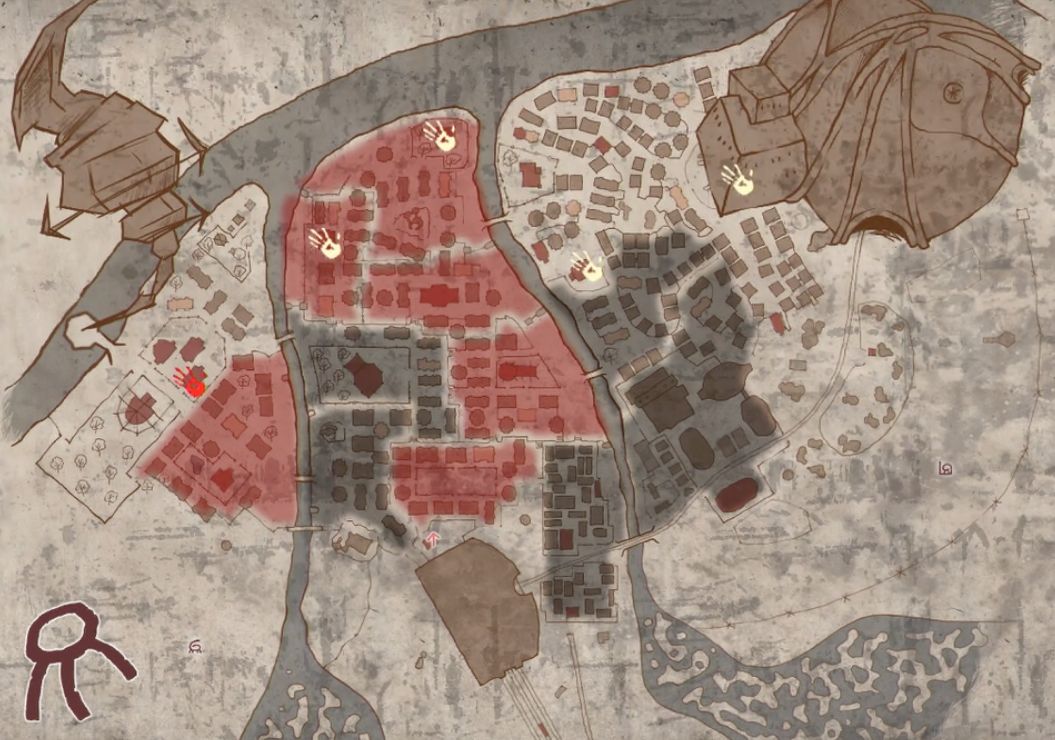
My eyes move from right to left over the picture—from the veins of sacrificial blood from the Abattoir, to the sharpened stem that plunges down to meet it, then up to that blackened horror incubating within the Polyhedron. Suddenly, it all clicks into place. The Bachelor's letter, the blood at the base of the Polyhedron, the urgency of removing the spike from the suffering auroch at the Bone Pillar: everything is united. Maybe the Kains have discovered how to be reborn in the Polyhedron, but in order to achieve this they need fuel, nourishment for the soul within. In the words of Elder Oyun, they need to pour old blood into new veins.
The Polyhedron siphons the lifeblood from the earth, the earth sickens, the Sand Plague comes. A syllogism, deadly in its simplicity.
I hurry over to the Polyhedron as a thin drizzle begins to fall. Just as Mishka said, blood is pooled at the base of the stairs leading up to the Inner Chamber. I collect a sample, and it's exactly the same as the blood I received from the Worms at the Bone Pillar.
If I had any doubts before, they're gone now. I don't care what the Bachelor says or whom he's been talking to. If we want to eradicate the Plague once and for all, the Polyhedron—and that thing growing inside it—must be destroyed.
The morning of the tenth day has come.
Infected in the past 24 hours: 340 people
Died in the past 24 hours: 623 people
Gone missing: 139 people
Number of dead total: 6230 people
Number of infected: 516 people
Less than three days remain.
I wake up early on the tenth day, hardly able to believe that I survived the night. To my immense relief, the health-draining effects of Elder Oyun's potion from yesterday seem to have worn off—my health is dangerously low, but stable. The death toll, on the other hand, is rather disturbing: up by over 2000 in a single day. According to the rest of the casualty report, only 600 of those people actually perished from infection, which means that over a thousand people have died of other causes. As I walk through the lamplit streets, filled with murderous arsonists and trigger-happy soldiers, it's not hard to guess what those causes were. And there are two more days to go.
I know that I'm going to be facing Elder Oyun's second trial today, so I stock up on first-aid supplies and choke down another revolting dead porridge before making my way to the Abattoir. I make a couple of detours into the deserted districts where the plague has burnt itself out, searching the abandoned homes for food and emptying the last of my shotgun ammo into the looters who get in my way. I luck out and find a loaf of stale bread in a kitchen, which I immediately wolf down to stay conscious.
Elder Oyun greets me with the news that he's found the butchers responsible for stealing the auroch blood from the Abattoir. Well, "found" isn't exactly accurate. He knows who they are, but they have gone into hiding. It falls to me to locate them as part of my second trial. Oyun gives me another potion to drink, though this time I have the good sense to ask him what it does before taking it. It will make me ravenously hungry, he replies, which will help because "if you are hungry, you will find the scent of blood better." He tells me to visit the sacrificial mound south of town to consult with the spirits of the steppe, warning me not to eat anything until I have located the offending butchers. Remembering yesterday's ordeal, I make sure to listen. I fight down the panic when I see my hunger meter skyrocket and my health meter plummet. If I made it through the first trial, I can make it through this one.
The hill of sacrifice is empty when I reach it just before midday. I lie down on the stone slab at the top and wait for the spirits to do their thing.
| Scenes like this are why I no longer play Pathologic right before bed. |
The butchers are defiant when I confront them. Each of them tells me the same thing—that I can't get the panacea blood I need from underground, that I need to gouge out the tumor that's been growing on the land and harvest the blood from the wound. It sounds suspiciously like the scorched-earth policy that the Bachelor has been advocating, and I'm in no mood for it. I duel each of them to the death (again, reloading the game every time they land a blow and sap my ebbing health) and return to the Elder with the news. This time he gives me the antidote to the potion, presumably because I didn't try to artificially fix my hunger/exhaustion meters as I did yesterday. When I bring up what the butchers told me before I killed them, he says something about how I can't trust anything they or the Bachelor say about the Polyhedron. The Kains are trying to use it to achieve immortality through reincarnation, to "pour old blood into new veins," Oyun says, an idea as blasphemous as it is unnatural. He will say no more, dismissing me until tomorrow.
Before I have time to be surprised at how straightforward (relatively speaking) this all was, I receive a letter from the last person I would expect: Fat Vlad. It seems he's been granted a temporary reprieve by the mob in the Apiary, and he wants to speak with me before he is marched away to that forbidden room to face his horrible fate. I find him in Mother Keeper's torchlit sanctuary, surrounded by guards but otherwise looking much the same as always.
He has two final pieces of information for me. First, there is an auroch dying at the "Bone Pillar" near my late father's abandoned home, which Vlad recommends that I check out before any of the other powers-that-be find it. Second, Vlad cautions me to beware of his former underling, Elder Oyun. The Elder is fighting a battle with me, Vlad says, and he is not to be trusted.
Watching Fat Vlad in the flickering light, I feel a pang of remorse. For the first time in the game, I believe he's telling the truth. With his execution fast approaching, all lies seem to have gone out of him, and he decided to help me with what little time he had left. He has nothing else to say to me. I feel worse than ever about my part in his death.
He was definitely telling the truth about the bull at the Bone Pillar, in any case. The poor animal lies impaled on a spike and surrounded by shifty-looking Worms. According to them, this is an auroch, and what happens to it is up to me. I am to ask my Adherents—the children who stand to inherit the town—what I should do with it. I'd better hurry, though. It's already late afternoon.
Once again, the issue of my character's walking speed returns to bedevil me. My Adherents are scattered all over town—most of them at the far edges—such that there's no efficient way to visit them all. Add to that the hellishness of the sprawling infected zones, and I'm going to be pressed for time even without having to deal with the health issues from yesterday. I talk to Spichka first, since he's close by, then make the laborious trek to meet with Notkin on the south side of town. Both of them seem horrified by what I tell them and say that the bull needs to be removed from the spike immediately.
| Mishka: "I have got wet and faded." |
I find the doll sitting out in the marshes, eerily alone. I don't have time to return it yet, not with nighttime approaching, so I stash it in my inventory and move on to the graveyard to meet with Laska. By now I have covered almost every area on the map and have to resort to chewing coffee beans to avoid keeling over from exhaustion.
To my dismay, Laska's not in the mausoleum that she apparently calls home. General Blok has arrested her for not allowing his soldiers to desecrate (or as he would put it, "sterilize") the graveyard. A teenage girl informs me that she's being held at the Town Hall, all the way up on the north side. (Haruspicus: "My legs are failing me!") Yet when I storm inside to confront him, it's not Laska standing next to him, but the Devotress.
| What is she doing here? |
Finally, Blok points me south again, where the army keeps its reserves of weaponry. I retrace my steps for the third time as I make the painfully slow journey, darkness falling around me. With the amount of distance I've covered today, I feel like I've run the Tour de France without a bicycle. (At this point, my notes for the day simply read, "THIS IS RIDICULOUS!! Running back and forth across town! AAAGH!!!") I pop the last of my coffee beans into my mouth as I stumble along, ignoring the hit to my health.
I find Laska locked up in a boxcar under armed guard. I order her released, by the general's authority, then ask about the auroch at the Bone Pillar. She adds her voice to the chorus calling for it to be released, and I make a beeline for the Bone Pillar in the northeast, hoping I'm not too late.
I arrive just before the bell tolls for 11:00. The Worms say that the auroch will be removed from the spike tomorrow morning, and each one hands me a vial of its blood: four panaceas' worth. I pocket them and head south one last time, to deliver Mishka's doll to her. Before I do, I take a short break to read the letter I received from the Bachelor this morning, who is still trying to convince me that the Polyhedron needs to be saved. The Kains have discovered the secret to eternal life, he says. I snort and disregard his argument.
Mishka is, of course, happy to see her doll. As a reward for my efforts, she hands me ... a vial of auroch blood? Where did you get this? I demand. From the base of the Polyhedron, she answers. Every now and then pools of blood will appear at the bottom, though nobody can say where it comes from.
Then my map changes.
My eyes move from right to left over the picture—from the veins of sacrificial blood from the Abattoir, to the sharpened stem that plunges down to meet it, then up to that blackened horror incubating within the Polyhedron. Suddenly, it all clicks into place. The Bachelor's letter, the blood at the base of the Polyhedron, the urgency of removing the spike from the suffering auroch at the Bone Pillar: everything is united. Maybe the Kains have discovered how to be reborn in the Polyhedron, but in order to achieve this they need fuel, nourishment for the soul within. In the words of Elder Oyun, they need to pour old blood into new veins.
The Polyhedron siphons the lifeblood from the earth, the earth sickens, the Sand Plague comes. A syllogism, deadly in its simplicity.
I hurry over to the Polyhedron as a thin drizzle begins to fall. Just as Mishka said, blood is pooled at the base of the stairs leading up to the Inner Chamber. I collect a sample, and it's exactly the same as the blood I received from the Worms at the Bone Pillar.
If I had any doubts before, they're gone now. I don't care what the Bachelor says or whom he's been talking to. If we want to eradicate the Plague once and for all, the Polyhedron—and that thing growing inside it—must be destroyed.
Monday, October 31, 2011
Pathologic: Day Nine, which informs the Haruspicus that there is a battle for the Order and ancestral lands ahead of him
(or, in which Kevin imbibes a potent cocktail of madness and despair)
The morning of the ninth day has come.
Infected in the past 24 hours: 356 people
Died in the past 24 hours: 454 people
Gone missing: 58 people
Number of dead at the moment: 4086 people
Number of infected total: 539 people
The town is dying. Less than four days remain.
Duke and I are beginning to argue. Not as our characters, but in real life. He can't believe that I am so naive as to trust anything I learn about the Plague from the barbaric Cult of Bulls. Look at the things they do, Duke tells me. Look at the things they make you do: ripping out people's organs so you can make antibiotics; delivering up the defenseless Vlad Olgimskiy to be cannibalized. It's rituals like those, Duke says, that are sickening the earth and bringing the Sand Plague on us. And you are helping them.
For my part, I am disgusted by Duke's sudden turn for the fatalistic. Unexpectedly, I find that I'm the one clinging to some last vestiges of hope. The town may be twisted and corrupt, but we can still save it. We can still beat this thing. I can't believe that after all we have gone through, after fighting tooth and nail to save the people of this wretched little town, Duke is ready to sacrifice everybody just to win. To me, it looks like he's giving up because it's easier to nuke the Sand Plague rather than cure it. But these people deserve life, if nothing else. Gesticulating wildly in my kitchen, I call him a fascist.
The thing is, neither of us is completely sure who's right. It's impossible to tell which of the townspeople are lying to us, but they can't all be telling the truth. Ever-shifting loyalties and agendas make it impossible even to determine who would have a reason to lie. Essentially, Duke's and my conflict is a case of the blind fighting with the blind. I'm fairly sure I'm doing the right thing, but Duke's arguments stick in my mind. Every time I complete a task for the Order, I feel a small twinge of anxiety. What if he's right?
If there's one thing I don't have, though, it's time to sort through the tangle of questions and worries. The game relentlessly draws me on as people keep dying and resources get scarcer. The proverbial cavalry has arrived, though their notion of keeping the peace involves shooting first and asking questions later.1 A summons arrives with the dawn, telling me to report immediately to the army's commanding officer, General Blok. He wants to know where I got the panacea.
On my way there, I pass the Clot, former home of Fat Vlad. It's dark and empty, and an Executor has been posted outside the door. When I talk to him, he refuses to let me inside. "This house belongs to the dead. You could have prevented this," he states flatly.
Thanks.
At the Town Hall, General Blok imperiously asks about my method of producing the panacea. He knows that the key ingredient is scarce, and he wants to get more for me—by whatever means possible. I don't like his tone and refuse to reveal my secrets. I have seen the way he operates. I can only imagine what would happen if he were to send his troops into the Abattoir to get me the auroch blood by force. He might destroy the only source of the precious blood. This oaf could ruin everything. Livid at my refusal to cooperate, Blok tells me to go to hell and kicks me out of the Town Hall. Unconcerned, I dust myself off and head toward the Abattoir to meet with Elder Oyun.
Today I will have the first of my three trials to determine if I'm worthy to be a leader in the Order. I will also get a good, long look into the swirling abyss of madness that awaits me when Pathologic finally decides to play real hardball.
Oyun is as proud and truculent as ever when I catch up with him. Some auroch blood went missing from the Abattoir last night, and he wants me to track down the thieves. He suspects the Bachelor, of course. I am doubtful about that, but I need that blood even more than the Elder does. I agree to look into it, and Oyun tells me not to rest until I find the truth. He then has me drink a potion before I leave, saying something about how I will get really tired.
I'm almost out of the Abattoir before I notice that my exhaustion meter seems to be filling up unnaturally fast. By the time I'm halfway to the Bachelor's house, it's full. Panicked, I eat the lemons in my inventory (which decrease exhaustion at the expense of increasing hunger), only to see any positive effects nullified in a matter of minutes. Whatever the Elder gave me to drink, it's screwing with my body. I don't keel over immediately once my exhaustion maxes out, which is what normally would happen; instead, my health starts to plummet. I use up every healing item I have just to stay alive long enough to reach the Bachelor's.
But he's not there. The woman who lives with him tells me that he has been taken captive by the Dogheads of the Polyhedron. For some reason the Bachelor decided to help the children get their hands on some guns, then idiotically tried to double-cross them by giving them blanks instead of live ammunition. The Dogheads are keeping him in a cell in the factory district, just a short distance from the Abattoir. My heart sinking, I start retracing my steps east, but not before vainly trying to fix my exhaustion/health problem with a one-hour nap (it does no good). I cough up the last of my money to buy some thousand-dollar tourniquets at the nearest pharmacy. I hope they'll keep me on my feet long enough to get to the bottom of all this, even as I try to ignore the fact that I'm practically fainting with hunger.
At the jail, the Bachelor's guards refuse to be talked into releasing their ward. Khan, leader of the Dogheads, wants his rifle ammunition, and the Bachelor stays put until he gets it. The guards say that the live ammunition is probably back at the Bachelor's house: again, on the other side of town. Upon hearing this, I become almost frantic. I don't have time for this. Pausing the game, I agonize for about two minutes, trying to think of a way out of this predicament. The tourniquets in my inventory won't keep me alive for long, and my health bar is shrinking so fast that I can actually watch it tick down, little by little. Even if my strength will hold out for the trip to and from the Bachelor's house, I'm going to have to start selling off inventory to buy more healing items, and then I don't know where the money to buy food will come from.
I just can't do it. I can see only one way out of this. I whip out my knife and pounce on the little guards, stabbing them to death almost before they can react. Then, out of habit more than anything else, I harvest their hearts, livers, and kidneys. My conscience protests that I've just done a terrible thing, but I can only give a weary internal shrug. I can't be virtuous anymore. I have to survive.
Despite the grisly scene, the Bachelor is grateful for my assistance. We don't have time to waste, he says—General Blok and his men are volatile, and we need to figure out the source of the Sand Plague before Blok just starts torching everything. The general has a personal grudge against the Inquisitor, and nothing would please him more than to see her die as a result of her failure to save the town.
It's an interesting revelation, but I have more pressing questions. Who took the auroch blood from the Abattoir? According to the Bachelor, it was a splinter group of Worms and butchers, perhaps hoping to brew their own panacea with it. Hoping that will be enough to satisfy Elder Oyun and earn some relief from whatever toxin he gave me to drink, I hare off to the Abattoir with the news.
Oyun doesn't take it well. He starts ranting about the other people in the town, about how they are messing with forces they don't understand. Oddly, even though the Worms have nothing to do with the Polyhedron, he starts railing against it and the Kains, saying that it's totally unnatural, an abomination on the face of the earth. It's the Polyhedron, with its impossible architecture and rumored mystical power, that has messed up the natural order and awakened the Sand Plague. If Oyun is to be believed, the Bachelor is placing all his hopes on the very thing that has caused the epidemic.
This concludes my first trial, but Oyun does not give me any antidote. Whether it was my decision to kill the Bachelor's guards or my panicked attempts to reduce my exhaustion level, I screwed up somewhere, and my constantly draining health looks to be a problem for the foreseeable future. I sell some ammunition, then some medication, to purchase a health kit. Then I trudge on. Grimly, I suppose that I should be thankful that I treated my infection level before taking the trial.
Everything seems to be going to hell. I receive a letter from the Devotress telling me that she's found out about my white lie to her on Day Six. She knows that I think she's the avatar of the Sand Plague, and she doesn't care. "Saints and miracle makers are always stained with mud and blood," her note reads. She includes a list of her Adherents, saying that I have to care for them in addition to my own if I want her help in the next few days. I also receive a plea for help from Kapella, who says that my Adherent Spichka is in danger and, oh yeah, the quarantine fires on the town's outskirts have been extinguished mysteriously. If we want travelers to be warned away from our plague-infested hamlet, somebody needs to get them lit again.
The rest of the day is a waking nightmare. As you can see from these screenshots, my hunger level is perilously high, but I can't do much about it because I have to sink all my money into tourniquets and health kits. This is also the first day where Pathologic's game design—specifically, my character's walking speed—begins actively chipping away at my sanity. I feel like I'm moving at a crawl as I walk to the outskirts to take care of the quarantine fires. I can see my health bar slowly ebb as my character ambles along with no way to move faster. And when I finally confront the outlaws responsible for the fires going out, any wound I incur necessitates a reload from the beginning because I have only enough healing items to compensate for the slow health drain—nothing else. I must have attempted to finish the day's final hours literally dozens upon dozens of times, growing more frazzled and irrational with each attempt.
When I finally succeed in killing the outlaws—among whom are Worms, regular townspeople, and the aged midgets—I feel almost no sense of accomplishment but merely a tired acceptance. By now I've been playing for at least five hours and, like my character, want nothing more than to go to sleep. When I report my success back to Kapella, I'm surprised to find both Spichka and the Inquisitor in her little room. The Inquisitor thanks me for relighting the watch-fires, darkly hinting that it was all a twisted ploy by General Blok to make her look bad. Spichka and Kapella also thank me, this time for keeping Spichka out of the clutches of his enemies. And here's where I learn what the children of the town are truly up to.
Kapella is setting the foundation for a new town, with new rulers. I had to save Spichka because he's going to ascend to the nobility someday. The town's children are not fools; they can see the toll that the Sand Plague is taking, and they are preparing to rebuild. Fat Vlad may be dead, the Kains may be going off the deep end, and adults everywhere are dying, but the children will pick up the pieces and avoid their elders' mistakes once the catastrophe has passed. If, that is, any of them are left alive by the end of it all.
I mull this over as I head over to the Bachelor's house to crash for the night. At least I have the ghost of a hope that I'm not struggling against these horrible difficulties for nothing. Once there, I talk to the Bachelor's landlady on a whim, and she suddenly hands over the rifle ammunition that the Dogheads had requested earlier in the day. Though I have no immediate use for 40 rifle rounds, I hold on to them tightly and avoid thinking about the guards that I killed. I don't have any money. These bullets are going to feed me in the days to come. And I am going to save this wretched little town if it kills me.
The morning of the ninth day has come.
Infected in the past 24 hours: 356 people
Died in the past 24 hours: 454 people
Gone missing: 58 people
Number of dead at the moment: 4086 people
Number of infected total: 539 people
The town is dying. Less than four days remain.
Duke and I are beginning to argue. Not as our characters, but in real life. He can't believe that I am so naive as to trust anything I learn about the Plague from the barbaric Cult of Bulls. Look at the things they do, Duke tells me. Look at the things they make you do: ripping out people's organs so you can make antibiotics; delivering up the defenseless Vlad Olgimskiy to be cannibalized. It's rituals like those, Duke says, that are sickening the earth and bringing the Sand Plague on us. And you are helping them.
For my part, I am disgusted by Duke's sudden turn for the fatalistic. Unexpectedly, I find that I'm the one clinging to some last vestiges of hope. The town may be twisted and corrupt, but we can still save it. We can still beat this thing. I can't believe that after all we have gone through, after fighting tooth and nail to save the people of this wretched little town, Duke is ready to sacrifice everybody just to win. To me, it looks like he's giving up because it's easier to nuke the Sand Plague rather than cure it. But these people deserve life, if nothing else. Gesticulating wildly in my kitchen, I call him a fascist.
The thing is, neither of us is completely sure who's right. It's impossible to tell which of the townspeople are lying to us, but they can't all be telling the truth. Ever-shifting loyalties and agendas make it impossible even to determine who would have a reason to lie. Essentially, Duke's and my conflict is a case of the blind fighting with the blind. I'm fairly sure I'm doing the right thing, but Duke's arguments stick in my mind. Every time I complete a task for the Order, I feel a small twinge of anxiety. What if he's right?
If there's one thing I don't have, though, it's time to sort through the tangle of questions and worries. The game relentlessly draws me on as people keep dying and resources get scarcer. The proverbial cavalry has arrived, though their notion of keeping the peace involves shooting first and asking questions later.1 A summons arrives with the dawn, telling me to report immediately to the army's commanding officer, General Blok. He wants to know where I got the panacea.
On my way there, I pass the Clot, former home of Fat Vlad. It's dark and empty, and an Executor has been posted outside the door. When I talk to him, he refuses to let me inside. "This house belongs to the dead. You could have prevented this," he states flatly.
Thanks.
At the Town Hall, General Blok imperiously asks about my method of producing the panacea. He knows that the key ingredient is scarce, and he wants to get more for me—by whatever means possible. I don't like his tone and refuse to reveal my secrets. I have seen the way he operates. I can only imagine what would happen if he were to send his troops into the Abattoir to get me the auroch blood by force. He might destroy the only source of the precious blood. This oaf could ruin everything. Livid at my refusal to cooperate, Blok tells me to go to hell and kicks me out of the Town Hall. Unconcerned, I dust myself off and head toward the Abattoir to meet with Elder Oyun.
| What does Blok think he's going to do with this thing? Shoot the Sand Plague? |
Oyun is as proud and truculent as ever when I catch up with him. Some auroch blood went missing from the Abattoir last night, and he wants me to track down the thieves. He suspects the Bachelor, of course. I am doubtful about that, but I need that blood even more than the Elder does. I agree to look into it, and Oyun tells me not to rest until I find the truth. He then has me drink a potion before I leave, saying something about how I will get really tired.
I'm almost out of the Abattoir before I notice that my exhaustion meter seems to be filling up unnaturally fast. By the time I'm halfway to the Bachelor's house, it's full. Panicked, I eat the lemons in my inventory (which decrease exhaustion at the expense of increasing hunger), only to see any positive effects nullified in a matter of minutes. Whatever the Elder gave me to drink, it's screwing with my body. I don't keel over immediately once my exhaustion maxes out, which is what normally would happen; instead, my health starts to plummet. I use up every healing item I have just to stay alive long enough to reach the Bachelor's.
| The Abattoir is on the eastern edge of town, the Bachelor's house is on the western edge, and there's plenty of plague in between. |
| The Bachelor's guards—are they actually adults, or just prematurely wizened children? Rumor has it that this is what happens to Dogheads who leave the Polyhedron. |
I just can't do it. I can see only one way out of this. I whip out my knife and pounce on the little guards, stabbing them to death almost before they can react. Then, out of habit more than anything else, I harvest their hearts, livers, and kidneys. My conscience protests that I've just done a terrible thing, but I can only give a weary internal shrug. I can't be virtuous anymore. I have to survive.
Despite the grisly scene, the Bachelor is grateful for my assistance. We don't have time to waste, he says—General Blok and his men are volatile, and we need to figure out the source of the Sand Plague before Blok just starts torching everything. The general has a personal grudge against the Inquisitor, and nothing would please him more than to see her die as a result of her failure to save the town.
It's an interesting revelation, but I have more pressing questions. Who took the auroch blood from the Abattoir? According to the Bachelor, it was a splinter group of Worms and butchers, perhaps hoping to brew their own panacea with it. Hoping that will be enough to satisfy Elder Oyun and earn some relief from whatever toxin he gave me to drink, I hare off to the Abattoir with the news.
Oyun doesn't take it well. He starts ranting about the other people in the town, about how they are messing with forces they don't understand. Oddly, even though the Worms have nothing to do with the Polyhedron, he starts railing against it and the Kains, saying that it's totally unnatural, an abomination on the face of the earth. It's the Polyhedron, with its impossible architecture and rumored mystical power, that has messed up the natural order and awakened the Sand Plague. If Oyun is to be believed, the Bachelor is placing all his hopes on the very thing that has caused the epidemic.
| The updated version of my map. The Polyhedron is actually a spike cruelly plunged into the earth, and it looks like it may be interfering with the flow of sacrificial blood from the Abattoir. |
Everything seems to be going to hell. I receive a letter from the Devotress telling me that she's found out about my white lie to her on Day Six. She knows that I think she's the avatar of the Sand Plague, and she doesn't care. "Saints and miracle makers are always stained with mud and blood," her note reads. She includes a list of her Adherents, saying that I have to care for them in addition to my own if I want her help in the next few days. I also receive a plea for help from Kapella, who says that my Adherent Spichka is in danger and, oh yeah, the quarantine fires on the town's outskirts have been extinguished mysteriously. If we want travelers to be warned away from our plague-infested hamlet, somebody needs to get them lit again.
| The Dogheads, apparently growing bolder as the Plague escalates, wait in ambush inside Spichka's darkened house. |
When I finally succeed in killing the outlaws—among whom are Worms, regular townspeople, and the aged midgets—I feel almost no sense of accomplishment but merely a tired acceptance. By now I've been playing for at least five hours and, like my character, want nothing more than to go to sleep. When I report my success back to Kapella, I'm surprised to find both Spichka and the Inquisitor in her little room. The Inquisitor thanks me for relighting the watch-fires, darkly hinting that it was all a twisted ploy by General Blok to make her look bad. Spichka and Kapella also thank me, this time for keeping Spichka out of the clutches of his enemies. And here's where I learn what the children of the town are truly up to.
Kapella is setting the foundation for a new town, with new rulers. I had to save Spichka because he's going to ascend to the nobility someday. The town's children are not fools; they can see the toll that the Sand Plague is taking, and they are preparing to rebuild. Fat Vlad may be dead, the Kains may be going off the deep end, and adults everywhere are dying, but the children will pick up the pieces and avoid their elders' mistakes once the catastrophe has passed. If, that is, any of them are left alive by the end of it all.
I mull this over as I head over to the Bachelor's house to crash for the night. At least I have the ghost of a hope that I'm not struggling against these horrible difficulties for nothing. Once there, I talk to the Bachelor's landlady on a whim, and she suddenly hands over the rifle ammunition that the Dogheads had requested earlier in the day. Though I have no immediate use for 40 rifle rounds, I hold on to them tightly and avoid thinking about the guards that I killed. I don't have any money. These bullets are going to feed me in the days to come. And I am going to save this wretched little town if it kills me.
1 In the middle of the night, as I trudged back to my laboratory after doing some trading with a Worm out in the marshes, I ran into one of Blok's hulking, flamethrower-toting men. He flambéd me without hesitation before I got too close. Either the troops are terrible at following Blok's orders, or else they're a little too good at it.
Wednesday, October 19, 2011
Pathologic: Day Nine, on which the town is being occupied and the kids ask the Bachelor for help for the first time
At 7am:
The morning of the
ninth day has come.
Infected in the past
24 hours: 352 ppl.
Died in the past 24
hours: 479 ppl.
Gone missing: 37 ppl.
Number of dead at the
moment: 4311
Number of infected:
503 ppl.
The town is dying.
Less than four days remain.
![]() |
| Today's Map - Note the infection is EVERYWHERE I HAVE TO WALK |
I find myself safe in General Blok’s office. It’s already
2pm, I’ve gotten no sleep, and I somehow have five individual letters to
answer.
![]() |
| When was there ever enough sun to have actual shadows? |
While I’m relieved the General saved my life, his presence
is unsettling. Rather than the old guards, we’ve got soldiers with rifles, and
gas-masked juggernauts wielding massive flamethrowers. The General is paranoid
of the Inquisitor—he thinks she’s manipulating everyone—and he wants to know
I’m on his side. Of course, I’m on everybody’s side. And nobody’s side. This
town is beyond “saving”. Victory is just a concept. Everyone is going to die,
including me. Catherina Saburov, lying sick in her manor, foretold my death the
moment I met her. Of course, I’m playing the pessimist.
Three Parks
The three leading ladies of the town are worried. Lara Ravel
(“House of the Living” girl) wants a pistol for “self defense”. I go to Julia
and she tells me Lara wants to kill the General; she’s convinced the military
will overrun the town. Julia doesn’t want to see Lara kill the General (she’s
got no chance anyway), so she offers herself up in exchange. I lie to General
Blok that Julia is planning on killing him (at her request), so he puts her
under house arrest.
Before I report back to Julia, I head to Anna Angel’s
house—she tells me cryptically to give a small gun to Lara. I pocket the gun,
head to Julia’s house to find five angry soldiers all hell-bent on killing me.
I gun each one down (for some reason they decide not to open fire with their
rifles) and take three fresh military grade rifles and rations from their
corpses, then go inside and collect my reward from Julia: one of the precious
few panaceas given out by Young Vlad. I head to Lara’s house, give her the gun
(there’s no way she will kill the general), collect a second, then a third
panacea from Anna. Mission accomplished.
I imagine something will go wrong, but it’s not my problem.
If the general dies, my life is much less complicated. And Anna is ripe for
blame, after all she’s done in the past. I’m covered.
Executors
The guards and exterminators are ruthless in their
efficiency—if anything plagued moves past them, they turn the torch to it. And
if my infection is past a quarter length, I become a target as well. I can’t
properly relate exactly how frustrating getting around the town is, especially
because the plague is mostly situated in the center, near General Blok.
![]() |
| These guys should have gotten here a long time ago. |
In the past two days, executors have begun to appear outside
the houses of different townsfolk. None of them are my adherents; I’ve kept in
step with all the quests so far. These are the adherents of the Haruspicus and
the Devotress. I’ve gotten passive aggressive notes from both of them asking me
to take care of their list of adherents, though keeping track of every sick
townsperson is out of the question. I simply don’t have time.
I feel as though I am fighting for my survival every moment of the day. I eat coffee beans to stave off exhaustion which depletes my health meter. And then, because my health is so low, I can't destroy my infection or strengthen my immunity, because taking pills shaves off a significant portion of my health. So, while running every errand, I have to do whatever I can to keep infection down, health up, all the while avoiding plague clouds and flamethrower-toting soldiers.
The Clot, Fat Vlad's manor, is locked up. It seems that, burdened with the weight of his
guilt, he tossed himself to the angry masses in the Apiary. The executor taunts
me, tells me I could have prevented it, then laughs in my face.
But what does it matter? He was a corrupt, fat old man. And,
more importantly, he wasn’t my Adherent.
Miracle of Children
Victor Kain tells me his family will die from the plague
after all this is over. He needs someone to preserve his legacy. That person
will be Maria Kain. So much of this depends on the Polyhedron, though. So I
climb the impossible steps and find Khan Kain, Victor’s son, down the Agate
Hole. I need to investigate the Polyhedron, I tell him; I need to find out
what’s really going on, and why everyone is so focused on the seemingly
miraculous potential of this structure.
![]() |
| Tweens don't need codpieces. Just saying. |
He says he’ll let me in, but I have to get him guns. He
needs to be able to intimidate the General’s men. There are over a thousand
children inside; all they will need to do is fire a few shots and scare them
off. Of course, his entire idea is ridiculous. General Blok purportedly
destroyed an entire fortress with minimal losses. There’s no way a tower of
children could stop him.
However, I indulge him. I tramp back to Blok’s outpost, ask
for a rifle, then give Khan the three soldiers’ rifles from earlier, my own,
and Blok’s. Khan lets me inside the inner room.
I feel like I’m in a dream. The interior is gorgeous—rich
velvet and light, and all the impossible stairs, writing all around. There are
paper cranes hanging from the ceiling, stairways that lead to nothing: it’s
fascinating. There are children, too, but nowhere near the thousand of which
Khan spoke.
![]() |
| So if this whole place is made of paper, like they say, it's kinda like a huge origami, isn't it? |
A few more things begin to make sense. Khan tells me the
interior is a place of dreams. He talks about rooms of mirrors—and when I tell
him I didn’t see any of this, that all I saw was stairs and walls, he scoffs.
I’m too old to understand or to see, he says. When the kids grow up, they stop
seeing it too.
Speculation
As I said earlier, there was talk of the Polyhedron being a
place of eternal youth. There was talk of the Kains’ “Inner Chamber”—in fact,
it was in this Inner Chamber where Simon Kain was found at the beginning,
infected with the Sand Plague. Is it possible that the Polyhedron, an
anaesthetized and cold needle of a structure, could have injected the Sand
Plague into the town, much like a syringe?
After discussing a few things with Kevin, I’ve learned that
there are actually aged midgets wandering around town; in fact, one of his
first quests was to kill a midget out on the steppe. According to the
Dualsouls, these “midgets” are actually rejects from the Dogheads in the
Polyhedron. With all the talk about eternal youth, and the sort of static
atmosphere provided within the Polyhedron, is it possible that the children of
the structure are actually older than they appear? That, if they leave the
Polyhedron for long enough, they age rapidly?
There is one other facet: Khan. My impression of him (which
has been conveyed by others as well) is that he is a child beyond his years. He
looks like a young teenager, but he speaks as a grown man. The Kains have been
very secretive throughout all of this. A few whispered hints of “reincarnation”
and “rebirth”. Do they hope to be reborn in the innermost chamber of the
Polyhedron?
And all of this becomes much more dire when I consider the
town: in order to give dreams, perhaps youth, the Polyhedron needs fuel. Where
does this energy come from? And more importantly, how can I harness it?
Subscribe to:
Posts (Atom)