Showing posts with label Simon Kain. Show all posts

Sunday, November 13, 2011

Pathologic: Day Eleven, in which the Bachelor will discover the truenature of the Kain family

At 7am:

The morning has come.
Infected in the past 24 hours: 371 ppl.
Died in the past 24 hours: 618 ppl.
Gone missing: 131 ppl.
Number of dead at the moment: 6798
Number of infected: 552 ppl.

Tomorrow everything will be over.

[I lost my map screenshot for today. The town is completely plagued or burnt out.]

Base of the Miracle
The Inquisitor needs a more in-depth look at the Polyhedron's architectural plans. She believes the structure—unnatural as it is—has somehow caused the epidemic. Perhaps something in the base will tell us more. This is preposterous, of course. I’ve been inside. It’s a wonder—a testament to human ingenuity. It shields from plague; it doesn’t spread it.

Andrey has the plans, so I head to the tavern. Of course he’s not there. He’s purportedly been arrested for his renegade hero routine yesterday. However, when I ask General Blok to recall his arrest, he tells me no such order was issued. A large faction of soldiers have staged a coup, and is leading Andrey to his death down at the southernmost part of the train tracks, just at the edge of town.

I follow the tracks to find a swarm of soldiers, all pointing their rifles at me. Unfazed, I walk through the ranks to the very end and address the officer in command. He’s some haughty everyman, and he believes I am the architect. I’m sentenced to death, he says; he’s taking control now. My pleas don’t matter, so I stall fortime by asking for a final smoke. He promptly knocks me out, and the world goes black.

Dude, you get the puppet avatar. There's no way you're getting out of this alive.
When I come to,I’m standing in front of a burning pyre out in the middle of the cemetery, stripped of all my weapons and medicine, shivering in the rain. I’ve only just oriented myself when several snarling attack dogs emerge from behind the graves and try to bite me. I jump onto the pyre, skirting the flames, and beat each dog’s brains in, then head to the gravekeeper’s house at the edge of the cemetery. After some convincing, the little girl Laska gives me some tourniquets and a butcher knife.

Two guards are stationed at the cemetery’s entrance. I stab one in the back, silently, then the other, take their rifles, and march cold-blooded back to the train yard. Everyone in this entire town—even the military—is an idiot. I shoot each soldier in the head before he can fire a single shot, then run to the patrol leader and shoot him squarely between the eyes. I take back every single thing he stole from me, then walk back to the Tavern in hopes that I might hear some news regarding Andrey.

The sop is waiting for me there. He tells me he’s surprised I didn’t ask about the base earlier. It turns out the Polyhedron is supported on a spring—a three hundred meter-long shaft, about five and a half meters in diameter, was drilled into the earth beneath the foundations of the town: a crystalline rose sprouted froma metal stalk. A sort of lever, weighted down by the foundations of the town itself.


The Inquisitor is convinced that this is the instrument which has stirred up the plague. Through some shift, the stalk punctured the clot at the heart of the town,which has sent plague up from the soil itself. This makes sense to her. But it isn’t good enough to me. Yes, the wound has stirred up the disease, but the disease has been there from the beginning. I have very good reason to suspect the Steppe folks and their pagan practices in the Abattoir. They thirst for blood. The worms always tell me they never have enough blood to feed the earth.

Who’s to say that the excess of sacrifice—the poisoned meat, the putrid flesh fed by these steppe barbarians—is not what originally created the plague? The Polyhedron was the one prick that revealed the infection: it was there all along. With modernization—with systematic and permanent housing, with wells digging into theground—the once-harmless practices of the natives, repeated ad infinitem in the same place, has become malignant.

Today's Pantomime was admittedly unsettling.
Preparations For Crowning
I take care of a few smaller tasks—saving several wrongly condemned men from a firing squad and suppressing some unsavory rumors about the Kain family. The most alarming quest of today concerns Maria Kain.

The Kain family continues to talk of dying, of suicide. They all seem to have gone mad. After some coaxing, I talk to George Kain, who talks of the Inner Chamber of the Polyhedron. It is a tomb, of sorts, and also a receptacle for the now-deceased Nina Kain, Simon’s love. Yet Nina Kain is returning, he says. The beautiful Maria Kain, who has loved me for quite some time, has accepted the soul of her mother.

Utter nonsense.Of course, Andrey and Peter have succeeded where I failed. I may have mentioned—the Bachelor and the Inquisitor met years before when an attempt to resurrect the human form was conducted in the capitol. It failed miserably. Perhaps, in this squat-hole of a town, it has not.

Maria needs pledges from the two other female authorities in town: the young Kapella and, inexplicably, Klara the Devotress. I go to both of them and ask for a token of their fealty. Klara protests—she says that Maria will become a “sorceress queen”and make her own twisted version of a utopia from the town—a “violation of nature”, man’s own attempt to create the kingdom of heaven. I dismiss her; this is all a simple formality. I return to find Maria’s followers congregated outside her front door. They look mad. Everyone in this part of town has gone mad. Perhaps it’s a side effect of the panacea.

Her Entourage

She’s waitingfor me inside the tomb behind the Kain family’s estate. Rather than summarize,I’ve transcribed a conversation so strange that Ospina herself would be proud. [I have made slight adjustments for clarity.]


MARIA: It’s not me. Not your Maria anymore, but not the Scarlet yet. Nothing of me is here. Touch my flesh: your hands will touch the air only.
BACHELOR: Here are the signs of recognition from Klara and Kapella. They bow to you, Dark Mistress.

MARIA: Scarlet. But let it be so. That means that if a miracle happens – and by tomorrow only those who should survive by my plan live, and the ruthless Authorities will forget about us as before –we shall deny the severe law of life. And then the dream will triumph. And a new Utopia will rise.

BACHELOR: What do you call Utopia, Maria?

MARIA: It’s not the Tower, Daniel. It’s the town. We understand the word “Utopia” not as an ideal of prosperous trade,a perfect social system and political validity, but as a mystical fact of materialization of the incomprehensible, normally inaccessible to the profane person.

BACHELOR: Who speaks now by your mouth?These aren’t your words, and this is not your voice.

MARIA: Truly. You listen. This world exists, but is not given into human hands. Never. It is revealed only by delicate hints; in inevitably perishes under a straight sight. Mystery is its life; this world dies if it is enslaved.
BACHELOR: This is why the pestilence has begun?
MARIA: Probably. But luckily, even in the best adjusted mechanism failures happen. Sometimes the two worlds—mundane and utopia—touch each other! The antibodies collide! And contrary to the law of self-preservation they do not perish, but merge, forming a marvelous symbiosis. Thus is Utopia – a terrestrial embodiment of an unearthly miracle – achieved!
BACHELOR: And you chose to create this town? This is how an embodied miracle looks?
MARIA: Yes. We could build a magnificent town of rock crystal, sapphire walls, emerald roofs and ruby roadways, as you would expect from children’s fairy tales about magic countries. But here true life – living people of flesh and blood – exists. What surprises you?
BACHELOR: Why dirt and dullness? Why worn walls, brick-works, rusty beams and sewage manholes? Is this how Utopia should look?
MARIA: This is how it looks. That’s why it’s Utopia instead of a dream. It is even associated with the word “bog”. It needs dirt. A bog of peat bathed in a ruby sky. Utopia accepts even the basest humans, the unattractive terrestrial. Therefore: the bloody Abattoir, rotten fields, barracks, and impoverished slums. This is the land.
BACHELOR: Oh, so . . . 
MARIA: Utopia needs the Cult of Bulls, a living echo of the symbiosis between the world of beasts and spirits and the world of men. The animal nature lays the foundation of our civilization. Dirt, blood, manure, devouring each other’s skin and meat and bones: tools from which civilization, the commonwealth of creators, grows. 
BACHELOR: And where’s the miracle? 
MARIA: In the earth a miraculous merge of the Anthropophobic Steppe and the Human world occurred. This settlement transfigured from a society of devourers into one of creators. A true wonder was born. At its height, the Cathedral was built. But here we failed. 
BACHELOR: . . . And then you built the Polyhedron. 
MARIA: Yes. The Tower of the Riverbank has finally metamorphosed – a miraculous merger of worlds. The world of the possible and the world of the impossible. 
BACHELOR: If all this was so great, why the pestilence? 
MARIA: I do not know, Daniel. This is not our fault. The town has not sustained this tension, has not endured the heat. So we begin again. There is no death. We are not afraid of it. You see, I am dead and incorporeal, yet I am here. Like a restless soul doomed to return.

Her words leave me conflicted. I lurch back to my bed through plague-ridden streets. Over the past two days chaos has overtaken the town: I can’t go ten steps without seeing another bandit cut an honest man down, or see the plagued burned down in waves like fields at the end of harvest. The buildings are red and blotched. And above it all, in perpetual bloom like a concrete rose, lingers the impossible shape of the Polyhedron. 

Wednesday, November 2, 2011

Pathologic: Day Ten, on which the creators of the impossible make their appearance and a discussion commences of the miracles witnessed.

At 7am:

The morning of the tenth day has come.
Infected in the past 24 hours: 340 ppl.
Died in the past 24 hours: 677 ppl.
Gone Missing: 139 ppl.
Number of dead at the moment: 6770
Number of infected: 576

Less than three days remain.

Today's Map. The Plague is almost unbearable.
Seized Focus
The Inquisitor is curious about the Polyhedron. Such a thing shouldn’t exist—it defies the laws of physics, of nature. Yet it stands, almost suspended, at the head of the town like some silvery crown. It was built by Peter Stamatin, and it is from him that we must procure the plans to study the structure in fuller detail.

I find his brother Andrey in the Tavern on the east side of town, and he tells me soldiers came to arrest them and, in a panic, he killed them and let his brother escape. Peter now wanders the town looking at his old architectural experiments: “endless stairways”, he calls them.

These things are impossible.
I ought to have mentioned these strange structures earlier. Originally I thought they were the remains of burnt houses. As it turns out, these were prototypes of what would eventually become the Polyhedron. I’ve walked up the stairs once or twice and surveyed the land—all the sounds of the city fade away at the top of these naked stairwells, leaving only one sound. And that sound is children—babies—crying, fading in and out.

Cue: screaming children sounds
I find Peter in the heart of a plague district, dressed as an Executor cremating bodies beneath one of his stairways. He’s gone mad—he tells me he’ll give me the plans if I bring him five bottles of twyrine to assist in his suicide. I go out, retrieve the twyrine, and procure the plans. He tells me he believes a building is capable of housing a soul—of capturing, freezing, a soul and containing it. The stairwells scattered through town were misfires, aborted attempts, at building the masterpiece that now sits like a crown at the head of the town.

The late Nina Kain funded this enterprise because she believed this building could house a spirit. The children believe the Polyhedron grants wishes and dreams, but the Kains have other (as of yet unknown) aspirations for the creation. Peter says it has power because we believe it has power: a miracle will not happen unless people believe it can happen.


After some gentle prodding, I convince Peter to give up suicide and live another day. It’s not so simple, of course. Klara, the Devotress, has been whispering in his ear, telling him that by building the Polyhedron he has taken a miracle into captivity. It is unnatural, to be sure, but is it truly evil?

Of course, I think over the Polyhedron, and the Kains’ belief in soul houses; the implications are chilling when I think of the cries of children in the endless stairs. I wonder if Peter didn't accidentally capture something in his contraptions that he shouldn't have.

Madness of the Kains
Catherina Saburov is convinced that Simon Kain has revived and is walking the streets. Ridiculous, of course, though I’m almost willing to believe anything at this point. After all, I have never actually seen Simon’s body. I check with Rubin, now freed from the Kain family and notably shaken, wondering why he is still alive: he tells me there is no possibility that Simon could have resurrected. He cannibalized every particle of his corpse to make the vaccine.

Victor Kain advises me to do damage control—to spread a rumor that George Kain believes he has become Simon—and pays me a handsome sum. I report to the Inquisitor who sees through my lie and responds with cool indifference. Something in our relationship has changed. The thing is that I don’t quite disbelieve the rumor myself. The Kains have slowly begun to slip in the past few days. George speaks of slipping into a trance to retrieve the spirit of the Polyhedron. Victor has begun to rave of reincarnation. Maria, of course, remains silent.

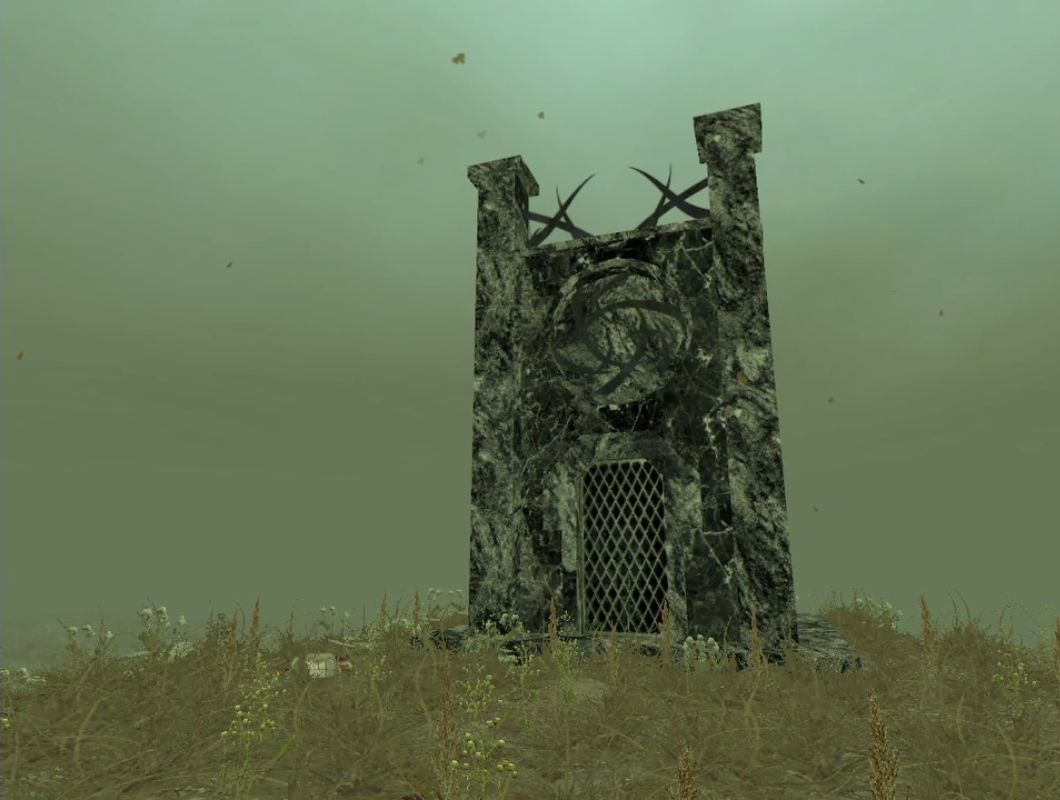
The Kain family tomb, I assume. Note again: the horns.
Pictogram
Mark Immortal, theater director, tells me that an uprising and sacrifice has broken out near the bone pillar in the Tanners District. He is, and has been, noticeably upset for his auditorium’s transformation into a morgue, though he comments that they have been his finest audience in a long while.

The problem is easily solved: after a quick inspection, I ask General Blok (still alive) to send his men in to clean things up, and go on my way. The men are protesting the Polyhedron—they say it is destroying the town, and they want it torn down. When I report back to Mark, he admits he instigated the riot. In his boredom, he’s decided to stir up a bit of mischief.

The Bone Pillar
Utopia
Pathologic is the Western name of this game, but in Russia the title is мор (Pestilence) with the subtitle утопия (Utopia).


In passing, I find a teenager on the street and ask him what he thinks of the Polyhedron. He tells me of its wonders: how, deep within, there is a kilometer-long labyrinth. He says, “You walk and walk in it, and it does not come to an end. When you go out – it is considered that it’s your reflection that leaves, and you yourself get to the Other Country.” I ask what “the reflection” means, and he replies, “It’s as though it’s you, and at the same time it’s not you. They leave not talkative. Therefore it’s said that it’s your reflection that comes back – to quiet the parents and so on. And your real self goes to the country of Utopia – to the magick country.”

This town is worthless. I hold to this. Yet the crown is its one treasure. The Polyhedron is impossible: a miracle, a feat of human ingenuity, completely accidental, and with its thousand uninfected children, it is the one pure thing this town has. Perhaps a cold anesthetic wonder, but a true wonder nonetheless. If one thing could be saved, it is the Polyhedron.

The sketch changes again.
Yet I am uneasy. The Polyhedron makes possible some passage to “Utopia”, the children say, but what is its true cost? I believe in equity: in order to gain anything, something must be given up. What have the depraved folk of this town not yet given up?

Sunday, October 2, 2011

Pathologic: Day Four, by the end of which the Haruspicus may find a friend and a half-dead enemy

(or, in which the best-laid plans of mice and men perish in a cataclysm of WTF)

The morning of the fourth day has come.

Infected in the past 24 hours: 40 people
Died in the past 24 hours: 59 people
Gone missing: 15 people
Number of dead at the moment: 236 people
Number of infected: 63 people

The anxiety of the Powers is growing. Less than nine days remain.

Since the beginning of the game, I've been periodically receiving notes containing death threats from one Stakh Rubin, a close friend and collaborator of my late father. Even after the Bachelor cleared my name at the end of Day One, Rubin alone was unconvinced. If anything, he became angrier. I know who you really are, his notes said, and I will kill you for what you've done.

I would be more worried except that I know that the Bachelor has been working closely with Rubin to fight the Plague, and I'm content to let sleeping dogs lie. As long as Rubin continues to help us work toward a cure and remains ignorant of my whereabouts at any given time, he can hate me all he wants. Of course, by now I should know that nothing in Pathologic is ever so simple; the dawn of Day Four brings a message from the Bachelor saying that Rubin has disappeared along with the latest Plague research, and guess who gets the joy of hunting him down.

I'm not happy about this, but one look at the town convinces me that we need that research. As expected, the Sand Plague has burnt itself out in the Tanners District from yesterday, but it's metastasized to other neighborhoods, including the warehouse district where Notkin lives. On top of that, medical supplies are scarcer than ever—a teenage girl on the street informs me that Fat Vlad has been stockpiling the town's antibiotics and immunity boosters and distributing them among the patrol guards, leaving nothing for any of the other citizens. Looting is increasingly common, and civilization is beginning to fray at the edges. Ragged-looking people are starting to appear on the streets: hungry, penniless, out of medicine and hope.

Before doing anything else, I check on Notkin to make sure he's okay. Navigating the streets in the warehouse district is significantly more hair raising than it was in the Tanners District, with plenty of narrow dead ends in which the infected can corner me. A plague cloud explodes upward when I accidentally step on a bloody pile of rags, worsening the infection in my bloodstream. It's not very far to Notkin's lair, but it takes me forever to find a safe route to his door.

Fortunately, Notkin is fine. In fact, he's back to his old posturing, bloodthirsty self again, working himself into a froth over the actions of looters. He wants me to kill a few, just to teach them a lesson about pillaging. I briefly wonder what exactly I'm doing, acting as a hitman for a high schooler, but then forget about it. It's not as if the looters don't have it coming to them.

On my way out the door, Notkin calls after to me to check on a boy named Spichka, who's holed up somewhere on the north side of town. Recognizing the name of another of my Adherents, I make a mental note, tie my handkerchief over my face, and plunge back into the green haze outside.

That green haze has sickened into a yellowish sepia color in the plague-ravaged Tanners District. All the infected people who were wandering around yesterday have succumbed to the Plague, and now the only living things wandering the streets are the knife-wielding bandits (no longer confined to nighttime, apparently) and swarms of rats. These latter are especially annoying; I have to waste a precious bullet just to scare off the pack that is chasing me through the neighborhood. My goal is to clear out those looters, talk to Spichka, and get out as fast as I can. The empty streets and eerily pristine interiors of the former plague houses give me the creeps.


First, the looters. These guys are scary. I've just gotten to the point where the bandits don't bother me anymore—they're slow and easy to outmaneuver now that I'm used to their tricks. Looters, on the other hand, are found only indoors, which gives them plenty of small rooms and blind corners to use as hiding places. And they are fast. When one pops out of an adjoining bedroom to attack me, I barely have time to draw my weapon before he's in my face, raining blows on me. I die a few times before I figure out how to react effectively. As it turns out, they may be good at punchin', but I'm better at shooting them in the face with a shotgun.

Gah! What is wrong with your eyes?
Next, I visit Spichka. He's actually kind of an annoying twerp, which might explain why he's been kicked out of the Dualsouls by Notkin. The more likely explanation, however, is that Spichka is seemingly the only one to see clearly that the conflict between Notkin and the bandits will end in tears if it keeps escalating. He directs me to a storehouse in the east, where the bandits keep a supply of weapons. If I clean it out, the gang war may cool off by a few degrees. I do as he says and get rewarded with increased reputation and a shiny new gun. I'm building quite an arsenal here.

I'm trooping back to the southern warehouses to inform Notkin of my success with the looters when I remember that I still have to figure out the Rubin thing. I pull out my map and discover that his secret hideout is right on my way. Feeling rather confident after my success as a vigilante, I decide to stop by and set him straight.

This is what a plague victim looks like underneath the rags.
I enter the warehouse with my shotgun drawn, ready to defend myself at a moment's notice. But it's quiet inside. The only sound is the soft, piteous moaning of two men on the floor, apparently in the final stages of infection, their bodies covered in bloody blotches. Rubin stands near the back of the room, with a body laid out on an improvised operating table beside him. He makes no aggressive movements in my direction and even starts up a conversation as I come closer. To my surprise, he's apologizing for his belligerence. He was always great friends with my father, he says, and in his grief he did some irrational things. I briefly consider taking him to task for his behavior but eventually decide to let bygones be bygones. We're both on the same side, after all, and any friend of my father is a friend of mine. Besides, I'm dying to know who that is on the table.

Body? What body? I—oh, THAT body.
Rubin has just finished dissecting the former mayor, Simon Kain, which he technically was not supposed to do. This is why he had to disappear suddenly without telling the Bachelor. The people in charge of the quarantine aren't happy with him for making off with the corpse of their revered leader, and they have set every guard in town on his trail. It was worth the risk though, Rubin says, for the discovery that he has just made: Simon Kain was partially immune to the Sand Plague. Not completely immune—there were no antibodies in his blood—but at least able to stave off the late stages of infection without the aid of medication. Rubin theorizes that natives of the area, of whom Kain was one, have some sort of natural immunity. If so, their internal organs are extremely valuable.

That's where I come in. Rubin is a skilled anatomist, but he's not the heir of Isidor Burakh and he doesn't have the confidence of the steppe people as I do. However, Rubin warns me that being associated with him will make me a target for the town guards too. Catherina Saburov, a prophetess of sorts, has been seeing visions of me, and she's been telling people that I will "drown the town in blood" and "let the rivers of blood flow." Rubin tells me to watch my back.

It's not great news, but at this point I'm not terribly surprised. This is Pathologic, after all. I'm mostly just relieved that I didn't have to have a shootout with the vengeful lunatic I presumed Rubin to be. I step over the dying men on the floor and exit the warehouse.

As soon as I set foot outside, I'm surrounded and attacked by a mob of guards. I gun one down and try to break through their ring, but one of them lands a blow and the screen goes black. I sigh and prepare to reload from the death screen.

The death screen never comes. Instead, a bell tolls, and I wake up in a jail cell with guards patrolling outside. Scowling, I hammer keys on the keyboard, pulling up my inventory screen. All of my weapons are gone. A message flashes up on the screen, informing me that it is 2:30 pm on Day Five, and I realize that I've missed my rendezvous with Notkin. My heart starts thumping as I notice that my health is low and my reputation back down to zero. This cannot be happening. Another message comes onscreen:

"You will not be able to defeat this enemy. Less than eight days remain."

Wednesday, September 14, 2011

Pathologic: Day Three, on which the Bachelor will be offered to proceed in hunting the imperceptible enemy and assess necrosis possibilities

At 7am:


Infected in the past 24 hours: 34 ppl.

Died in the past 24 hours: 31 ppl.

Gone missing: 11 ppl.
Number of dead at the moment: 93
Number of infected: 48 ppl

Less than ten days remain.

They say that in its early stages the plague is manageable. Incrementally, the little bar in the top right hand corner slowly climbs whether I’m asleep or awake. They say that once the plague has established itself (around the halfway mark) it rockets, floods the immune system, and death is imminent. Naturally, I keep my pills well stocked. Like everything, however, there’s a trade-off. I can’t just pop pills whenever I feel like it; each boost to my immune system shaves off a bit of my overall health, which means I have to scour the pharmacies for tourniquets.

Simon’s Body

Rubin (poser-magician-doctor) has fled his house, now overrun with plague, and the body of Simon Kain, which has started this whole mess, has also disappeared.

The Apiary 
The Olgimskiys and Kains are in a tussle over the Apiary and the Polyhedron—two massive structures at opposite ends of the town. George Kain worries that the looming white asylum has become a breeding ground for disease, while Olkimskiy says the same thing about the spindly, impossible spiral that is the Polyhedron. I am charged to quiet these fears by taking a visit to the very top of the Polyhedron, which is home to the Dogheads. (I gotta say they’re not as terrifying as Quintin makes them out to be in his review).


I didn't think I was that heavy.
The leader of the Dogheads, a kid named Khan, the oldest son of Victor Kain, meets me at the top of the Polyhedron and assures me that nobody has been infected, that he runs a tight ship. When I insist on inspecting the premises, he refuses, and I’m promptly kicked out.


The Polyhedron really is quite impressive.
This thing makes no sense.
It's strange--it almost looks like a giant bug. See the stinger? 
Strange markings on each floor.
Once things are squared between Kain and Olgimskiy, and both are assured that the Polyhedron and Apiary are safe, Olgimskiy’s son Young Vlad is willing to share what he knows: a few Butchers have been sighted in the Knots and have holed up in a house. When I arrive, it’s obvious the body is not Simon’s, though the Butchers are happy to see me. They rush at me, knives in hand. Two headshots later, I’m on my way back to a disappointed Victor Kain.

Just after speaking to Victor, I receive a letter from Rubin. He’s got Simon Burakh’s body in a warehouse downtown, and needs me to track down some infected tissue.

Imperceptible Enemy

Only the Haruspicus is allowed to dissect bodies, despite the fact that I am a learned physician. Yet I need the infected tissue, which means I need help from the Butchers of the Cult of Bulls. I spend several hours passing between the squabbling nobles who, again, each want something. Creepy-as-hell death child Ospina won’t tell me where the butchers are unless Olgimskiy stops pursuing the butchers. Olgimskiy twists my arm to get Artemiy Burakh (the Haruspicus) off the hook. Et Cetera.

I find myself lying to the nobles. Saburov, who would waste Simon Burakh’s body, wants to know where it is, and of course I lie. Only Rubin and I can identify the Plague. Yet, as the one charged with fighting the virus, these men are looking to me for guidance, as the only pure, objective outsider in the town. And yes, I lie, twice, three times. There’ll be hell to pay if anyone ever finds out. I guess I’m not quite the goodie two shoes I thought I was.


Today's map: the red section is the infected district.
After wading through internal politics, I find the information I seek. There are three likely houses in the Tanners District—in the Northeast corner of town—where the butchers could be.

Plague Bouncer: Worst. Job. Ever.
It’s on my way to the houses that the changes in the town today become abundantly clear. I see an unfamiliar sight as I approach the Tanner’s district: A large shrouded human-shaped cross of wood, draped with dirty brown rags. At the entrance are several mustachioed honchos who tell me the area ahead is rife with plague, that I should stay clear. With my privileges as Bachelor, I tell them it’s on my authority. They tell me that above all, I cannot shoot the infected. They are "taken by the devil", and have their own lot to die already. The guards will kill me if I harm any of the infected.

“Sure whatever,” I think.

Beyond the guards are hunched figures covered in dirty brown shrouds. Piles of bloody and infected clothing litter the ground; the sound of coughing and sobbing women fills the air. Disconcerted, I check my map. The butchers are situated squarely in the middle of the dead zone.


I did not enjoy taking this screenshot.
It’s unsettling. Miasmic clouds float across the landscape, full of plague, which are easy enough to avoid. A few large rats waddle through the filth; I fire my gun into the air when they approach, which sends them running. The real horrors are the wandering plague-ridden citizens, who reach out to me as soon as they see my medical bag. They’re beyond saving, but so desperate for healing that they force themselves upon me, coughing. My immunities suffer, and the little disease bar in the corner raises ever so slightly.


"Peek-a-boo!"
Two of the bodies have been taken back by their families. The third and final body has been removed to the cemetery in the south. I arrive at the scene to find the body guarded by several men, who demand an exorbitant ransom. Naturally, I say “hell no” to that, and am immediately attacked by the guards.

For some inexplicable reason, I find myself suddenly transported to Alexander Saburov’s home, where he tells me he’ll make an exception, and that I can get to the body when the guards change, before 10pm tonight. It’s already 9:12, and the cemetery is all the way across town. Heart-pounding, I make my way through the plague-ridden streets, arrive at the cemetery just before the shift change, and find my sample of blood.

I present the blood to Rubin in his super-secret lair, then whip out my microscope.

What I discover is crucial. The invincible plague has a single weakness: it cannot linger in dead tissue, and is not fully airborne (despite what the plague clouds might have led me to believe—this is an inconsistency I cannot fully reconcile). The point is that it cannot stay in one place. By tomorrow morning, the disease in the Tanners District will have run its course, and the plague could very well disappear altogether if properly quarantined.

The Bachelor's optimism is feigned, of course. He wouldn’t want the threat to end too soon. He needs a worthy adversary. This is a war and He has been appointed general and savior--the only strategist, in charge of keeping the town a step ahead. After all, in the end it’s only a game.


(Note: Due to formatting issues, the screenshots don't display as nice as they used to. By all means, click on the pics to see the weirdness up close.)