Showing posts with label duke. Show all posts

Monday, April 30, 2012

Pathologic: Infected Zones

I wrote this article for Kill Screen. So here it is--a piece on Pathologic. Like it on the website and your facebook page to get some buzz.


Read the original here.


In 1770, a strain of bubonic plague tore through Russian quarantine and infected Moscow. The plague took out maybe a third of the population of Moscow. As the dead piled up, city limits were extended to accommodate new graveyards. Quarantines were enforced and the economic paralysis sent shockwaves through the food supplies, until an army of starving and enraged Muscovites broke out into the streets and began the infamous Plague Riot. Once quarantine began to take effect, the plague died out relatively quickly, but at its peak, it was claiming a thousand lives per day. The event—both plague and riot—induced a complete breakdown of the infrastructure of Russian society, killing weak and strong, breaking down the economy, citizens’ rights, and basic human dignity.

In the manual for Pathologic, Russian developer Ice-Pick Lodge (which also madeThe Void) introduces its game with an appeal. Cataclysms and outbreaks of new diseases are the natural mechanism of pruning an overpopulated planet, it writes.Pathologic is a prototype of a “simulator of human behavior in the condition of pandemic”: it purports to test the user’s ability to make right decisions in times of crisis. It’s also agonizing to play, shoddily translated, and ugly as sin. Eurogamer’s John Walker called it “Oblivion with cancer ... a fascinating game. And a very broken one.” The game has cultivated a fiercely devoted fan base despite its poor reception in the West.

Pathologic shows the devolution of a society over the course of 12 days as plague overtakes a small, nameless Settlement. Events of the game closely mirror the real-world events of an epidemic. As the Sand Plague breaks, grows, and gradually consumes the settlement, characters research the cure and quarantine infected sections, until the military is summoned to suppress the growing chaos. By the end, it becomes nearly impossible to walk three steps without seeing a murder, as starvation drives people from their homes to be either infected or looted by raiders, and those raiders are in turn exterminated by soldiers.

Ice-Pick Lodge furnishes a mythologized restitching of the pandemic. Among the entrails of the Settlement’s history and the skeletal narrative, Pathologic paints a stirring portrait of the human condition and asks how we, as humans, have infected the earth. The Settlement in Pathologic is torn between past and future: the symbiosis of simple life on the steppe has been exchanged for modern life in the city. Innovation is bought by polluting the environment. In Pathologic, the environment retaliates through the natural mechanism of the Sand Plague.

It’s not surprising that a piece like Pathologic is distinctly Russian. Ice-Pick Lodge’s game functions as a sort of stylized reaction to key events in Russia and the Soviet Union’s history. Consider Chernobyl: the destruction of the reactor in 1986 scattered radioactive waste to the wind, resulting in untold deaths worldwide (the book Chernobyl estimates nearly a million premature deaths from the disaster). The testing, under direct orders from Moscow, is infamous. We won’t know the full effect of the disaster for years. It was inhumanly impossible to contain the radioactive fallout—400 times that of Hiroshima.

The Aral Sea was one of the world’s largest inbound bodies of water, yet 50 years of abuse under Soviet authority have reduced it to a fraction of its former breadth. Long piers extend over barren salt flats where the Aral has retreated. Between 1960 and 2008, the sea shrank from 26,300 square miles to a couple thousand, spread between several disparate lakes. The remaining waters are heavily polluted from chemical waste: the whole thing has been called one of the planet’s worst environmental disasters.

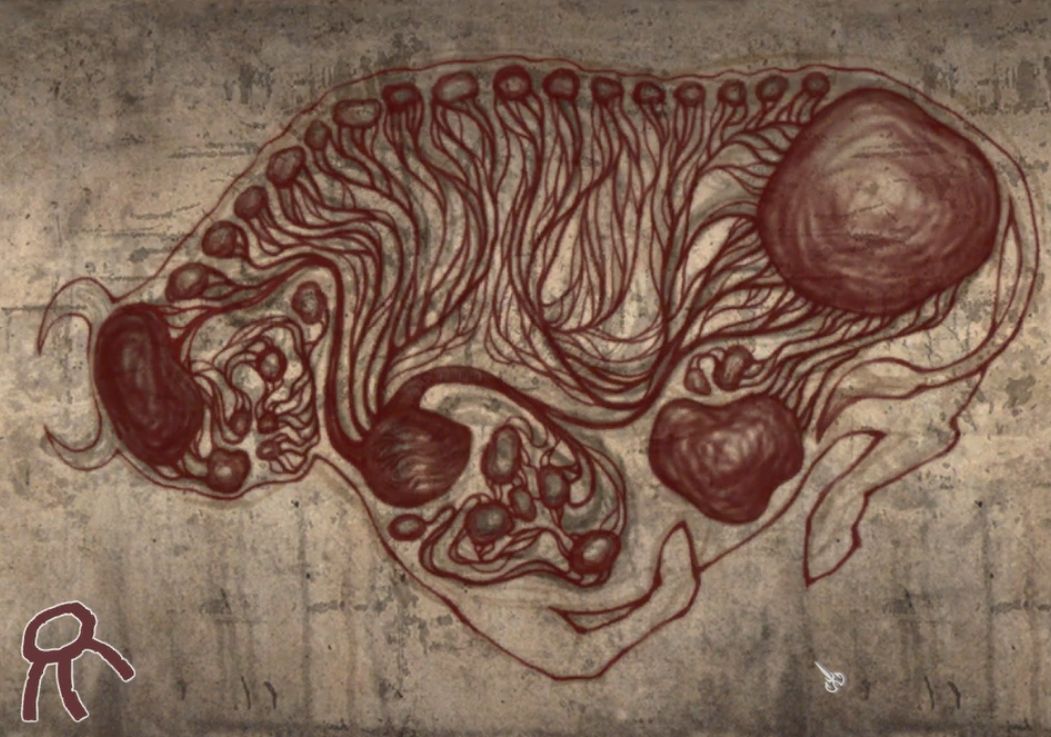
When viewed specifically as a Russian work, Pathologic becomes an apologetic of remorse. Mistakes made in the Soviet era were often glossed over or denied: Ice-Pick Lodge seeds Pathologic with increasingly overt symbolism. The Settlement’s districts are named for parts of the body, and the player’s map constantly evolves, tracking infected zones and objectives, until symbolism is thrown out the window and the map is replaced with a cutaway of the internal workings of a bull. The most powerful moments in the game lie in discovering, bit by bit, the extent to which the Settlement has ravaged the ground on which it was built. 

Pathologic acts as a statement, rising out of the Russian consciousness, that attempts to peel back the scars history has left and force players to ask questions. While it invites cliches like “humans are evil because they destroy the environment,” it doesn’t deserve such a simple interpretation. The developer invites players to spend 40 agonizing hours in a pandemic simulator not just to show how depraved and craven the human animal can become in such extreme circumstances, but to ask players what it is they want to believe. Do you believe in the power of logic and science? Do you cling to tradition? Or are you willing to trust in something more?

Sunday, December 4, 2011

Pathologic: Day Twelve, in which it will become apparent what all this was for (Part II)

I don't need to repeat what Kevin has written. The children are psychopathic gods, and this town is their sandbox. To them, this is a game (as it is to me, I note with some irony--both as the Bachelor and as his player). I'm a "toy who came alive"--a "scary puppet".

"Ask whom you want - you are a puppet. Your name is Bachelor. You are a scary clown.
When we play with you, you are always bad."
In my journal afterwards:

Yes, the pestilence has happened in the sand box . . . Anyway, but the hero--the hero is severely deceived: It seems all this time he thought himself a living person saving living people. This feeling, no doubt, added eagerness to him, helped him to reach the ending, even with some triumph.


Vain. This is all in vain. He is a puppet saving silly dolls in a painted small town. It is strange that the almighty Authorities were silent till now. Probably they are bothered, or simply want to go home for supper.


Aoi.


I wander the town, talking to my adherents one last time. They all speak of the destruction of the town, specifically the construction on the other side of the river. It is strange how, till now, both as the Bachelor and player, I have cauterized any emotional connection to the town. It isn't that I'm not properly "role playing" as the Bachelor. In fact, I believe I experience the emotional disconnect precisely because I'm playing the part of the Bachelor. Yet here, on the final day, my head is spinning. Up till now I've known precisely the answer. The town must be destroyed. Not as an act of apathy or aggression: the root of the pestilence is here, has been here all along, and will endure long after I leave.

The Devotress tells me I have to sacrifice something. That a stand must be taken. "One queen by all means wants to destroy a wonderful tower; the other one wants to exterminate as many people as possible for her own calm."


Each of the Haruspicus' adherents have the same thing to say. "One always has to fight for li[f]e, otherwise it's not real. You cannot tear off the umbilical cord that has been feeding us all since the world's creation. It has already found death almost everywhere."

The Kains are obsessed with the idea of the Utopia on the other side of the river. The children are obsessed with their lives ahead here, in the town stained with blood. I can't help the feeling of despair in thinking of each possible future. The instruments of death are both here: the Polyhedron and the Sand Plague. The roles they played in the horror I've witnessed are irrelevant. The true evil is in our own humanity. As long as humans live, they will desecrate. They will cheat, lie, steal, murder--they will waste and build and lay waste again and again. It is here, in this manufactured game of pawns and queens, that I have been shown--not told--the true nature of the human spirit.


As Kevin walks toward the Cathedral, the sky above blue with broken clouds, I have nothing more than the same yellow haze to which I've grown accustomed. Perhaps I played the game wrong. Perhaps I have been too pessimistic.

I have no idea what to say when I come to the Cathedral at 7pm. The Executor says that "All works in the interest of inevitability. You cannot hide anywhere from it. Evil conquers all." With I sigh, I open the doors and enter the sanctuary. There are Aglaja the Inquisitor, Artemiy Burakh the Haruspicus, Maria Kain and General Blok; all of them have something different to say--some piece of the puzzle. The Haruspicus is under the impression that I would destroy the town as a way of spiting Aglaja. Aglaja says "Here and now I suggest buying the happiness of several thousand for a small sacrifice, because Utopia demands sacrificing more and more. Even this Utopia."


On the Polyhedron, she remarks, “On a whim of the Authorities, the Miracle, casually embodied in the Polyhedron, has been violently rejected by the flesh of the town which has grown it up and fed it with the resources: people and hot blood. This flesh became for it simultaneously a bowels and a prison . . . And how is that you came to the town at this time? A hero by all attributes. Almost a miracle maker. The Authorities tried to manipulate you to defend the miracle—not the Kains; they are unfortunate and possessed. This is their role. They are puppets. But you—You want to become a slave again? The Authorities subordinate you to the plan.”

Is she lying? Am I being manipulated? Everyone in this town has an angle: The Inquisitor has her death sentence hanging over her head, the Kains envision their own paradise. The Haruspicus has his crop of children, all waiting to be corrupted like their forebears. The General only wants to see this place burn. As for me, all I want is to win. Not as a player, but as the Bachelor, at the edge of the board, finally empowered, no longer pawn.

Maria Kain takes me aside at the rear of the Cathedral. “I have already begun, my Daniel,” she says. “When night falls and the wind scatters smoke from the charred ground, and the dust and rubble are swept clean, you will see new constellations in the sky. They will shine down, and when they reach the merlons of the Polyhedron, a miracle will happen.”

“What will they be like? And how will you name them?” I ask.

“We shall see. But I expect the red shall prevail in them. Ruby, scarlet, crimson, violet, pink, claret, garnet—the colour of fire, stained blood. Perhaps you will even see something familiar in their structure.”

I imagine, in this scene, the Bachelor's expression as he listens to Maria. The brief hope her words give, even as she talks about her "Authority"--her place as mother in this town, giving birth to whatever Utopia she envisions. My pulse racing, I turn, walk down the steps, and speak to the General.

"So, Bachelor. Your decision was not made by calculation or self-interest; it was not urged by the circumstances, but only by your conscience. I have received the order to raze everything to the ground. But there is no such necessity. I am ready to believe you, having risked my life and honour, wherefore I am merciful. Where do I target my guns?" he asks.


The Final Set of Decisions
The general is wrong. In the end, I have only my own interests at heart. My modus operandi as the Bachelor has been calculation and manipulation from the beginning--a power play. Things have finally become clear. The Authorities are irrelevant. All I want--and have wanted--is my own victory. And that is, in the end, what all of this was for.

I am reminded of something Mark Twain once said. "Faith is believin' what you know ain't so." I look to Maria, smug and assured behind the general, then down at my choices. Utopia was always a myth. Moreover, I can't stand the thought of letting the Kain family have their own private paradise.

For a moment, I imagine the Bachelor spitting at Maria's feet, then looking to General Blok.

"It is enough to destroy the Polyhedron to stop the spreading of infection. There is no sense to destroy the whole town," I tell him.


Check and mate. Smug, I leave the Cathedral. The trains will leave soon. I can imagine the scenarios beyond. With the Architect's help, and proper planning, the Bachelor could very well return to the capitol and build several more Polyhedrons. Perhaps in healthier soil, with fewer variables, he could perfect the work that was started here and begin anew.


I sleep until midnight and see the ending. The general orders the guns to fire, and the Polyhedron is blown to bits as the Authorities watch in horror. The town blossoms. The Haruspicus sits with the children, the streets are green, and the Sand Plague has retreated into the warm earth. This is, of course, not my victory: it belongs to Artemiy Burakh. The town has no need of me anymore. I imagine the Bachelor back at the Capitol right now, hard at work, and closer than ever to creating a Utopia.

Tuesday, November 29, 2011

Pathologic: Day Twelve, in which it will become apparent what all this was for (PART I)

At 7am:

The morning of the twelfth day has come.
Infected in the past 24 hours: 378 ppl.
Died in the past 24 hours: 648 ppl.
Gone missing: 122 ppl.
Number of dead at the moment: 7776
Number of infected: 512 ppl.

This day is the last. Less than fourteen hours remain to make a worthy decision.

Today's Forecast: Clear, with a 40% chance of artillery fire.
I walk outside and find the streets deserted. Everything has gone: the rats, the dirtied sheets, the plague clouds and leprous robed figures. The bandits have been exterminated. Every single district of the town has swept clean of any trace of the plague, save for the now-useless scarecrows which were once stationed at the entrance to each zone. I've received panicked requests from both the Haruspicus and the Devotress: their adherents are sick, and I'm the only one with enough panaceas to cure them.

First, however, I'd like to share some thoughts.

The decision I make today should be impartial: I've spent twelve days in this hell-hole of a town gathering information, making observations of its squabbling inhabitants, running errands, watching men die in the streets. Nobody is beyond judgment here. Yet I have a gnawing feeling in the pit of my stomach. Maria (or Nina?) Kain's little diatribe yesterday did nothing to strengthen my resolve. Did I really call her "Dark Mistress"? And, really, have I been playing into the Kains' hand all along? They want the Polyhedron to construct a Utopia. They want the town destroyed as much as I--though they want it destroyed so that they can birth a new town, a new Utopia, on the other bank of the Gorkhon. Victor Kain tells me the new town will be larger, better, birthed from the cocoon of the Polyhedron. 


I'm sick of hearing everyone else's drivel about how the Polyhedron is unnatural. It's a tool. We have been making tools since we crept down from the trees: we made fire, cut stone, burrowed holes. These things are not "natural"--but it doesn't make them intrinsically evil. It's how they are used that determines that. The question all along has been this: what is the Polyhedron's use?


Despite the ominous colour scheme, I insist this thing is as harmless as a kitchen knife.
If the knife were in the hands of little kid.
The Polyhedron was created to preserve. It's more than a tomb. It revolutionizes our idea of the tomb: it turns our tombs into brief waypoints, regurgitates our consciousness, refracts the breath and light of the human spirit and pours old wine into new skins. Is this evil? I don't know if it is. The reality of all this, however, is that like any tool, the Polyhedron has been misused. It was thrust, unceremoniously, into the heart of the earth. And from this, one of two things may have happened: either the wound became infected, sending the Sand Plague upward through the man-made tunnels beneath the city, or the puncture stirred up a restless poison.


I am more inclined to believe the latter. The Sand Plague has struck before. It has been here from the beginning. If the architect had any knowledge of this, he might have chosen a better place to make the puncture. Is the Sand Plague a judgment? A fizzing antibody? It's pure science--a manageable result of a routine operation. We might find a harmless plot of land near the capitol, conduct some research, do some digging, and plug in a dozen more Polyhedrons with no repercussions. All this was nothing more than an experiment. We could do it better next time.


The Polyhedron is not evil. But after my chilling conversation with Maria yesterday, I am conflicted. It comes to this: The Polyhedron or the Town. Destroy the Town and a legion of Kains will build their own version of "paradise" no different from the current madhouse on the other side of the river. Destroy the Polyedron and the residents of this god-forsaken little hamlet will go on with their pagan practices: the children will grow into quibbling men and women. They will abuse the earth, pour poisoned blood and tar into the ground, and go on killing and expiring and expending.


In the end, nothing will truly change. So what does my decision matter?


This sculpture at the Kains' makes much more sense in light of Kevin's map.
I have enough panacea to save just one set of Adherents: either the Haruspicus' children or the Devotress' corrupt ones. It might as well be the children. I find, after administering several doses to the last of the sick, that I suddenly have a letter from the Authorities. It's cryptic and mildly passive aggressive, and for the better part of the day I pay it no heed. The General will need my decision at 7pm, promptly, at the Cathedral. 


However, at the apex of the Polyhedron, the door has opened again. I step inside, into the inner sanctum, and trace my way down the steps, deeper and deeper, to the very base. After a brief head-swimming blackout, I am greeted with this strange scene:


It's two kids in a garden standing behind a sandbox in which they have crudely modeled their own version of the Town and the Polyhedron. I've gone on and on about finding a "true adversary". And in the end, I don't believe it was ever the plague. Here, at the base of the Polyhedron, I may have found my adversary.

Wednesday, November 2, 2011

Pathologic: Day Ten, on which the creators of the impossible make their appearance and a discussion commences of the miracles witnessed.

At 7am:

The morning of the tenth day has come.
Infected in the past 24 hours: 340 ppl.
Died in the past 24 hours: 677 ppl.
Gone Missing: 139 ppl.
Number of dead at the moment: 6770
Number of infected: 576

Less than three days remain.

Today's Map. The Plague is almost unbearable.
Seized Focus
The Inquisitor is curious about the Polyhedron. Such a thing shouldn’t exist—it defies the laws of physics, of nature. Yet it stands, almost suspended, at the head of the town like some silvery crown. It was built by Peter Stamatin, and it is from him that we must procure the plans to study the structure in fuller detail.

I find his brother Andrey in the Tavern on the east side of town, and he tells me soldiers came to arrest them and, in a panic, he killed them and let his brother escape. Peter now wanders the town looking at his old architectural experiments: “endless stairways”, he calls them.

These things are impossible.
I ought to have mentioned these strange structures earlier. Originally I thought they were the remains of burnt houses. As it turns out, these were prototypes of what would eventually become the Polyhedron. I’ve walked up the stairs once or twice and surveyed the land—all the sounds of the city fade away at the top of these naked stairwells, leaving only one sound. And that sound is children—babies—crying, fading in and out.

Cue: screaming children sounds
I find Peter in the heart of a plague district, dressed as an Executor cremating bodies beneath one of his stairways. He’s gone mad—he tells me he’ll give me the plans if I bring him five bottles of twyrine to assist in his suicide. I go out, retrieve the twyrine, and procure the plans. He tells me he believes a building is capable of housing a soul—of capturing, freezing, a soul and containing it. The stairwells scattered through town were misfires, aborted attempts, at building the masterpiece that now sits like a crown at the head of the town.

The late Nina Kain funded this enterprise because she believed this building could house a spirit. The children believe the Polyhedron grants wishes and dreams, but the Kains have other (as of yet unknown) aspirations for the creation. Peter says it has power because we believe it has power: a miracle will not happen unless people believe it can happen.


After some gentle prodding, I convince Peter to give up suicide and live another day. It’s not so simple, of course. Klara, the Devotress, has been whispering in his ear, telling him that by building the Polyhedron he has taken a miracle into captivity. It is unnatural, to be sure, but is it truly evil?

Of course, I think over the Polyhedron, and the Kains’ belief in soul houses; the implications are chilling when I think of the cries of children in the endless stairs. I wonder if Peter didn't accidentally capture something in his contraptions that he shouldn't have.

Madness of the Kains
Catherina Saburov is convinced that Simon Kain has revived and is walking the streets. Ridiculous, of course, though I’m almost willing to believe anything at this point. After all, I have never actually seen Simon’s body. I check with Rubin, now freed from the Kain family and notably shaken, wondering why he is still alive: he tells me there is no possibility that Simon could have resurrected. He cannibalized every particle of his corpse to make the vaccine.

Victor Kain advises me to do damage control—to spread a rumor that George Kain believes he has become Simon—and pays me a handsome sum. I report to the Inquisitor who sees through my lie and responds with cool indifference. Something in our relationship has changed. The thing is that I don’t quite disbelieve the rumor myself. The Kains have slowly begun to slip in the past few days. George speaks of slipping into a trance to retrieve the spirit of the Polyhedron. Victor has begun to rave of reincarnation. Maria, of course, remains silent.

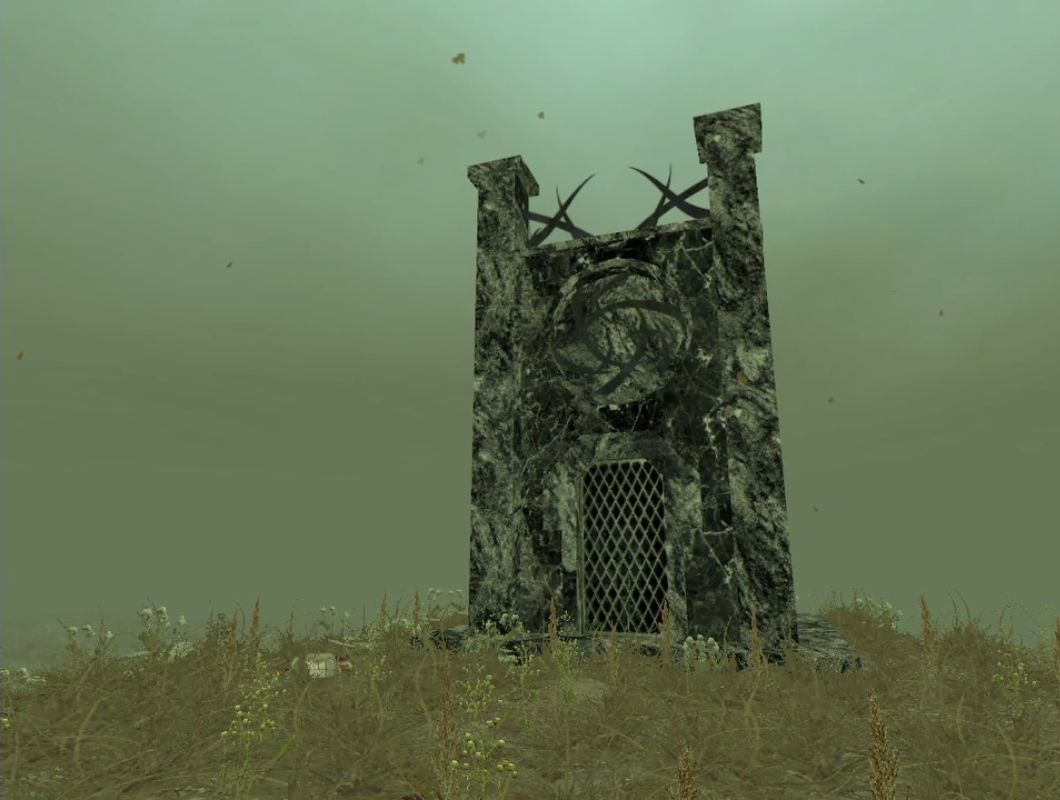
The Kain family tomb, I assume. Note again: the horns.
Pictogram
Mark Immortal, theater director, tells me that an uprising and sacrifice has broken out near the bone pillar in the Tanners District. He is, and has been, noticeably upset for his auditorium’s transformation into a morgue, though he comments that they have been his finest audience in a long while.

The problem is easily solved: after a quick inspection, I ask General Blok (still alive) to send his men in to clean things up, and go on my way. The men are protesting the Polyhedron—they say it is destroying the town, and they want it torn down. When I report back to Mark, he admits he instigated the riot. In his boredom, he’s decided to stir up a bit of mischief.

The Bone Pillar
Utopia
Pathologic is the Western name of this game, but in Russia the title is мор (Pestilence) with the subtitle утопия (Utopia).


In passing, I find a teenager on the street and ask him what he thinks of the Polyhedron. He tells me of its wonders: how, deep within, there is a kilometer-long labyrinth. He says, “You walk and walk in it, and it does not come to an end. When you go out – it is considered that it’s your reflection that leaves, and you yourself get to the Other Country.” I ask what “the reflection” means, and he replies, “It’s as though it’s you, and at the same time it’s not you. They leave not talkative. Therefore it’s said that it’s your reflection that comes back – to quiet the parents and so on. And your real self goes to the country of Utopia – to the magick country.”

This town is worthless. I hold to this. Yet the crown is its one treasure. The Polyhedron is impossible: a miracle, a feat of human ingenuity, completely accidental, and with its thousand uninfected children, it is the one pure thing this town has. Perhaps a cold anesthetic wonder, but a true wonder nonetheless. If one thing could be saved, it is the Polyhedron.

The sketch changes again.
Yet I am uneasy. The Polyhedron makes possible some passage to “Utopia”, the children say, but what is its true cost? I believe in equity: in order to gain anything, something must be given up. What have the depraved folk of this town not yet given up?

Wednesday, October 12, 2011

Pathologic: Day Eight, by the end of which the Bachelor will be convinced not to expect anything good from the Earth.

At 7am:

The morning of the eighth day has come.
Infected in the past 24 hours: 249 ppl
Died in the past 24 hours: 391 ppl
Gone missing: 59 ppl
Number of dead at the moment: 3128
Number of infected: 570

Less than five days remain. Tomorrow the sanitary army will arrive.

Today's Map
It’s a fundamental law of physics: Each action demands an equal and opposite reaction.

Ice Pick Lodge labeled this game as a prototype of an epidemic simulator. If I pull back for a moment and assess what has happened—and where I’ve just found myself—I couldn’t be more horrified. I’m controlling a pixeled avatar, a stuck up researcher from the city, whose shoes I have easily filled. If I were to answer to friends for what I’ve said and done in this virtual sphere right now, I’d be ashamed. I’ve killed men in barbaric combat—just to try to understand the primitives of this godforsaken place. I’ve dodged murders, taken down roomfuls of muggers, and lied to everyone in this entire town, in exchange for the numerous lies that have been told to me.

If Ice Pick were to assess my decisions, I’ve failed. I came into this town as a representative of civility and objective truth, and I mucked the whole thing up. Rubin has disappeared. Hundreds are dead in the Cathedral, and my first reaction when I spoke to the townsfolk was relief that all this wouldn’t be blamed on me. Of course, this is human nature. In the end, we’re all meat—heat—desire, and we all want to survive.

I’ll explain the day as quickly as I can.

Black Market of Panacea
The Haruspicus and I have created a panacea, through my research and his alchemy. Several worms, holed up in the now-open Apiary, have begun to produce a false elixir and sell it for an exorbitant sum. When I confront them, they point a finger of blame to Young Vlad Olgimskiy and say he has bought all of the true panacea and is hording it for personal gain. When I visit him, he tells me that yes, this is true: he used the vast funds at his disposal to buy it all up, but only so that he could sell it for (basically) nothing to the women of the town—Lara, Julia and Anna. It seems that he’s had a genuine change of heart.

I hope those large bags are just full of dead cow meat.
Kevin has already written about the Apiary—he took a visit to that harrowing place yesterday—but I’d like to share some impressions. I enter the asylum greeted by the cries of madmen. Butchers and worms run to and fro on strange errands, and massive bags of rotting meat hang from the ceiling. Bodies litter the floors, and there are strange experiments going on in back rooms. This place is filled with the refuse of the human race.

I assume this is a painting of the Apiary--otherwise it's gotta be a communist propaganda poster.
Underground Decay
The panacea is not enough to stave off infection. Yes, it cures the infection completely, yet it’s not enough. The fact is that as long as the source persists, this infection will come back again and again, and eventually spread beyond this microcosm. There’s something—either from the Abattoir, the Polyhedron, the water source—that will continue to fuel the outbreak. There is a dry rot in the infrastructure, and we need to search it out.

The difficulty of each errand today will be exacerbated by the plague: it has truly reached its peak. To enter an infected zone today is almost certain death. Plague clouds materialize all at once, hemming me in, as brown-swathed infected pursue with a reckless abandon, knowing they will die. The remaining arsonists patrol the streets accompanied by knife-wielding maniacs, all of them ready and capable of ending me with one strike.

I investigate the water source first. Young Vlad has filled in the well in his place, rendering any research utterly useless. My only recourse is to investigate the Abattoir: something there is poisoning the ground itself, the Inquisitor is certain. To this end, I ask Taya (the “Mother Keeper” girl in the Apiary) to order open the gates. She tells me she might, but only if Big Vlad offers himself as a sacrifice for his crimes. He was singlehandedly responsible for the shut-in at the Apiary which allowed the asylum to become a breeding ground for the disease and killed hundreds. I’m convinced I still need Big Vlad, however, so the Mother Keeper gives me another task: I need to break into her old house (the same one Lara picked to be a “House of the Living” on Day 2) and recover her favorite rocking horse toy.

That's not soot on my nose. It's Sand Plague.
The mission is difficult; not only do I need to procure a lockpick, but the former “House of the Living” is impossible to navigate, filled to the brim with miasmic plague clouds. Choking, I rush up the stairs, grab the rocking horse and run back to Taya who says she’ll open the Abattoir for my inspection just before midnight tonight.

At half past eleven, I make my way to the Apiary, find the gaping tunnel before me and run through to the Abattoir. After wandering for a bit, I come upon a large room, where half a dozen butchers circle me and proceed to beat me up. In just the nick of time, a wave of soldiers rush in, gun down the barbarians and take me to the town center. On my way there, I’m treated to a cinematic showing lines of soldiers marching in formation—a stern-faced general at their fore. The army has arrived.

This is me about to get lynched.
Aglaja and Young Vlad
From my conversations with these two, I have come to an unsettling conclusion. Simply put, the town must be destroyed.

So much of this town is unnatural. After researching the Polyhedron (the dogheads—the gang of children who live there—came to my house) I have learned several interesting points. First: it is something entirely synthetic. None of the children who live there have been infected. People say it is a place of magical energy, that time is static. Some say it grants eternal youth. Some say that only the youthful can benefit from its strange magic. The Kain family talks of the inner sanctum as a chamber where a spirit can choose its path—this has something to do with Eve’s suicide, attempting to become “part of the Cathedral”. The Cathedral is so close to the Polyhedron—perhaps they are linked.

So yes: the Polyhedron is a miracle, a strange healing instrument of sorts. Yet it is an artificial, unliving thing, and it has paralyzed the earth. I zoomed out from my map today to see the town overlaid with the image of a bull—organs, intestines, spine, everything. And at the tip—the head—is the jagged, pointed, impossible Polyhedron.

I yelped when this came up instead of my map.
This was all steppe at one point—there were wanderers in yurts, moving across the surface of the land, briefly drawing from the resources, then moving on. Like symbiotes, they fed from the land in life, and with their death (and blood) proceeded to feed the land. Yet the town has changed everything. Trains arrived from far away bringing the oafish townsfolk, who built their structures piece by piece, attaching themselves to the land like melanoma.

The Haruspicus experienced the tunnels beneath the town as a sort of ventricle—as blood vessels through an abdomen. There are hundreds more beneath each house, beneath each manhole I pass on each street, all of them burrowed deep with cold, sharp trowels by greedy townsfolk. These aren’t blood vessels: they are carved wounds. We call the disease the Sand Plague because it comes from the earth, when in reality it is not a plague at all. The plague is the antibodies of the earth, and we are all parasites, sucking the life from the ground, poisoning its blood and flesh gradually.

The people of this blighted town are corrupt, squabbling animals, and they are only getting their just payment for the ways they have grossly abused the earth. Even the steppe folk have been corrupted, drawing inward into myopic ramblings of cultish earth gods and goddesses, upholding traditions that no longer have meaning, that will not shield them from the judgment. As I walk through the outskirts of the town, I can occasionally make out the remaining yurts covered in rust-colored scabs. No one is safe. Everyone is judged.

The Inquisitor describes this microcosm as a carefully wound and intricate mechanism, and something is throwing it off. The Polyhedron, with its odd stasis, has wound the clock to a halt, left the earth vulnerable and incapable of repair, while the Abattoir has gummed up the inner workings with whatever the Butchers are dumping into the system.

The Bachelor is a doctor. I am playing the role of surgeon. The true blight here is not the Sand Plague, but the cancerous growth of this town. The most logical recourse is to excise this tumor before it can spread. I don’t know what will make this possible, but I am assured the tools will present themselves in the days to come.

Sunday, October 9, 2011

Pathologic: Day Seven, on which the Bachelor will be able to reveal the truth and obtain a priceless ally

At 7am:

The morning of the seventh day has come.
Infected in the past 24 hours: 209 ppl.
Died in the past 24 hours: 342 ppl.
Gone missing: 19 ppl.
Number of dead at the moment: 2394
Number of infected: 437 ppl.

Even together with the Inquisitor you will not defeat this enemy. Less than six days remain.

Today's Map
As soon as I step out of Eve Yahn’s house a cinematic plays. It’s the Inquisitor—a slim, severe woman—ordering executions, followed by an image of the gallows. At this, I start to worry a bit. I have nothing to show for yesterday—no culpable source for the disease. I can only hope she’ll understand.

Tough . . . love?
Also, today is the day when everyone starts calling me oinon. I did a double-take at first; I thought they were calling me onion.

Truth, Lies, and Some More In Between
Not only is the Inquisitor understanding: she’s an admirer of my research. Three years ago, we met at an exhibition in which I resurrected dead tissue. Aglaja is confident in my abilities; moreover, she says I’ve been manipulated. “They” have sent me here on false pretenses in an effort to destroy my work and me. I can only assume she means the higher authorities, academia—all of them jealous of my brilliance. How convenient it was, she tells me, that the town’s sole medic would die on the first day (an almost negligible detail to me on Day 1). I was set up to fail in my fight against this enemy from the very beginning.

Don't let the cowering lackeys or blood-red throne confuse you: she's a teddy bear.
There have been three spectators in town disguised as Executors. They have been feeding rumors of the Shabnak, false information to the masses that has spread faster than the plague. I have to find them and collect their ledgers for Aglaja. This is not terribly difficult to do—each is situated in the heart of the three main districts.

One of the spectators has something interesting to say. He tells me not to trust the Inquisitor; she would like nothing more than to burn this town to the ground. She's wanted, convicted, and this is her last act as Inquisitor, and she would like nothing more than to bring ruin and shame to the higher powers. I take note of this as I grab his ledger.

Eve is Gone
As I scurry around town, I receive a disturbing note from Eve Yahn (my landlady-with-benefits). She says she can’t take any more of this—that she needs a sign of a miracle. Minutes later, I receive a letter from the Devotress blaming me for my mistakes; Eve has jumped from the highest parapet of the Cathedral, expecting to be saved by some miracle.

Andrey Stamatin, who owns the pub in the eastern district (which I frequent for coffee and roses) has some woes. I find from his entourage that he has gone to the swamps in search of Eve; he doesn’t know she’s died. Instead he’s gotten it into his head that the smooth-headed Worms have stolen her to become a “Bride of the Worms”—perhaps for sacrifice or something worse.

Cursing under my breath, I tramp down to the swamps. It’s not to far a detour on my way back to the Inquisitor. I arrive at a rust-red yurt to find a large posse of high-cheekboned butchers and worms, all of them thirsty for blood. After several failed engagements, I adopt a stealthier approach, draw my adversaries out to the swamp to wander after me, and rush to the yurt to speak to Andrei, who has discovered the horrible truth. Yes, Eve has died. There’s no getting her back, no hoax, no trickery. If I want comfort from now on, I’ll need to visit the tavern.

We should seriously check into whether or not this game has ever induced Seasonal-Affective Disorder. 
Andrey says one rather unsettling thing before we part ways. He tells me Eve jumped because she wanted to become “The Soul of the Cathedral”. Something about an Inner Chamber. I’m reminded of the Kain family’s talk of the “Inner Chamber” in which the late Simon Kain, the first diseased, died on Day 1 and 2 (another seemingly unimportant detail to me back then). At this point, however, I still don’t understand.

Truth, Lies, etc. (continued)
The Inquisitor is frustrated with the ledgers I collected. They are false. The numbers have been stacked; the information collected is off, somehow, though we don’t know which of the three is wrong. She tells me that I must arrest one of the three spectators. One tells the truth, one always lies, and the other one vacillates between the two. Right, Wrong, Neutral. I can’t help but think, as she sends me to discern which is which, that I’m being put through an elaborate test. She wants to see how trustworthy I am.

She said he did it of his own free will but . . . uh . . .
Look carefully at the hollow--there's a strange face etched into the roof of the Cathedral.
The details of the rest are inconsequential, of course. I find the traitor, take him back to the Inquisitor, and she orders him to jump from the top balustrade of the Cathedral to his death. She tells me afterwards that I made the right decision, and she’ll have more for me to do tomorrow.

A new "map"?
When I’ve finished, I look at my map to see a second drawing on the back. It’s the town from the side—a large, awkward hump on a hill. I don’t understand the meaning at all. The etchings at the bottom are like traced veins. I’m certain this will make more sense in the days to come.

Mask & Overall
I receive a letter from the Haruspicus asking for an executor’s mask and suit and spend much of the rest of the afternoon scouring the town and countryside for something, but nothing turns up. I must have missed something earlier. However, my wandering turns up two interesting things.

The culture of this place disgusts me. The townsfolk built their awkward little houses, now brimming with plague, when they ought to have stayed in their yurts. As I head north through the Tanner’s District, I come upon a Worm standing outside an empty pen. Curious, I ask him what he’s doing. He tells me the earth needs blood, and that by performing a special ritual we can nourish it. I want to know more, and he hints that I might be able to participate. I accept, and moments later I find myself hemmed in the pen, facing a bloodthirsty butcher with nothing but my fists to defend myself.

I panic, then relax and step forward. He delivers a crushing blow, nearly killing me, and so I step back, then forward, timing my punches just so. After a few minutes, he goes down. The worm, looking rather glum, tells me I didn’t shed enough blood, but he would give me the fellow’s pancreas as a reward. I take a sample of blood instead. It may prove useful.


Kevin constantly berates me for being “so prissy” but I just killed a man with my bare hands. There’s nothing prissy about that. That’s what this town is—it’s designed to make animals of men.

Horns. Everywhere.
The other image that interests me is in the cemetery. I hadn’t noticed it before, but most every tombstone has some sort of image of bulls upon it—in the form of horns. Bull horns everywhere. It’s a strange anthropomorphism. There’s so much talk about the Abattoir—the bulls in the fields and the infections—and now rather than cows in the pens, there are hundreds of human carcasses, stacked and canvassed. The people of this town are mere livestock on their way to the slaughter.

Friday, October 7, 2011

Pathologic: Day Six, on which the Bachelor will be offered to choose from several different sources of contamination


At 7am:

The morning of the sixth day has come.
Infected in the past 24 hours: 163 ppl.
Died in the past 24 hours: 140 ppl.
Gone missing: 12 ppl.
Number of dead at the moment: 840
Number of infected: 335 ppl.

Less than seven days remain. A governmental emissary will arrive tomorrow.

I stagger out of Lara Ravel’s house at half past five, starving and mildly woozy from the infection to find myself surrounded by the plague. The afflicted leprous figures march about in packs, and patrolling the streets are a new brand of soldier: the Humpback’s men. Unlike the oafish bandits, these fellows sport a seemingly unlimited supply of Molotov Cocktails, which they lob at anyone and everyone from worrying distance. Their purpose, it seems, is simply to rile things up.

One hit is from these is fatal.
These new annoyances, however, are the least of my worries.

Today's Map
Witch Hunt
The first thing I do in the morning is visit Rubin, who should have completed the improved vaccine. Sure enough, he has. (This differs significantly from Kevin’s experience of Day 6, in which the vaccine failed miserably). Yet his conscience weighs heavily upon him. The Haruspicus was aware that Rubin was keeping the body of the first infected, Simon Kain, for inspection and research. What he didn’t know that it was I who told Rubin to hold the body illegally, to keep it under wraps, though we both knew it might come out sooner or later. He confesses to me that he can’t take it anymore: he has to come clean to the Kain family.

I panic, of course. He can’t do that. It would ruin my reputation if it came out that he had kept the body under my instruction. So much rests on that one lie. I tell him to keep it—that I’ll handle it—that he has to stay and continue his research. He reluctantly agrees, though he holds onto the vaccine.

The consequences of my decisions are at hand. I get several letters and hear whispers from the townsfolk. The Inquisitor is coming tomorrow. But, more upsetting, there has been an incident in the Cathedral.

I arrive early morning to find the Cathedral utterly dead—nearly 800 people wiped out by the Sand Plague. Something got in. To my relief, however, the finger of blame isn’t pointed at me, but to the leading women of the town. The shabnak—the she-cannibal—was accused of breaking in and giving the people infected water to drink. Hours later, streams of infected flooded the streets while a few were left to clean up the remains in the Cathedral.

They did a good job cleaning up.
Saburov outlines the plan: I will interrogate the women of the town and decide who is the vector. Of course I know better; all I have to do is draw their blood and examine it for traces of the virus. It takes a bit of convincing, but I take a sample from Anna Angel, who tells me Klara (the Devotress) is also a prime suspect.

The real gem here is Ospina, who practically spits venom when I whip out the syringe. She does her best to advise me in the “proper way” of finding the shabnak. I’ve transcribed the entire conversation here (with a few minor adjustments for clarity):

ME: Ospina, you are accused of being a cannibal. They will come for you soon.
OSPINA: What is a shabnak? It is a malicious spirit who wears the flesh of a woman on his bones. Shabnak can be known by a characteristic attribute – his hands are long, all toes are of the same length, and the teeth are shown on all body from under the skin
ME: Thanks for the lesson.
OSPINA: That’s it … I am always glad to help you. If you want I’ll help you catch the monster. If you do not cope with that yourself … almost a week has passed and the people still perish, perish, perish …
ME: Help me. Where do I start? Perhaps from the survey of suspected?
OSPINA: Yes. You gather all women who cause your anxiety in the Cathedral, for now it is empty. Build a bonfire at the entrance. Order them to strip naked and survey them carefully … Search for sharp edges under the skin, but you will not find. And then …
ME: I have a more reliable way. Let’s look at your blood.
OSPINA: It is not necessary to take blood. Search for the teeth. Let me continue … sooner or later one of them will break and rush away crying – right into the fire. And then her essence will become visible! She will turn all black, howl, crook her fingers – everyone will realize at once that this is not human.
ME: Of course. And now stand still. I have a few needles; don’t worry.

Ospina
After taking her sample, I find Klara at the Saburov Manor. She won’t allow me to take her blood; she considers herself above reproach. And then an extraordinary claim: she says that she and the Devotress are two different people, though the Devotress looks just like her. She tells me that, with all my science and system, I have no right to investigate her. I appeal to Saburov, who has effectively adopted the little whelp, who tells me I can draw her blood, but when I return she has disappeared.

I rush around town, furious, asking everyone for information. I track down Mishka, a young boy living out in the train yard, and he tells me I’m a hunted man. That the Devotress—who is undoubtedly the shabnak—is searching for me with murderous intent.

The Thing Coming From the Steppe
I scour the rest of the town and receive a tip from Spichka, a young boy holed up in the Tanner’s District. He saw the Bone Cannibal just now, rounding the Abattoir. If I hurry, I may catch it. Heart pounding, I draw my revolver and prepare to finish this once and for all. A true vector! The real, tangible foe in all of this—a discernible victory. With the shabnak gone, it will be only a matter of time till the virus dies out.

Rounding the Abattoir, I see it: a hunched, gangly figure with a white face and long neck. Hardly a thing that could pass for the Devotress. As I step toward it, the air thickens and I begin to choke. I aim my pistol at its (admittedly small) head, fire two shots, and watch as the thing goes limp.

Shabnak or Animated Totem?
Upon closer inspection, I can’t say this is any sort of shabnak. I don’t know what it is—some kind of clay golem, animated by the weird cultic rituals of these steppe barbarians. It was just an illusion.

I find Klara mourning his corpse when I return. Stricken with grief, she holds out her arm and lets me take a sample, which I immediately rush to the microscope. The blood is irregular, strange indeed, but there is no sign of the Plague. I return to her and give my analysis. Yet, knowing that the Inquisitor will come tomorrow, and that she will want blood, Klara says she’ll offer herself as a sacrifice. She’s somehow responsible, she says—and they will need someone to blame anyway.

I resist—she cannot do this. It isn’t right. She is an inexplicable anomaly, there’s no doubt about that, but she is no vector. It’s true: she’d be an easy solution. She’d placate the Inquisitor. It would be an easy solution. But it wouldn’t be right. I tell her the decision is her own, though I don’t think she should turn herself in.

They Want to Burn the Apiary
My final task for the day is a seemingly impossible gambit. The humpback, with his league of arsonists, wants to deliver a deathblow to the Olgimskiy family: he’s going to burn down the Apiary, a nexus of disease that has produced wave after wave of infected (or so they say). While I could care less for the Olgimskiys, the Apiary will be indispensible to my research. They can’t burn it down. The only thing for me to do, then, is to kill the humpback.

It’s late evening when I arrive, and raining. I approach the main entrance to see the Humpback near the tunnel, four arsonists arrayed around him, Molotov cocktails at the ready. I check my revolver: I’ve only got four bullets. Whatever. I rush the first two, a headshot each, then whirl to the next, take him and his companion out, then stand, facing the Humpback. He’s got an alarmingly good throwing arm. I pocket the gun, bare my fists, and approach him, strafing left and right, trying to get in a good punch. The close range is too much, however, and he’s too good a shot. I go down once, twice, three times, until, frustrated, I rush out to the streets to trade a needle for a bullet. When I come back I find him there, standing crooked with that dull cow-eye look. Fearless, I run up to him, gun at the ready, and take him out with a decisive shot.

The entrance to the Apiary, sans two psychopathic arsonists.
Finally, a true victory. I’m not worried about the Inquisitor tomorrow. I think we’ll get along just fine; if anything she ought to admire my work.