The morning of the eighth day has come.
Infected in the past 24 hours: 244 people
Died in the past 24 hours: 417 people
Gone missing: 40 people
Number of dead at the moment: 3336
Number of infected: 503 people
Less than five days remain. The sanitary army will arrive tomorrow.
As always, the devil is in the details. My successful creation of the panacea yesterday came as a complete surprise, albeit a pleasant one; I had assumed that, with nearly a week to go, I would face a long struggle to find the cure if I found one at all. To have created the panacea so relatively early struck me as curiously easy, at least by Pathologic's standards. As the eighth day progresses, however, I realize that the worst part is yet to come. The blood that I use to create the serum is extremely rare (thanks mostly to the obstinacy of the people of the Abattoir), and a single flask of panacea is no cure at all when an entire town is clamoring for it. The Inquisitor predicts that the town will tear itself apart as citizens vie for a dose of the serum, of which there is not enough to go around. The question is no longer "can I find a cure in time?" It's "which people get to be cured?"
It seems that the game is going to make me choose who lives and who dies.
Ashes, Ashes, We All Fall Down
Each day I find myself writing something about how the Sand Plague has gotten almost unbearable, only to discover that things have somehow gotten even worse on the next day. Day Eight is no exception. Nearly every district in town now is either crawling with the Plague or convulsing in its wake. On previous days I could usually pass safely through an infected zone with some fleet footwork and a bit of luck, but now it is impossible for me to come out unscathed on the other side of an infected zone. Multiple plague clouds converge on me from different directions; arsonists, bandits, and the infected attack me on sight; rats chase me even into healthy districts until I stab them or seek refuge indoors. My gloves, boots, and facemask have all degraded to the point where they hardly shield me from the Plague at all (yes, in Pathologic even your clothing wears out, requiring expensive mending). I can't properly convey the deep, weary feeling of relief that sweeps over me whenever the green-hued air of an infected zone gives way to the normal browns and tans of a healthy area.
 |
| Oh MAN, we are screwed. |
The Bachelor, for his part, thinks the inhabitants of the Abattoir are to blame. Whatever sacrifices they're making in there, whatever blood they're pouring into the earth, it's poisoning everything. Unsurprisingly, the Cult of Bulls isn't going to admit someone with such opinions into their inner sanctum, which means that once again he needs my help. I agree, though less from a desire to help him than from a desire to talk with Elder Oyun again. The Bachelor is beginning to worry me; in our conversations he seems increasingly detached from our battle with the Sand Plague. I sense that our goals and loyalties are gradually diverging from one another.
Perhaps sensing the Inquisitor's scrutiny, the Abattoir has closed its entrance, which means that once again I must do a favor for Mother Keeper to open it. This quest isn't as difficult as the last one I had to complete for her, but it's more disturbing in its implications. It seems that, despite my encouraging words to her on Day Six, the timid, soft-hearted Klara has disappeared, leaving only her cunning doppelganger to quietly spread fear around town. (Or maybe the Devotress everyone has been seeing is actually Klara, and my well-intentioned white lie did no good. Maybe the "doppelganger" is just some trick. Trying to pin down exactly what this game is doing with the Devotress character is a maddening exercise in confusion.) The Devotress has been appearing solely to the children of the town—my Adherents—and telling them frightening stories and riddles. Mother Keeper is scared of her, which does not bode well considering that Mother Keeper does not seem to be scared by anyone or anything else. She wants me to get the Devotress to tell her the end of the story that the Devotress has been telling to all the kids. There is an urgency to the request that suggests there's more behind it than merely a child's curiosity.
I finally track her down in the trainyard, interrupting a strange tête-a-tête between her and bedraggled orphan Mishka. The story she tells has something to do with a crystal flower that parasitically grows in a garden, killing all the normal flowers around it until nothing remains but crystal flowers. There's obviously a connection between the crystal flower and the Sand Plague, but it's hard to tell whether the Devotress intends her story as a cautionary tale, a fable to be emulated, or a glimpse of some unavoidable future. In any case, what I've heard will satisfy Mother Keeper, though I worry about leaving Mishka alone in that railcar with the Devotress. Why is she focusing so much attention on my Adherents?
Burakh Vs. the Elder
Ever since I received my inheritance on Day Two, I have had two goals for my time in town. The first was to find a cure for the Sand Plague and produce a panacea. The second and more enigmatic goal was to figure out the identity of the "Betrothed," the one to whom belongs a strange symbol that I found in my heritage box. Why exactly this is so important is a question that I have been unable to answer so far, though from today's title I have a feeling that I'm going to find out today. The Elder supposedly is the one who can tell me who the Betrothed is and why I should care.
This assumption hits a snag almost immediately. Elder Oyun seems to have decided overnight that he doesn't trust me, and he refuses to cooperate with my requests for more information and more panacea-producing auroch blood. When I protest that my heritage entitles me to those things, he scoffs that I haven't grown into my father's legacy yet. Whoever handed over my inheritance has been keeping things from me, including another special object without which I don't deserve so much as a cup of water from the Order.
When I confront Ospina about this, she says that she did it only because she's in love with me (?) and didn't want me getting mixed up with the Elder before I was ready. Leaving aside the sudden declaration of love (which might be a translation issue, her attempt to manipulate me, or both—I have no idea which), I'm furious that she kept something from me that hurt my position with the Elder. She claims she was doing it for my own good—there was apparently bad blood (no pun intended) between Oyun and my father, and things might have gone badly for me if Oyun had thought I was making a power play for his position as head of the Order. He is in a precarious position right now, Ospina says. The Oyuns are not a respected family as the Burakhs are, and he's the Elder only because Fat Vlad, who controls the Abattoir's meat-production operations, set him on the proverbial throne (perhaps as a sort of puppet ruler). Now that Oyun's sacrifices are failing to appease whatever force is causing the epidemic, many in the Cult of Bulls are calling him a fraud.
With that, Ospina hands me a talisman made of a bull's horn. This is the last piece of my inheritance, she says. I am still unhappy that she didn't give it to me earlier, but she has convinced me that at least she didn't do it out of malice. Besides, how could you stay mad at a face like this:
 |
| OSPINA QUOTE OF THE DAY: "The Inquisitor continues her terrible harvest. Is she at least beautiful?" |
Well, maybe the town, too. Over the generations, the people of the Abattoir have been sacrificing bulls and pouring the blood into that huge pit I saw yesterday. They say that, down there in the darkness, the blood nourishes the earth, which is actually a living being they call an udurg: "a body that contains a world." The stuff I use to create the panacea comes from that underground reservoir. According to the Elder, the Sand Plague has come because something is interfering with the reservoir, either blocking or poisoning it. Contrary to what the Bachelor seems to think, the town and the earth beneath it form a symbiotic relationship. With its nourishment either drying up or becoming corrupted, the world is slowly eating itself, and the town along with it. This would explain why even the town's structures are being ravaged by disease. The only way to reverse this process and save the town, Oyun says, is to present some sort of sacrifice, to provide the udurg once more with untainted blood.
What must I sacrifice, then? I ask. But the Elder has clammed up again.
 |
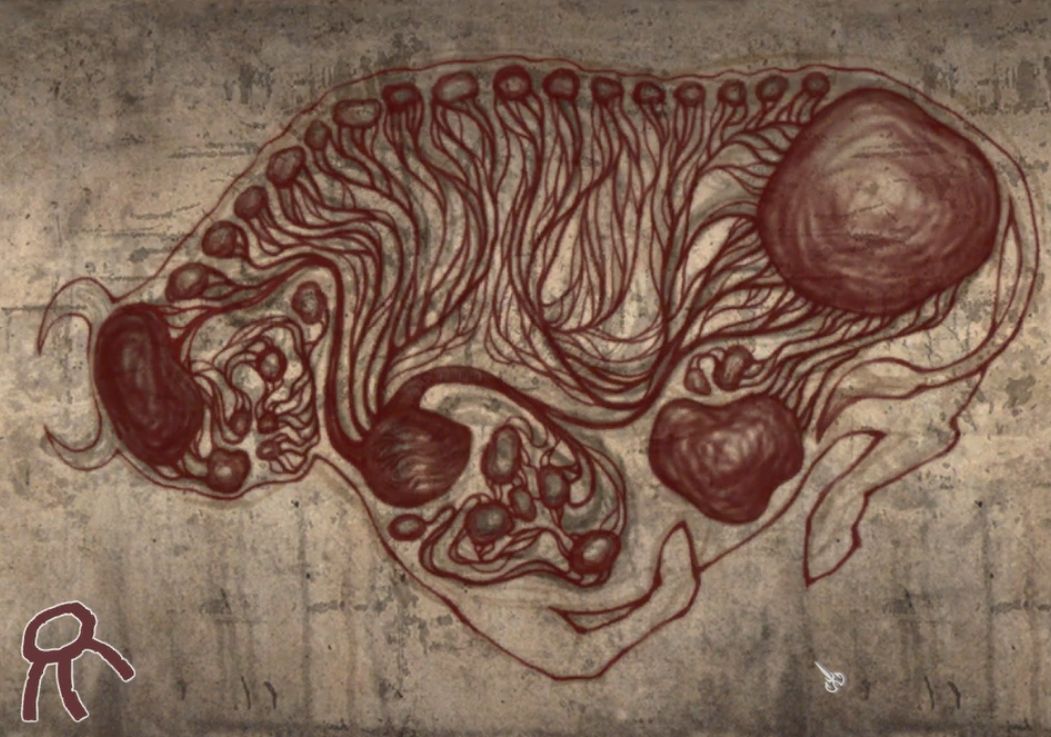
| The alternate view of my town map. Notice that the hill on which the town rests has been revealed to be a bull. |
The Inquisitor is pleased with my findings—more than pleased, she seems downright giddy in her fascination with the idea of the udurg—and I settle in for an evening of scrounging for tomorrow's supplies. Funny how the wearying process of scraping together enough cash to meet the 800-dollar price tag on a loaf of bread, so onerous at first, is becoming almost mundane. I guess one gets used to anything after a while.
At around 8 pm, I receive a letter from George Kain containing some unsettling news. Now that the Apiary has been unlocked, its inhabitants have been calling for the head of Fat Vlad Olgimskiy, the man who had locked them up and left them to rot. Fat Vlad, perhaps shaken by the Inquisitor's presence, has decided to surrender himself to the mob. According to George Kain, though, he is not to blame. He's only taking the rap so that his son, Young Vlad—the true mastermind behind the Apiary fiasco—will be spared. Kain tells me that, as the only person with any influence over the butchers of the Apiary, I have a responsibility to go to them and make sure they punish the right guy.
I am at a loss. I've distrusted the elder Olgimskiy from the start, but even I don't think that he deserves whatever horrible fate the denizens of the Apiary have prepared for him. On the other hand, I have no reason to believe that Young Vlad is guilty either, and Kain, as a member of one of the rival families, could have ulterior motives for disposing of the scion of the Olgimskiys. I go to the Inquisitor with the news, telling her to throw the weight of her authority behind an investigation. She callously dismisses my concerns as beneath her and warns me not to tell her how to do her job. I am to handle this "petty" matter on my own.
Not knowing what else to do, I head toward the Apiary on the other side of town, hoping that I'll have an idea of what to do by the time I get there. No such luck. All too quickly, I am standing before Mother Keeper in her torchlit inner sanctum, with her waiting for me to deliver the guilty party into the Order's hands. I have three dialogue options:
1) Fat Vlad is guilty
2) Young Vlad is guilty
3) I refuse to help
I'm afraid to take the third option, which would keep my hands clean but also leave the quest unfulfilled. Failed quests can put my Adherents in danger, and I am also worried about losing whatever favor I've curried with the Order. The quest must be finished. My mouse hovers over Young Vlad's name, but then I remember his helpfulness, his knowledge of the town's secrets, my deep-seated distrust of Fat Vlad, and George Kain's questionable motives. I change my mind and, with a click, condemn Fat Vlad to the butchers' clutches. I feel like a coward.
Before I leave, I ask Mother Keeper exactly what will happen to the man. She replies that the Worms and butchers will take him into a back room that she is forbidden to enter. When they finally leave, Fat Vlad will be gone—vanished without a trace. I feel the hairs on my neck prickle. "Mother, do they eat him?"
The kid looks back at me in the firelight. "I am not allowed to go in that room, Burakh." Her expression does not change.