The morning of the tenth day has come.
Infected in the past 24 hours: 340 people
Died in the past 24 hours: 623 people
Gone missing: 139 people
Number of dead total: 6230 people
Number of infected: 516 people
Less than three days remain.
I wake up early on the tenth day, hardly able to believe that I survived the night. To my immense relief, the health-draining effects of Elder Oyun's potion from yesterday seem to have worn off—my health is dangerously low, but stable. The death toll, on the other hand, is rather disturbing: up by over 2000 in a single day. According to the rest of the casualty report, only 600 of those people actually perished from infection, which means that over a thousand people have died of other causes. As I walk through the lamplit streets, filled with murderous arsonists and trigger-happy soldiers, it's not hard to guess what those causes were. And there are two more days to go.
I know that I'm going to be facing Elder Oyun's second trial today, so I stock up on first-aid supplies and choke down another revolting dead porridge before making my way to the Abattoir. I make a couple of detours into the deserted districts where the plague has burnt itself out, searching the abandoned homes for food and emptying the last of my shotgun ammo into the looters who get in my way. I luck out and find a loaf of stale bread in a kitchen, which I immediately wolf down to stay conscious.
Elder Oyun greets me with the news that he's found the butchers responsible for stealing the auroch blood from the Abattoir. Well, "found" isn't exactly accurate. He knows who they are, but they have gone into hiding. It falls to me to locate them as part of my second trial. Oyun gives me another potion to drink, though this time I have the good sense to ask him what it does before taking it. It will make me ravenously hungry, he replies, which will help because "if you are hungry, you will find the scent of blood better." He tells me to visit the sacrificial mound south of town to consult with the spirits of the steppe, warning me not to eat anything until I have located the offending butchers. Remembering yesterday's ordeal, I make sure to listen. I fight down the panic when I see my hunger meter skyrocket and my health meter plummet. If I made it through the first trial, I can make it through this one.
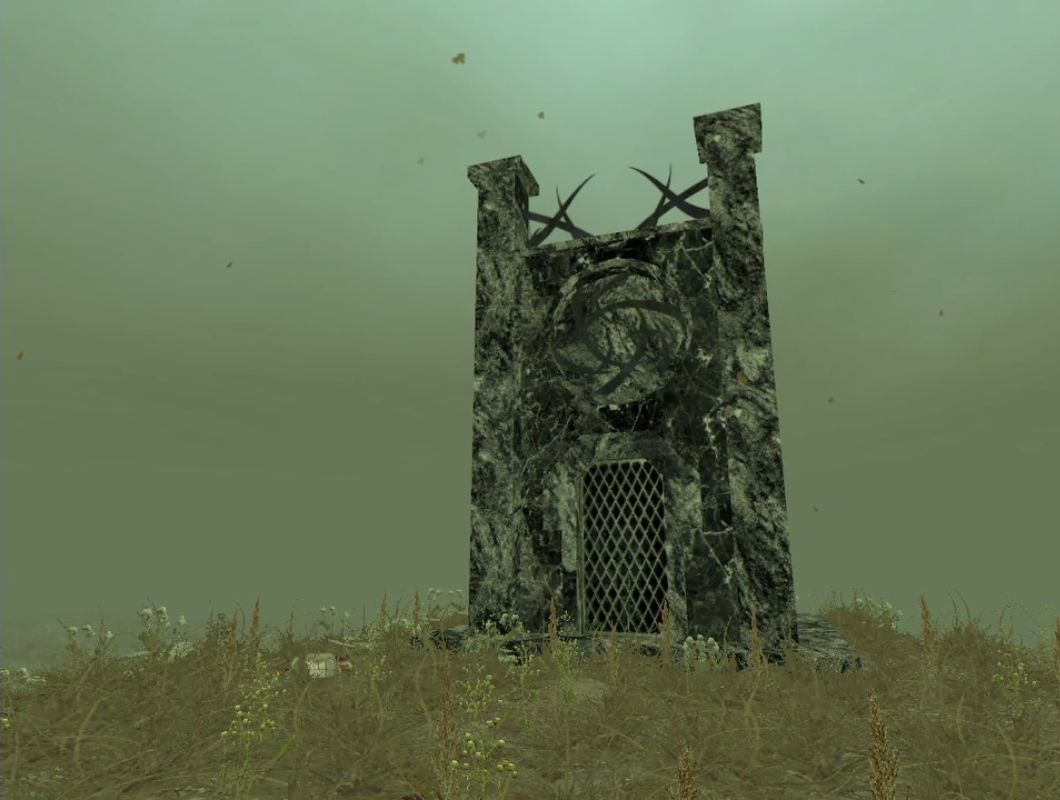
The hill of sacrifice is empty when I reach it just before midday. I lie down on the stone slab at the top and wait for the spirits to do their thing.

 |
| Scenes like this are why I no longer play Pathologic right before bed. |
The butchers are defiant when I confront them. Each of them tells me the same thing—that I can't get the panacea blood I need from underground, that I need to gouge out the tumor that's been growing on the land and harvest the blood from the wound. It sounds suspiciously like the scorched-earth policy that the Bachelor has been advocating, and I'm in no mood for it. I duel each of them to the death (again, reloading the game every time they land a blow and sap my ebbing health) and return to the Elder with the news. This time he gives me the antidote to the potion, presumably because I didn't try to artificially fix my hunger/exhaustion meters as I did yesterday. When I bring up what the butchers told me before I killed them, he says something about how I can't trust anything they or the Bachelor say about the Polyhedron. The Kains are trying to use it to achieve immortality through reincarnation, to "pour old blood into new veins," Oyun says, an idea as blasphemous as it is unnatural. He will say no more, dismissing me until tomorrow.
Before I have time to be surprised at how straightforward (relatively speaking) this all was, I receive a letter from the last person I would expect: Fat Vlad. It seems he's been granted a temporary reprieve by the mob in the Apiary, and he wants to speak with me before he is marched away to that forbidden room to face his horrible fate. I find him in Mother Keeper's torchlit sanctuary, surrounded by guards but otherwise looking much the same as always.
He has two final pieces of information for me. First, there is an auroch dying at the "Bone Pillar" near my late father's abandoned home, which Vlad recommends that I check out before any of the other powers-that-be find it. Second, Vlad cautions me to beware of his former underling, Elder Oyun. The Elder is fighting a battle with me, Vlad says, and he is not to be trusted.
Watching Fat Vlad in the flickering light, I feel a pang of remorse. For the first time in the game, I believe he's telling the truth. With his execution fast approaching, all lies seem to have gone out of him, and he decided to help me with what little time he had left. He has nothing else to say to me. I feel worse than ever about my part in his death.

He was definitely telling the truth about the bull at the Bone Pillar, in any case. The poor animal lies impaled on a spike and surrounded by shifty-looking Worms. According to them, this is an auroch, and what happens to it is up to me. I am to ask my Adherents—the children who stand to inherit the town—what I should do with it. I'd better hurry, though. It's already late afternoon.
Once again, the issue of my character's walking speed returns to bedevil me. My Adherents are scattered all over town—most of them at the far edges—such that there's no efficient way to visit them all. Add to that the hellishness of the sprawling infected zones, and I'm going to be pressed for time even without having to deal with the health issues from yesterday. I talk to Spichka first, since he's close by, then make the laborious trek to meet with Notkin on the south side of town. Both of them seem horrified by what I tell them and say that the bull needs to be removed from the spike immediately.
 |
| Mishka: "I have got wet and faded." |
I find the doll sitting out in the marshes, eerily alone. I don't have time to return it yet, not with nighttime approaching, so I stash it in my inventory and move on to the graveyard to meet with Laska. By now I have covered almost every area on the map and have to resort to chewing coffee beans to avoid keeling over from exhaustion.
To my dismay, Laska's not in the mausoleum that she apparently calls home. General Blok has arrested her for not allowing his soldiers to desecrate (or as he would put it, "sterilize") the graveyard. A teenage girl informs me that she's being held at the Town Hall, all the way up on the north side. (Haruspicus: "My legs are failing me!") Yet when I storm inside to confront him, it's not Laska standing next to him, but the Devotress.
 |
| What is she doing here? |
Finally, Blok points me south again, where the army keeps its reserves of weaponry. I retrace my steps for the third time as I make the painfully slow journey, darkness falling around me. With the amount of distance I've covered today, I feel like I've run the Tour de France without a bicycle. (At this point, my notes for the day simply read, "THIS IS RIDICULOUS!! Running back and forth across town! AAAGH!!!") I pop the last of my coffee beans into my mouth as I stumble along, ignoring the hit to my health.
I find Laska locked up in a boxcar under armed guard. I order her released, by the general's authority, then ask about the auroch at the Bone Pillar. She adds her voice to the chorus calling for it to be released, and I make a beeline for the Bone Pillar in the northeast, hoping I'm not too late.
I arrive just before the bell tolls for 11:00. The Worms say that the auroch will be removed from the spike tomorrow morning, and each one hands me a vial of its blood: four panaceas' worth. I pocket them and head south one last time, to deliver Mishka's doll to her. Before I do, I take a short break to read the letter I received from the Bachelor this morning, who is still trying to convince me that the Polyhedron needs to be saved. The Kains have discovered the secret to eternal life, he says. I snort and disregard his argument.
Mishka is, of course, happy to see her doll. As a reward for my efforts, she hands me ... a vial of auroch blood? Where did you get this? I demand. From the base of the Polyhedron, she answers. Every now and then pools of blood will appear at the bottom, though nobody can say where it comes from.
Then my map changes.

My eyes move from right to left over the picture—from the veins of sacrificial blood from the Abattoir, to the sharpened stem that plunges down to meet it, then up to that blackened horror incubating within the Polyhedron. Suddenly, it all clicks into place. The Bachelor's letter, the blood at the base of the Polyhedron, the urgency of removing the spike from the suffering auroch at the Bone Pillar: everything is united. Maybe the Kains have discovered how to be reborn in the Polyhedron, but in order to achieve this they need fuel, nourishment for the soul within. In the words of Elder Oyun, they need to pour old blood into new veins.
The Polyhedron siphons the lifeblood from the earth, the earth sickens, the Sand Plague comes. A syllogism, deadly in its simplicity.
I hurry over to the Polyhedron as a thin drizzle begins to fall. Just as Mishka said, blood is pooled at the base of the stairs leading up to the Inner Chamber. I collect a sample, and it's exactly the same as the blood I received from the Worms at the Bone Pillar.
If I had any doubts before, they're gone now. I don't care what the Bachelor says or whom he's been talking to. If we want to eradicate the Plague once and for all, the Polyhedron—and that thing growing inside it—must be destroyed.