Showing posts with label Apiary. Show all posts

Tuesday, October 18, 2011

Pathologic: Day Eight, on which the Haruspicus will discover who is the bearer of the secret mark

(or, in which Kevin gets a tour of the sausage factory)

The morning of the eighth day has come.

Infected in the past 24 hours: 244 people
Died in the past 24 hours: 417 people
Gone missing: 40 people
Number of dead at the moment: 3336
Number of infected: 503 people

Less than five days remain. The sanitary army will arrive tomorrow.


As always, the devil is in the details. My successful creation of the panacea yesterday came as a complete surprise, albeit a pleasant one; I had assumed that, with nearly a week to go, I would face a long struggle to find the cure if I found one at all. To have created the panacea so relatively early struck me as curiously easy, at least by Pathologic's standards. As the eighth day progresses, however, I realize that the worst part is yet to come. The blood that I use to create the serum is extremely rare (thanks mostly to the obstinacy of the people of the Abattoir), and a single flask of panacea is no cure at all when an entire town is clamoring for it. The Inquisitor predicts that the town will tear itself apart as citizens vie for a dose of the serum, of which there is not enough to go around. The question is no longer "can I find a cure in time?" It's "which people get to be cured?"

It seems that the game is going to make me choose who lives and who dies.

Ashes, Ashes, We All Fall Down

Each day I find myself writing something about how the Sand Plague has gotten almost unbearable, only to discover that things have somehow gotten even worse on the next day. Day Eight is no exception. Nearly every district in town now is either crawling with the Plague or convulsing in its wake. On previous days I could usually pass safely through an infected zone with some fleet footwork and a bit of luck, but now it is impossible for me to come out unscathed on the other side of an infected zone. Multiple plague clouds converge on me from different directions; arsonists, bandits, and the infected attack me on sight; rats chase me even into healthy districts until I stab them or seek refuge indoors. My gloves, boots, and facemask have all degraded to the point where they hardly shield me from the Plague at all (yes, in Pathologic even your clothing wears out, requiring expensive mending). I can't properly convey the deep, weary feeling of relief that sweeps over me whenever the green-hued air of an infected zone gives way to the normal browns and tans of a healthy area.

Oh MAN, we are screwed.
Even the buildings are diseased. This has been going on for a while, but today is the first day that I notice just how awful everything looks. Nearly every structure is covered in bloody sores, leading the Inquisitor to theorize that this isn't just some nasty bug. It's something elemental, a force of nature. Maybe it comes from the earth itself. She has already tasked the Bachelor with testing soil samples.

The Bachelor, for his part, thinks the inhabitants of the Abattoir are to blame. Whatever sacrifices they're making in there, whatever blood they're pouring into the earth, it's poisoning everything. Unsurprisingly, the Cult of Bulls isn't going to admit someone with such opinions into their inner sanctum, which means that once again he needs my help. I agree, though less from a desire to help him than from a desire to talk with Elder Oyun again. The Bachelor is beginning to worry me; in our conversations he seems increasingly detached from our battle with the Sand Plague. I sense that our goals and loyalties are gradually diverging from one another.

Perhaps sensing the Inquisitor's scrutiny, the Abattoir has closed its entrance, which means that once again I must do a favor for Mother Keeper to open it. This quest isn't as difficult as the last one I had to complete for her, but it's more disturbing in its implications. It seems that, despite my encouraging words to her on Day Six, the timid, soft-hearted Klara has disappeared, leaving only her cunning doppelganger to quietly spread fear around town. (Or maybe the Devotress everyone has been seeing is actually Klara, and my well-intentioned white lie did no good. Maybe the "doppelganger" is just some trick. Trying to pin down exactly what this game is doing with the Devotress character is a maddening exercise in confusion.) The Devotress has been appearing solely to the children of the town—my Adherents—and telling them frightening stories and riddles. Mother Keeper is scared of her, which does not bode well considering that Mother Keeper does not seem to be scared by anyone or anything else. She wants me to get the Devotress to tell her the end of the story that the Devotress has been telling to all the kids. There is an urgency to the request that suggests there's more behind it than merely a child's curiosity.

I finally track her down in the trainyard, interrupting a strange tête-a-tête between her and bedraggled orphan Mishka. The story she tells has something to do with a crystal flower that parasitically grows in a garden, killing all the normal flowers around it until nothing remains but crystal flowers. There's obviously a connection between the crystal flower and the Sand Plague, but it's hard to tell whether the Devotress intends her story as a cautionary tale, a fable to be emulated, or a glimpse of some unavoidable future. In any case, what I've heard will satisfy Mother Keeper, though I worry about leaving Mishka alone in that railcar with the Devotress. Why is she focusing so much attention on my Adherents?

Burakh Vs. the Elder

Ever since I received my inheritance on Day Two, I have had two goals for my time in town. The first was to find a cure for the Sand Plague and produce a panacea. The second and more enigmatic goal was to figure out the identity of the "Betrothed," the one to whom belongs a strange symbol that I found in my heritage box. Why exactly this is so important is a question that I have been unable to answer so far, though from today's title I have a feeling that I'm going to find out today. The Elder supposedly is the one who can tell me who the Betrothed is and why I should care.

This assumption hits a snag almost immediately. Elder Oyun seems to have decided overnight that he doesn't trust me, and he refuses to cooperate with my requests for more information and more panacea-producing auroch blood. When I protest that my heritage entitles me to those things, he scoffs that I haven't grown into my father's legacy yet. Whoever handed over my inheritance has been keeping things from me, including another special object without which I don't deserve so much as a cup of water from the Order.

When I confront Ospina about this, she says that she did it only because she's in love with me (?) and didn't want me getting mixed up with the Elder before I was ready. Leaving aside the sudden declaration of love (which might be a translation issue, her attempt to manipulate me, or both—I have no idea which), I'm furious that she kept something from me that hurt my position with the Elder. She claims she was doing it for my own good—there was apparently bad blood (no pun intended) between Oyun and my father, and things might have gone badly for me if Oyun had thought I was making a power play for his position as head of the Order. He is in a precarious position right now, Ospina says. The Oyuns are not a respected family as the Burakhs are, and he's the Elder only because Fat Vlad, who controls the Abattoir's meat-production operations, set him on the proverbial throne (perhaps as a sort of puppet ruler). Now that Oyun's sacrifices are failing to appease whatever force is causing the epidemic, many in the Cult of Bulls are calling him a fraud.

With that, Ospina hands me a talisman made of a bull's horn. This is the last piece of my inheritance, she says. I am still unhappy that she didn't give it to me earlier, but she has convinced me that at least she didn't do it out of malice. Besides, how could you stay mad at a face like this:

OSPINA QUOTE OF THE DAY: "The Inquisitor continues her terrible harvest. Is she at least beautiful?"
Back in the Abattoir, I present the talisman to Elder Oyun. It is not quite enough to convince him that I deserve full access to the Order's secrets, but he grudgingly agrees to reveal the identity of the Betrothed: the earth.

Well, maybe the town, too. Over the generations, the people of the Abattoir have been sacrificing bulls and pouring the blood into that huge pit I saw yesterday. They say that, down there in the darkness, the blood nourishes the earth, which is actually a living being they call an udurg: "a body that contains a world." The stuff I use to create the panacea comes from that underground reservoir. According to the Elder, the Sand Plague has come because something is interfering with the reservoir, either blocking or poisoning it. Contrary to what the Bachelor seems to think, the town and the earth beneath it form a symbiotic relationship. With its nourishment either drying up or becoming corrupted, the world is slowly eating itself, and the town along with it. This would explain why even the town's structures are being ravaged by disease. The only way to reverse this process and save the town, Oyun says, is to present some sort of sacrifice, to provide the udurg once more with untainted blood.

What must I sacrifice, then? I ask. But the Elder has clammed up again.

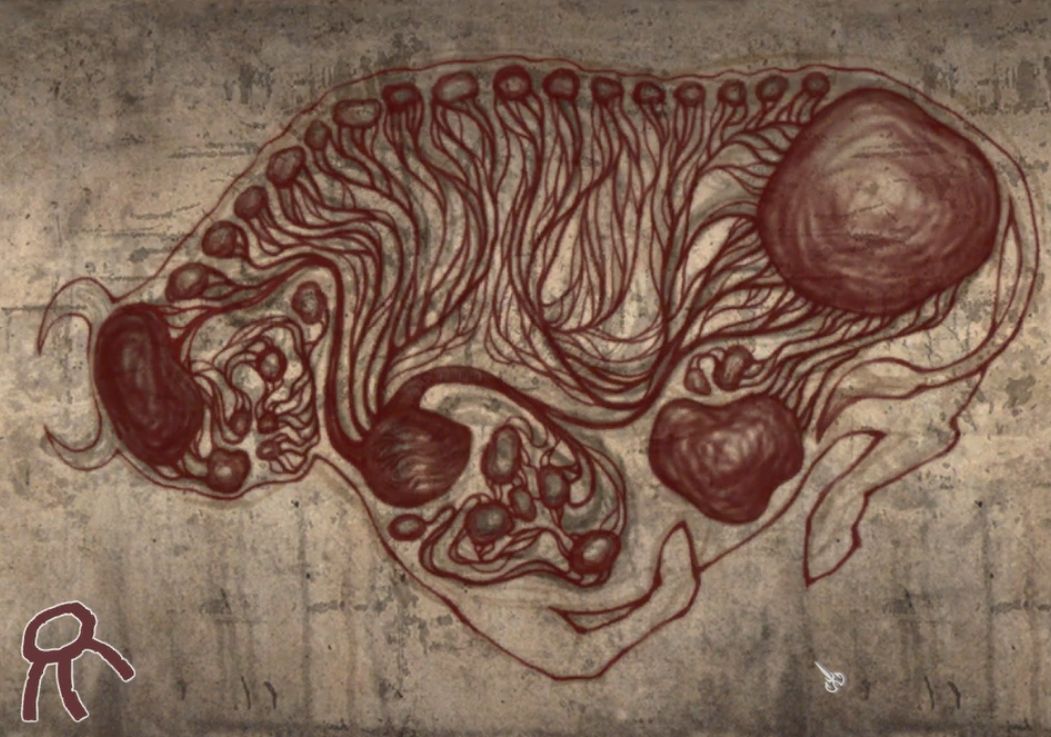
The alternate view of my town map. Notice that the hill on which the town rests
has been revealed to be a bull.
The Life of Fat Vlad

The Inquisitor is pleased with my findings—more than pleased, she seems downright giddy in her fascination with the idea of the udurg—and I settle in for an evening of scrounging for tomorrow's supplies. Funny how the wearying process of scraping together enough cash to meet the 800-dollar price tag on a loaf of bread, so onerous at first, is becoming almost mundane. I guess one gets used to anything after a while.

At around 8 pm, I receive a letter from George Kain containing some unsettling news. Now that the Apiary has been unlocked, its inhabitants have been calling for the head of Fat Vlad Olgimskiy, the man who had locked them up and left them to rot. Fat Vlad, perhaps shaken by the Inquisitor's presence, has decided to surrender himself to the mob. According to George Kain, though, he is not to blame. He's only taking the rap so that his son, Young Vlad—the true mastermind behind the Apiary fiasco—will be spared. Kain tells me that, as the only person with any influence over the butchers of the Apiary, I have a responsibility to go to them and make sure they punish the right guy.

I am at a loss. I've distrusted the elder Olgimskiy from the start, but even I don't think that he deserves whatever horrible fate the denizens of the Apiary have prepared for him. On the other hand, I have no reason to believe that Young Vlad is guilty either, and Kain, as a member of one of the rival families, could have ulterior motives for disposing of the scion of the Olgimskiys. I go to the Inquisitor with the news, telling her to throw the weight of her authority behind an investigation. She callously dismisses my concerns as beneath her and warns me not to tell her how to do her job. I am to handle this "petty" matter on my own.

Not knowing what else to do, I head toward the Apiary on the other side of town, hoping that I'll have an idea of what to do by the time I get there. No such luck. All too quickly, I am standing before Mother Keeper in her torchlit inner sanctum, with her waiting for me to deliver the guilty party into the Order's hands. I have three dialogue options:

1) Fat Vlad is guilty
2) Young Vlad is guilty
3) I refuse to help

I'm afraid to take the third option, which would keep my hands clean but also leave the quest unfulfilled. Failed quests can put my Adherents in danger, and I am also worried about losing whatever favor I've curried with the Order. The quest must be finished. My mouse hovers over Young Vlad's name, but then I remember his helpfulness, his knowledge of the town's secrets, my deep-seated distrust of Fat Vlad, and George Kain's questionable motives. I change my mind and, with a click, condemn Fat Vlad to the butchers' clutches. I feel like a coward.

Before I leave, I ask Mother Keeper exactly what will happen to the man. She replies that the Worms and butchers will take him into a back room that she is forbidden to enter. When they finally leave, Fat Vlad will be gone—vanished without a trace. I feel the hairs on my neck prickle. "Mother, do they eat him?"

The kid looks back at me in the firelight. "I am not allowed to go in that room, Burakh." Her expression does not change.

Wednesday, October 12, 2011

Pathologic: Day Eight, by the end of which the Bachelor will be convinced not to expect anything good from the Earth.

At 7am:

The morning of the eighth day has come.
Infected in the past 24 hours: 249 ppl
Died in the past 24 hours: 391 ppl
Gone missing: 59 ppl
Number of dead at the moment: 3128
Number of infected: 570

Less than five days remain. Tomorrow the sanitary army will arrive.

Today's Map
It’s a fundamental law of physics: Each action demands an equal and opposite reaction.

Ice Pick Lodge labeled this game as a prototype of an epidemic simulator. If I pull back for a moment and assess what has happened—and where I’ve just found myself—I couldn’t be more horrified. I’m controlling a pixeled avatar, a stuck up researcher from the city, whose shoes I have easily filled. If I were to answer to friends for what I’ve said and done in this virtual sphere right now, I’d be ashamed. I’ve killed men in barbaric combat—just to try to understand the primitives of this godforsaken place. I’ve dodged murders, taken down roomfuls of muggers, and lied to everyone in this entire town, in exchange for the numerous lies that have been told to me.

If Ice Pick were to assess my decisions, I’ve failed. I came into this town as a representative of civility and objective truth, and I mucked the whole thing up. Rubin has disappeared. Hundreds are dead in the Cathedral, and my first reaction when I spoke to the townsfolk was relief that all this wouldn’t be blamed on me. Of course, this is human nature. In the end, we’re all meat—heat—desire, and we all want to survive.

I’ll explain the day as quickly as I can.

Black Market of Panacea
The Haruspicus and I have created a panacea, through my research and his alchemy. Several worms, holed up in the now-open Apiary, have begun to produce a false elixir and sell it for an exorbitant sum. When I confront them, they point a finger of blame to Young Vlad Olgimskiy and say he has bought all of the true panacea and is hording it for personal gain. When I visit him, he tells me that yes, this is true: he used the vast funds at his disposal to buy it all up, but only so that he could sell it for (basically) nothing to the women of the town—Lara, Julia and Anna. It seems that he’s had a genuine change of heart.

I hope those large bags are just full of dead cow meat.
Kevin has already written about the Apiary—he took a visit to that harrowing place yesterday—but I’d like to share some impressions. I enter the asylum greeted by the cries of madmen. Butchers and worms run to and fro on strange errands, and massive bags of rotting meat hang from the ceiling. Bodies litter the floors, and there are strange experiments going on in back rooms. This place is filled with the refuse of the human race.

I assume this is a painting of the Apiary--otherwise it's gotta be a communist propaganda poster.
Underground Decay
The panacea is not enough to stave off infection. Yes, it cures the infection completely, yet it’s not enough. The fact is that as long as the source persists, this infection will come back again and again, and eventually spread beyond this microcosm. There’s something—either from the Abattoir, the Polyhedron, the water source—that will continue to fuel the outbreak. There is a dry rot in the infrastructure, and we need to search it out.

The difficulty of each errand today will be exacerbated by the plague: it has truly reached its peak. To enter an infected zone today is almost certain death. Plague clouds materialize all at once, hemming me in, as brown-swathed infected pursue with a reckless abandon, knowing they will die. The remaining arsonists patrol the streets accompanied by knife-wielding maniacs, all of them ready and capable of ending me with one strike.

I investigate the water source first. Young Vlad has filled in the well in his place, rendering any research utterly useless. My only recourse is to investigate the Abattoir: something there is poisoning the ground itself, the Inquisitor is certain. To this end, I ask Taya (the “Mother Keeper” girl in the Apiary) to order open the gates. She tells me she might, but only if Big Vlad offers himself as a sacrifice for his crimes. He was singlehandedly responsible for the shut-in at the Apiary which allowed the asylum to become a breeding ground for the disease and killed hundreds. I’m convinced I still need Big Vlad, however, so the Mother Keeper gives me another task: I need to break into her old house (the same one Lara picked to be a “House of the Living” on Day 2) and recover her favorite rocking horse toy.

That's not soot on my nose. It's Sand Plague.
The mission is difficult; not only do I need to procure a lockpick, but the former “House of the Living” is impossible to navigate, filled to the brim with miasmic plague clouds. Choking, I rush up the stairs, grab the rocking horse and run back to Taya who says she’ll open the Abattoir for my inspection just before midnight tonight.

At half past eleven, I make my way to the Apiary, find the gaping tunnel before me and run through to the Abattoir. After wandering for a bit, I come upon a large room, where half a dozen butchers circle me and proceed to beat me up. In just the nick of time, a wave of soldiers rush in, gun down the barbarians and take me to the town center. On my way there, I’m treated to a cinematic showing lines of soldiers marching in formation—a stern-faced general at their fore. The army has arrived.

This is me about to get lynched.
Aglaja and Young Vlad
From my conversations with these two, I have come to an unsettling conclusion. Simply put, the town must be destroyed.

So much of this town is unnatural. After researching the Polyhedron (the dogheads—the gang of children who live there—came to my house) I have learned several interesting points. First: it is something entirely synthetic. None of the children who live there have been infected. People say it is a place of magical energy, that time is static. Some say it grants eternal youth. Some say that only the youthful can benefit from its strange magic. The Kain family talks of the inner sanctum as a chamber where a spirit can choose its path—this has something to do with Eve’s suicide, attempting to become “part of the Cathedral”. The Cathedral is so close to the Polyhedron—perhaps they are linked.

So yes: the Polyhedron is a miracle, a strange healing instrument of sorts. Yet it is an artificial, unliving thing, and it has paralyzed the earth. I zoomed out from my map today to see the town overlaid with the image of a bull—organs, intestines, spine, everything. And at the tip—the head—is the jagged, pointed, impossible Polyhedron.

I yelped when this came up instead of my map.
This was all steppe at one point—there were wanderers in yurts, moving across the surface of the land, briefly drawing from the resources, then moving on. Like symbiotes, they fed from the land in life, and with their death (and blood) proceeded to feed the land. Yet the town has changed everything. Trains arrived from far away bringing the oafish townsfolk, who built their structures piece by piece, attaching themselves to the land like melanoma.

The Haruspicus experienced the tunnels beneath the town as a sort of ventricle—as blood vessels through an abdomen. There are hundreds more beneath each house, beneath each manhole I pass on each street, all of them burrowed deep with cold, sharp trowels by greedy townsfolk. These aren’t blood vessels: they are carved wounds. We call the disease the Sand Plague because it comes from the earth, when in reality it is not a plague at all. The plague is the antibodies of the earth, and we are all parasites, sucking the life from the ground, poisoning its blood and flesh gradually.

The people of this blighted town are corrupt, squabbling animals, and they are only getting their just payment for the ways they have grossly abused the earth. Even the steppe folk have been corrupted, drawing inward into myopic ramblings of cultish earth gods and goddesses, upholding traditions that no longer have meaning, that will not shield them from the judgment. As I walk through the outskirts of the town, I can occasionally make out the remaining yurts covered in rust-colored scabs. No one is safe. Everyone is judged.

The Inquisitor describes this microcosm as a carefully wound and intricate mechanism, and something is throwing it off. The Polyhedron, with its odd stasis, has wound the clock to a halt, left the earth vulnerable and incapable of repair, while the Abattoir has gummed up the inner workings with whatever the Butchers are dumping into the system.

The Bachelor is a doctor. I am playing the role of surgeon. The true blight here is not the Sand Plague, but the cancerous growth of this town. The most logical recourse is to excise this tumor before it can spread. I don’t know what will make this possible, but I am assured the tools will present themselves in the days to come.

Tuesday, October 11, 2011

Pathologic: Day Seven, a fatal, crucial, and decisive day for the Haruspicus

(or, in which Kevin punches the Sand Plague right in its stupid face)

The morning of the seventh day has come.

Infected in the past 24 hours: 181 people
Died in the past 24 hours: 350 people
Gone missing: 16 people
Number of dead at the moment: 2450 people
Number of infected: 450 people

Even together with the Inquisitor you will not be able to defeat this enemy. Less than six days remain.


Look at those numbers—the death toll has quadrupled from yesterday. It's not exactly an auspicious moment for the government Inquisitor to come calling.

The executors, bowing to the Inquisitor. Not pictured: the town wetting its collective pants.
The Bachelor is worried. As the official leader of the hunt for a cure, he looks really bad now that all our best efforts have failed, and he readies himself for his appointment with the Inquisitor with the funereal air of a condemned man.1

I too am uneasy about the summons that arrives for me. While I know that I have done nothing that warrants execution—a punishment that the Inquisitor freely doles out—I also know that I have enemies in town who would love to put me squarely in her crosshairs. After all, I have been doing things—exacting vigilante justice on looters, consorting with weirdos like Ospina and the Worms, cutting open corpses on the street for their organs—that would look pretty bad when presented in a certain light. Unless I want to take a one-way trip to the gallows, I have to track her down and explain myself before she starts hearing tales. Thus begins a not-so-merry chase around town that takes up the greater part of the day.

The Inquisitor has set up shop in the Cathedral on the town's west side, but she's gone by the time I arrive for our meeting. A cackling executor tells me that she has thrown wide the doors of the Apiary and is there right now, taking note of the horrifying conditions under which Fat Vlad's prisoners have been living. Worried that my association with Vlad in the early days of the epidemic (was that really only a few days ago? it seems like ages) will come back to bite me, I hoof it over there as fast as I can, cursing every delay as plague zones sprawl across my path.


I thought the first section of the Apiary was disturbing, but I'm taken aback by what I find in the main part of the building. The only living Worms I'd seen up to this point were hanging out in the marshes, but there are tons of them in here, quite literally running around. Their frantic dashing back and forth, along with the unhinged, echoing shrieks that occasionally reverberate throughout the building, set me on edge even before I have a chance to explore. When I do, I find that the Apiary is laid out like a maximum-security prison, with multiple levels of cell-like rooms that extend up to the ceiling and are accessible primarily via catwalks. Unlike the rooms in the first section, these cells are not boarded up, probably because they are not occupied by stricken Worms gasping their last breaths into the dusty wooden floor. That does not mean, however, that the rooms are empty:


I also stumble across a larger back room that looks like it was being used for dissection and experiments. Was Stakh Rubin here?


Unfortunately, I've missed the Inquisitor, who has already moved on to the Town Hall to release some unjustly incarcerated citizens. I do however run into the Mother Keeper again, who has parked her adorable five-year-old self in some sort of temple room on the Apiary's third floor. She has resumed her duties as a spiritual leader in the Cult of Bulls, and as further thanks for my help yesterday with the pills, she tells me that I now have permission to enter the Abattoir. I thank her, but it's a privilege that I won't be able to exercise until I catch up with the Inquisitor. I make my way through the throngs of Worms and butchers and step outside into the free air.

Just a reminder: this shrine is presided over by a kindergartner.
By the time I reach the Town Hall, the prisoners have already been freed and the Inquisitor has moved on. It's the same story wherever I go—I'm always one step behind my quarry as she blazes a path through town, righting wrongs and meting out justice. According to George Kain, her zeal is due to the fact that she is facing her own inquisition back at the capital. She's been given one last chance: personally eradicate the epidemic here in town, or else face the hangman when she returns home. She has a very personal stake in what happens here. Interesting—I mentally file that information away before proceeding to the Cathedral, to which the Inquisitor has returned after her sojourn in town.

Our conversation is a little cold at first as we feel each other out; but my knowledge of the Inquisitor's tenuous position has emboldened me, and she seems impressed with my refusal to apologize for my actions. In any case, we both want the same thing (if for different reasons), so there's no sense in her stringing up a potential ally. The Inquisitor is an interesting lady, if a bit abstract in her manner of speaking. She talks a lot about duty and politics and life, which makes for a fascinating if hard-to-follow talk. She seems interested in the town beyond its relevance to her job and is quite knowledgeable about its bull-related nature religion. So knowledgeable, in fact, that she has made a discovery that's eluded the Bachelor and me. The human-bull hybrid (called an "auroch") that we thought a fantasy exists, it's alive, and its blood can be found somewhere in the Abattoir. She sends me to meet with the Elder of the Abattoir, newly returned, to see if I can wrangle some blood out of him.

I've been dying to see the interior of the Abattoir ever since Day 1, so I get over there as fast as I can. To be honest, I was hoping for something a bit more mind-blowing after all the build-up. The part of the Abattoir that I'm able to explore is basically just a gigantic cavern, populated by a mix of butchers and Worms (the latter of which are becoming creepier and creepier by the hour). The town's paltry remaining cattle are penned up inside, their lowing echoing off the dank stone walls. There is one feature of the place that intrigues me, though, and that's a large chamber that looks as if it's used for sacrifices. In the middle of the floor is a seemingly bottomless pit. I wonder what goes into it—or what comes out.

Part of the Abattoir, as viewed from a high platform. It's hard to tell from this shot, but there's a
pit on the right side. I have no idea where it leads.
The Elder of the Abattoir, Oyun, is waiting for me at the end of the system of caverns. It doesn't take long for me to realize that this guy is going to be trouble.

Yes, your neck tendons are very impressive. You can stop flexing now.
Something about the saturnine Oyun doesn't add up. Other members of the Order say that he tried to sacrifice an auroch last night to stop the Plague, but he botched it somehow. The Elder growls that he did everything right but that a couple of Worms sacrificed another bull at the same time and somehow messed everything up. Having been with those Worms last night, though (gathering the blood sample for the Bachelor), I know that this isn't true. Whatever caused Oyun's ritual to fail, it wasn't us. I can't decide whether some greater power was working against him, or he has some secret agenda of his own, or he's just plain incompetent. I file that away, too, and ask for the auroch blood, which Oyun hands over with plenty of dark muttering about how I don't deserve it. He orders me to come back tomorrow so he can test whether I truly am Isidor Burakh's heir. Sure, whatever. I pocket the vial and head for my laboratory.

I have a twyre recipe that I have used only once, to make another disgusting dead porridge and beat back my infection. It involved a few rare herbs, but it also reduced my infection to almost nil. If any recipe should be used with the rare auroch blood, it's that one. I brew it up, add the blood, and press "mix," holding my breath.

A brightly colored flask labeled "panacea" appears in my inventory. I carry it to the Inquisitor, hoping against hope. Evenly, she tells me that, yes, this is indeed the panacea we've been striving for all this time. I've done it. I've found the cure!

... Now what?

1 In Duke's playthrough, as you've read, the Bachelor is on much better terms with the Inquisitor than he is here. Why the difference? I can only speculate that Duke's heroic efforts on Day Five—particularly his costly liberation of the wrongly imprisoned citizens in the Town Hall—actually had a positive effect after all.

Sunday, October 9, 2011

Pathologic: Day Six, by the end of which the Haruspicus will find out how important a role mythic beings can play in our lives

(or, in which hope takes a beating)

The morning of the sixth day has come.

Infected in the past 24 hours: 165 people
Died in the past 24 hours: 110 people
Gone missing: 23 people
Number of dead at the moment: 660 people
Number of infected: 311 people

Less than seven days remain. A governmental emissary will arrive tomorrow.


The Bachelor has bad news for me. Possibly because it came from a butcher instead of from the twyrine bride, the heart that I brought him yesterday failed to produce a vaccine for the Sand Plague. Evidently, the low-level immunity possessed by the steppe natives is more low-level than it is immunity—their blood produces effective antibodies but in such low quantities that eventually the Sand Plague will overwhelm the immune system anyway. Once again, the Bachelor's experiment fails.

We are running out of time. The town is descending into anarchy as the Sand Plague, unchecked by any sort of cure, continues to extend its tendrils throughout the town. Bodies litter the streets as bandits and arsonists clash violently with guard patrols. Every now and then an infected person slips through the quarantine because the guards are too busy fighting off looters. Impatient with the Bachelor's and my fruitless search for a vaccine, regular townsfolk have decided to take matters into their own hands. At a loss to explain the mind-boggling scale of this calamity, they're looking for a scapegoat to blame for the epidemic's onset. It's a good old-fashioned witch hunt, and the witch they've settled on is the mysterious Devotress.

Artemiy Burakh is many things, but a sympathetic listener he is not.
The Devotress hasn't done much to dispel the dark rumors surrounding her presence in town. Children say that they have witnessed her killing a man merely by placing her palms on his eyes and holding them there until he stops struggling. Others whisper that her hands can "turn people's souls inside out," healing or killing them at her whim. The stories of the "bone cannibal" have resurfaced and seem to point to her. The Devotress's response is to say that she is actually two people—the sweet-natured "Klara," and a doppelganger who frightens children and speaks only in sarcastic riddles—which doesn't exactly allay the townsfolk's fears.

Here's the thing though: I believe her. Something fishy indeed seems to be going on; I meet her in two locations over the course of the day, and there's no way she could have been traveling between them without me knowing. The doppelganger is holed up in the graveyard with poor little Laska and informs me that the Apiary (or the first level of it, anyway) is now open to exploration, though she gleefully hints that I may not like what I find: "Absolute hell. You'll see." Meanwhile, Klara is hiding at Anna Angel's house and seems abjectly terrified by her predicament. She says she doesn't even know what she's doing in town. She has no memory of how she got here and feels trapped by the chaos and odd phenomena swirling around her. The Rat Prophet has been appearing to her too, scaring her with ominous pronouncements that she can't understand. If I can get some solid answers out of the Prophet, she says, at least then she can face the angry mob with some certainty about who she really is.

Having been the victim of misguided, rumor-fed hatred myself, I feel for her and agree to help, even though the hatch to the Rat Prophet's underground chamber is still in the middle of a plague zone. Infected areas have only gotten more harrowing; in addition to the increased numbers of contagious victims milling about in the streets, plague clouds are even more prevalent. There's even a new kind of mist accompanying this next stage of the epidemic: brown and fetid, it actually chases me around until either it catches me or I reach a safe haven indoors. It's almost as if the Sand Plague is developing agency.

This seems like a crazy thought until I meet with the Rat Prophet. (It's amazing how open-minded one becomes when one encounters things like a tuxedo-wearing person with a rat's head and a subterranean lair.) According to him, this mess has never been a wholly natural occurrence; if I don't believe him, perhaps I should ask my good friend the Devotress. After all, she's the personification of the Sand Plague itself.

I immediately call him a liar, which he shrugs off with a "believe what you want" attitude. Honestly, I'm not sure what to think. I certainly have no reason to trust him. Then again, unlike the town's conniving nobles, he has no reason to lie. If he is telling the truth, then the townspeople are right to fear the Devotress. As I climb back out of the hatch, I wonder what I will tell Klara. In the meantime, though, she'll have to wait. The Bachelor has another idea.

It's a long shot, he admits, but it's one of the only options left. The experiment with the blood of the steppe people failed, but there are other natives of the steppe: the cattle. The animals have been bearing up quite well throughout this ordeal—none of them have died of the Plague or even contracted it. Maybe the cure will come from them.

The only problem is that almost no cattle remain in the area. Most have already been slaughtered to provide food for the town as it languishes under quarantine. The only people who might have an idea where to find more cows serve in the Order of Bulls and live in the Apiary and the Abattoir. Up to now those areas have been closed to us. However, the imminent arrival of the State Inquisitor has led Fat Vlad to hastily lift his dubious lockdown of the Apiary, and as the trusted heir of Burakh I can now get in and speak with the Order. In fact, one of my Adherents, known as the "Mother Keeper," is a leader in the Order. She can tell me where to find a bull.

The battered door to the first section of the Apiary. Looks like even the guard isn't too happy to be standing in such close proximity.
The Devotress wasn't lying when she said that the interior of the Apiary is hell. Debris and furniture wall off some hallways; other rooms have boards nailed across the doorways. Through the gaps I can see Worms and butchers curled on the floor, silently suffering through their infection. Screams keep echoing from the depths of the building, and they are not screams of pain—they're screams of madness.

My Adherent is waiting for me up four or five flights of stairs. Since all of my Adherents are children, I'm not expecting an adult. But I also was not expecting to see a five-year-old flanked by three bodyguards:

Meet one of the cult's prominent figures, a girl who has not yet learned how to read.
"Mother Keeper" does know of a bull I can use, but she wants me to do a favor for her first. She and her followers want to return to their shrine deep in the bowels of the Apiary, but that part of the building is crawling with the infected. If I really want to test that bull's blood, I have to bring her 50 doses of immunity boosters in the next nine hours. No pills, no bull.

To put that number in perspective, I've accumulated less than 20 of those pills over the past six days. Thankfully, I haven't been popping too many of them thanks to my innate resistance as a steppe native, but I'm still staring at only 13 doses in my inventory when I exit the Apiary. The pharmacies around town stock them, but only in small quantities. Children on the street sometimes have them for trade, but with the infected areas swelling in size, there aren't many children around either. Briefly, I entertain the idea of killing and robbing some guards, who carry large quantities of medicine on them at all times. I quickly quash those thoughts. The crime I committed on Day Two is still a raw spot in my memory. If I'm going to get those pills, I'm going to have to run all over town, check every single shop, and hope.

It takes a sizable chunk out of my funds, but I meet the deadline with only half an hour to spare. "Mother Keeper" blithely tells me to meet the Worms at a hill south of town. They will bring the bull. I will bring whatever optimism I have left that all this scrambling around was worth it.


After exchanging curt greetings with the Worms, I inject the bull with a sample of the Plague, then take a blood sample back to the Bachelor. I wait with bated breath while he examines the sample under his microscope.

Once again, the experiment fails.

The bull's immune system is the exact opposite of what we found with the steppe people. When infected, the bull's body is able to slow the Plague's growth to a crawl. However, without any way to fight off the small amount that remains, the bull will die, same as any other creature.

I had figured that I would be angry, or at least annoyed, that all my energy and sacrifice was for nothing as usual. The most I can muster after hearing the bad news is resignation. I don't think I was honestly expecting good news in the first place. The only option left is to find the blood of some bull-human hybrid that can both retard the Plague's reproduction and kill whatever's left, and, as the Bachelor helpfully points out, no such animal exists. There is no final cure. We're done.

Before going to bed, I troop over to Anna Angel's house to see Klara again. Expectantly, she asks me what the Rat Prophet said. I reply that he said she is not responsible for the epidemic, that she is here to help people. By now I've decided that the Prophet was right, but I lie for two reasons. First, I just don't have the heart to tell Klara that, knowingly or not, she has the blood of the entire town on her hands. Second, I'm afraid of what she might do if she resigns herself to being an angel of death. She can be on our side for the time being. We're going to need all the help we can get.

Friday, October 7, 2011

Pathologic: Day Six, on which the Bachelor will be offered to choose from several different sources of contamination


At 7am:

The morning of the sixth day has come.
Infected in the past 24 hours: 163 ppl.
Died in the past 24 hours: 140 ppl.
Gone missing: 12 ppl.
Number of dead at the moment: 840
Number of infected: 335 ppl.

Less than seven days remain. A governmental emissary will arrive tomorrow.

I stagger out of Lara Ravel’s house at half past five, starving and mildly woozy from the infection to find myself surrounded by the plague. The afflicted leprous figures march about in packs, and patrolling the streets are a new brand of soldier: the Humpback’s men. Unlike the oafish bandits, these fellows sport a seemingly unlimited supply of Molotov Cocktails, which they lob at anyone and everyone from worrying distance. Their purpose, it seems, is simply to rile things up.

One hit is from these is fatal.
These new annoyances, however, are the least of my worries.

Today's Map
Witch Hunt
The first thing I do in the morning is visit Rubin, who should have completed the improved vaccine. Sure enough, he has. (This differs significantly from Kevin’s experience of Day 6, in which the vaccine failed miserably). Yet his conscience weighs heavily upon him. The Haruspicus was aware that Rubin was keeping the body of the first infected, Simon Kain, for inspection and research. What he didn’t know that it was I who told Rubin to hold the body illegally, to keep it under wraps, though we both knew it might come out sooner or later. He confesses to me that he can’t take it anymore: he has to come clean to the Kain family.

I panic, of course. He can’t do that. It would ruin my reputation if it came out that he had kept the body under my instruction. So much rests on that one lie. I tell him to keep it—that I’ll handle it—that he has to stay and continue his research. He reluctantly agrees, though he holds onto the vaccine.

The consequences of my decisions are at hand. I get several letters and hear whispers from the townsfolk. The Inquisitor is coming tomorrow. But, more upsetting, there has been an incident in the Cathedral.

I arrive early morning to find the Cathedral utterly dead—nearly 800 people wiped out by the Sand Plague. Something got in. To my relief, however, the finger of blame isn’t pointed at me, but to the leading women of the town. The shabnak—the she-cannibal—was accused of breaking in and giving the people infected water to drink. Hours later, streams of infected flooded the streets while a few were left to clean up the remains in the Cathedral.

They did a good job cleaning up.
Saburov outlines the plan: I will interrogate the women of the town and decide who is the vector. Of course I know better; all I have to do is draw their blood and examine it for traces of the virus. It takes a bit of convincing, but I take a sample from Anna Angel, who tells me Klara (the Devotress) is also a prime suspect.

The real gem here is Ospina, who practically spits venom when I whip out the syringe. She does her best to advise me in the “proper way” of finding the shabnak. I’ve transcribed the entire conversation here (with a few minor adjustments for clarity):

ME: Ospina, you are accused of being a cannibal. They will come for you soon.
OSPINA: What is a shabnak? It is a malicious spirit who wears the flesh of a woman on his bones. Shabnak can be known by a characteristic attribute – his hands are long, all toes are of the same length, and the teeth are shown on all body from under the skin
ME: Thanks for the lesson.
OSPINA: That’s it … I am always glad to help you. If you want I’ll help you catch the monster. If you do not cope with that yourself … almost a week has passed and the people still perish, perish, perish …
ME: Help me. Where do I start? Perhaps from the survey of suspected?
OSPINA: Yes. You gather all women who cause your anxiety in the Cathedral, for now it is empty. Build a bonfire at the entrance. Order them to strip naked and survey them carefully … Search for sharp edges under the skin, but you will not find. And then …
ME: I have a more reliable way. Let’s look at your blood.
OSPINA: It is not necessary to take blood. Search for the teeth. Let me continue … sooner or later one of them will break and rush away crying – right into the fire. And then her essence will become visible! She will turn all black, howl, crook her fingers – everyone will realize at once that this is not human.
ME: Of course. And now stand still. I have a few needles; don’t worry.

Ospina
After taking her sample, I find Klara at the Saburov Manor. She won’t allow me to take her blood; she considers herself above reproach. And then an extraordinary claim: she says that she and the Devotress are two different people, though the Devotress looks just like her. She tells me that, with all my science and system, I have no right to investigate her. I appeal to Saburov, who has effectively adopted the little whelp, who tells me I can draw her blood, but when I return she has disappeared.

I rush around town, furious, asking everyone for information. I track down Mishka, a young boy living out in the train yard, and he tells me I’m a hunted man. That the Devotress—who is undoubtedly the shabnak—is searching for me with murderous intent.

The Thing Coming From the Steppe
I scour the rest of the town and receive a tip from Spichka, a young boy holed up in the Tanner’s District. He saw the Bone Cannibal just now, rounding the Abattoir. If I hurry, I may catch it. Heart pounding, I draw my revolver and prepare to finish this once and for all. A true vector! The real, tangible foe in all of this—a discernible victory. With the shabnak gone, it will be only a matter of time till the virus dies out.

Rounding the Abattoir, I see it: a hunched, gangly figure with a white face and long neck. Hardly a thing that could pass for the Devotress. As I step toward it, the air thickens and I begin to choke. I aim my pistol at its (admittedly small) head, fire two shots, and watch as the thing goes limp.

Shabnak or Animated Totem?
Upon closer inspection, I can’t say this is any sort of shabnak. I don’t know what it is—some kind of clay golem, animated by the weird cultic rituals of these steppe barbarians. It was just an illusion.

I find Klara mourning his corpse when I return. Stricken with grief, she holds out her arm and lets me take a sample, which I immediately rush to the microscope. The blood is irregular, strange indeed, but there is no sign of the Plague. I return to her and give my analysis. Yet, knowing that the Inquisitor will come tomorrow, and that she will want blood, Klara says she’ll offer herself as a sacrifice. She’s somehow responsible, she says—and they will need someone to blame anyway.

I resist—she cannot do this. It isn’t right. She is an inexplicable anomaly, there’s no doubt about that, but she is no vector. It’s true: she’d be an easy solution. She’d placate the Inquisitor. It would be an easy solution. But it wouldn’t be right. I tell her the decision is her own, though I don’t think she should turn herself in.

They Want to Burn the Apiary
My final task for the day is a seemingly impossible gambit. The humpback, with his league of arsonists, wants to deliver a deathblow to the Olgimskiy family: he’s going to burn down the Apiary, a nexus of disease that has produced wave after wave of infected (or so they say). While I could care less for the Olgimskiys, the Apiary will be indispensible to my research. They can’t burn it down. The only thing for me to do, then, is to kill the humpback.

It’s late evening when I arrive, and raining. I approach the main entrance to see the Humpback near the tunnel, four arsonists arrayed around him, Molotov cocktails at the ready. I check my revolver: I’ve only got four bullets. Whatever. I rush the first two, a headshot each, then whirl to the next, take him and his companion out, then stand, facing the Humpback. He’s got an alarmingly good throwing arm. I pocket the gun, bare my fists, and approach him, strafing left and right, trying to get in a good punch. The close range is too much, however, and he’s too good a shot. I go down once, twice, three times, until, frustrated, I rush out to the streets to trade a needle for a bullet. When I come back I find him there, standing crooked with that dull cow-eye look. Fearless, I run up to him, gun at the ready, and take him out with a decisive shot.

The entrance to the Apiary, sans two psychopathic arsonists.
Finally, a true victory. I’m not worried about the Inquisitor tomorrow. I think we’ll get along just fine; if anything she ought to admire my work.

Wednesday, September 14, 2011

Pathologic: Day Three, on which the Bachelor will be offered to proceed in hunting the imperceptible enemy and assess necrosis possibilities

At 7am:


Infected in the past 24 hours: 34 ppl.

Died in the past 24 hours: 31 ppl.

Gone missing: 11 ppl.
Number of dead at the moment: 93
Number of infected: 48 ppl

Less than ten days remain.

They say that in its early stages the plague is manageable. Incrementally, the little bar in the top right hand corner slowly climbs whether I’m asleep or awake. They say that once the plague has established itself (around the halfway mark) it rockets, floods the immune system, and death is imminent. Naturally, I keep my pills well stocked. Like everything, however, there’s a trade-off. I can’t just pop pills whenever I feel like it; each boost to my immune system shaves off a bit of my overall health, which means I have to scour the pharmacies for tourniquets.

Simon’s Body

Rubin (poser-magician-doctor) has fled his house, now overrun with plague, and the body of Simon Kain, which has started this whole mess, has also disappeared.

The Apiary 
The Olgimskiys and Kains are in a tussle over the Apiary and the Polyhedron—two massive structures at opposite ends of the town. George Kain worries that the looming white asylum has become a breeding ground for disease, while Olkimskiy says the same thing about the spindly, impossible spiral that is the Polyhedron. I am charged to quiet these fears by taking a visit to the very top of the Polyhedron, which is home to the Dogheads. (I gotta say they’re not as terrifying as Quintin makes them out to be in his review).


I didn't think I was that heavy.
The leader of the Dogheads, a kid named Khan, the oldest son of Victor Kain, meets me at the top of the Polyhedron and assures me that nobody has been infected, that he runs a tight ship. When I insist on inspecting the premises, he refuses, and I’m promptly kicked out.


The Polyhedron really is quite impressive.
This thing makes no sense.
It's strange--it almost looks like a giant bug. See the stinger? 
Strange markings on each floor.
Once things are squared between Kain and Olgimskiy, and both are assured that the Polyhedron and Apiary are safe, Olgimskiy’s son Young Vlad is willing to share what he knows: a few Butchers have been sighted in the Knots and have holed up in a house. When I arrive, it’s obvious the body is not Simon’s, though the Butchers are happy to see me. They rush at me, knives in hand. Two headshots later, I’m on my way back to a disappointed Victor Kain.

Just after speaking to Victor, I receive a letter from Rubin. He’s got Simon Burakh’s body in a warehouse downtown, and needs me to track down some infected tissue.

Imperceptible Enemy

Only the Haruspicus is allowed to dissect bodies, despite the fact that I am a learned physician. Yet I need the infected tissue, which means I need help from the Butchers of the Cult of Bulls. I spend several hours passing between the squabbling nobles who, again, each want something. Creepy-as-hell death child Ospina won’t tell me where the butchers are unless Olgimskiy stops pursuing the butchers. Olgimskiy twists my arm to get Artemiy Burakh (the Haruspicus) off the hook. Et Cetera.

I find myself lying to the nobles. Saburov, who would waste Simon Burakh’s body, wants to know where it is, and of course I lie. Only Rubin and I can identify the Plague. Yet, as the one charged with fighting the virus, these men are looking to me for guidance, as the only pure, objective outsider in the town. And yes, I lie, twice, three times. There’ll be hell to pay if anyone ever finds out. I guess I’m not quite the goodie two shoes I thought I was.


Today's map: the red section is the infected district.
After wading through internal politics, I find the information I seek. There are three likely houses in the Tanners District—in the Northeast corner of town—where the butchers could be.

Plague Bouncer: Worst. Job. Ever.
It’s on my way to the houses that the changes in the town today become abundantly clear. I see an unfamiliar sight as I approach the Tanner’s district: A large shrouded human-shaped cross of wood, draped with dirty brown rags. At the entrance are several mustachioed honchos who tell me the area ahead is rife with plague, that I should stay clear. With my privileges as Bachelor, I tell them it’s on my authority. They tell me that above all, I cannot shoot the infected. They are "taken by the devil", and have their own lot to die already. The guards will kill me if I harm any of the infected.

“Sure whatever,” I think.

Beyond the guards are hunched figures covered in dirty brown shrouds. Piles of bloody and infected clothing litter the ground; the sound of coughing and sobbing women fills the air. Disconcerted, I check my map. The butchers are situated squarely in the middle of the dead zone.


I did not enjoy taking this screenshot.
It’s unsettling. Miasmic clouds float across the landscape, full of plague, which are easy enough to avoid. A few large rats waddle through the filth; I fire my gun into the air when they approach, which sends them running. The real horrors are the wandering plague-ridden citizens, who reach out to me as soon as they see my medical bag. They’re beyond saving, but so desperate for healing that they force themselves upon me, coughing. My immunities suffer, and the little disease bar in the corner raises ever so slightly.


"Peek-a-boo!"
Two of the bodies have been taken back by their families. The third and final body has been removed to the cemetery in the south. I arrive at the scene to find the body guarded by several men, who demand an exorbitant ransom. Naturally, I say “hell no” to that, and am immediately attacked by the guards.

For some inexplicable reason, I find myself suddenly transported to Alexander Saburov’s home, where he tells me he’ll make an exception, and that I can get to the body when the guards change, before 10pm tonight. It’s already 9:12, and the cemetery is all the way across town. Heart-pounding, I make my way through the plague-ridden streets, arrive at the cemetery just before the shift change, and find my sample of blood.

I present the blood to Rubin in his super-secret lair, then whip out my microscope.

What I discover is crucial. The invincible plague has a single weakness: it cannot linger in dead tissue, and is not fully airborne (despite what the plague clouds might have led me to believe—this is an inconsistency I cannot fully reconcile). The point is that it cannot stay in one place. By tomorrow morning, the disease in the Tanners District will have run its course, and the plague could very well disappear altogether if properly quarantined.

The Bachelor's optimism is feigned, of course. He wouldn’t want the threat to end too soon. He needs a worthy adversary. This is a war and He has been appointed general and savior--the only strategist, in charge of keeping the town a step ahead. After all, in the end it’s only a game.


(Note: Due to formatting issues, the screenshots don't display as nice as they used to. By all means, click on the pics to see the weirdness up close.)