Showing posts with label Inner Chamber. Show all posts

Thursday, December 1, 2011

Pathologic: Day Twelve—Endgame (Part 1)

(or, in which the game shows Kevin what a REAL existential crisis looks like)

The morning of the twelfth day has come.

Infected in the past 24 hours: 337 people
Died in the past 24 hours: 635 people
Gone missing: 133 people
Number of dead at the moment: 7620 people
Number of infected: 535 people

This day is the last. Less than fourteen hours remain to make a worthy decision.


I have no idea what to expect when the game clock ticks over to midnight on Day 12. I've been getting letters from General Blok and the Inquisitor, who both tell me that I will be responsible for deciding the town's fate by the end of the day. All the backbiting and power plays and lying have resulted in a stalemate, and it's up to me to break it before the Sand Plague surges permanently out of control. The final council convenes at 7 pm in the Cathedral. By then I will have to have sorted out what, if anything, needs to be destroyed to save the town.

Until yesterday, this would have been an easy choice for me. But after hearing that my father was involved with the work on the Polyhedron and after discussing it with Duke, I'm no longer quite so sure that Petr Stamatin's architectural marvel is the root cause of the epidemic. I'm simultaneously eager and apprehensive about what will happen before this evening: eager because I'm finally going to get some answers, apprehensive because I don't know what ordeals await me before then.

Nothing could have surprised me more than what I see when I finally set foot outside my door in the morning.


The streets are utterly, eerily deserted. No children, no thugs, no infected—even the soldiers have vanished, with the exception of a couple of sentries who have inexplicably remained at their posts. I wander around for an hour, searching for any sign of life, but the only sound I hear is my own footsteps on the cobblestones. Even the Sand Plague is mysteriously absent. What's going on? When I talk to the Bachelor about it, he reacts almost with a shrug. He plans to tell General Blok to destroy the town. Don't you care that that will kill everyone? I ask. "Look around you!" he counters. "Everyone is already dead. The two of us is all that's left."

That's not entirely true, of course—there is the matter of the still-living Adherents, mine and the Bachelor's and the Devotress's. It seems that now is the time to cure everyone I can with the panacea I've been hoarding. I visit all 18 Adherents, curing the six who had fallen ill in the last few days. When I've finished, I have one flask of panacea remaining, and I finally allow myself the luxury of drinking it and purging the Plague from my body. After over a week of worrying and slowly hemorrhaging blood, I can hardly believe the sight of a completely empty infection meter.

This final journey through the town also affords me the chance to speak one last time with my Adherents. It's a goodbye of sorts. Whatever happens tonight, I probably won't see them again, and the eleven days I've spent helping them and worrying about them has forged a bond between us. I'm not exaggerating when I say that I'll kind of miss them when this is all over. They're already preparing themselves for the future. With Kapella coming into her powers as a seer, she's told them what their lives will be like if the town survives today, and they're eager to share this information with me. Notkin will manage the warehouses and forage for supplies out in the steppe. Spichka will grow up to be a savvy leader and merchant. Mother Keeper will act as my right hand among the butchers of the Order. And poor damp Mishka says she will move out of her cramped railcar and blossom into a tall, raven-haired beauty. As I move from one child to another, hearing their hopeful stories, I'm touched. Surrounded as they are by the relentless despair of the rest of the game, these moments are startlingly, charmingly bittersweet.

Of course, this being Pathologic, nothing goes untempered by hints of darkness. Khan and Notkin persist in their feud and are already plotting intrigues against each other. Spichka sees this and plans on using their conflict to his own advantage. Mother Keeper says that part of her role as my right hand will be keeping the nobles-to-be from tearing each other apart. If I choose to destroy the Polyhedron and save the town, the children will raise civilization from the ashes, but it won't take much for them to return to the backstabbing ways of their forebears. In this place, nothing ever truly heals.

The exact spot in the trainyard where I woke up bleeding twelve days ago. I've come a long way since then, but some places look the same as they ever did.
After I finish with my Adherents, I don't know what to do other than wait for the meeting at the Cathedral to start. Then at 6 pm I receive a mysterious letter from "the Authorities" summoning me to the Inner Sanctum of the Polyhedron. Eager to see the interior of this building for the first time in the game (and find out who "the Authorities" are), I rush inside and am greeted with the same amazing sights that Duke saw on Day Nine: warm colors, strange decorations, vertiginous stairways. I descend to the very bottom, with crowds of children silently watching me. I step onto a complex design etched into the floor. Abruptly, I am transported to a courtyard in the middle of a featureless void, lit only by a single lamppost. Two children stand beside a sandbox, staring at me. I strike up a conversation with the boy, and that's when the bottom falls out of reality.

Note the subtle change in scale: These "children" are as big as I am.
All of this—the Sand Plague, the slaughter, people dying agonizing deaths in blood-spattered houses—has been nothing more than a children's game, two kids playing with dolls in a sandbox. The boy is amazed to see me standing before him, for of course the Haruspicus also was a doll, a prop moved from place to place within the model town. "You came to life!" the boy exclaims. "You have been doing whatever you want lately. It's impossible! You are spoiling the game!"

I read the words with a dizzy feeling. Is that all this was? All the things I was forced to do to stay alive, all the dark places I had to visit, all the random catastrophes that occurred day after day—it was just a charade, pointless. To these kids, they were just ripping the wings off flies and smashing sandcastles for kicks, but down there in their creation, people scrambled for salvation. And I have only been their tool, playing the part they wanted me to play. I open my journal to find a new entry scrawled there:
It seems that all this time he had been thinking that he was a living man, saving living people. That feeling, without doubt, added to his aspiration, helped him reach the endgame and even triumph.


In vain, all this is in vain ... He is a puppet, saving dolls in a drawn town.
Everything I've done, then, has been meaningless. I feel like a door has softly clicked shut behind me, stranding me in a dark room. (Duke, who was sitting near me at the time, can tell you that I kept saying "No. Oh, no" over and over.) My struggles to save the town only felt real because of the magic of the Polyhedron, which the boy tells me "brings things to life." "We only made the town," he says, "but it became a wonder all by itself. We put the dolls we didn't care for in it ... They were handicapped anyway."

"I'm not a doll. I am a human being!" I reply. It seems to be less a protest than a futile whimper.

The girl beside the boy agrees with him. "You were never loved, really. You have always been a scary doll, and playing with you wasn't much fun."

Not to be overly dramatic, but I imagine that this is what losing my faith might feel like: God is capricious and sadistic, and he doesn't give a shit about you. I turn to leave the courtyard.


Outside the Polyhedron, I am surprised to find that I feel defiant rather than listless or hopeless. When I receive a letter from "the Developers" calling me to the Theater, I immediately march off in that direction, passing the Cathedral, where the council is beginning. I don't know what awaits me at the Theater, but I'm already steeling myself against it. I still have a decision to make, and I am going to make it even if it does mean nothing.

I am surprised yet again. Inside the Theater, an Executor and a Tragedian are waiting for me. When I speak to the Tragedian, his tone is sad. We have the following exchange, in which I experience one of the most electrifying moments I've ever had as a gamer.

Tragedian: You see how sad our fate is. We are poor actors, who hoped you'd be the director of a new pantomime, because the old one is so boring. But you turned out to be a doll ...
Haruspicus: But I am not a doll.
Tragedian: Did I hear correctly? Who is speaking?
Haruspicus: It's me—the player.

The conversation that changes everything.
Up till now I was merely playing through the Haruspicus, pretending to be him, having my in-game avatar do and say the same things that I would do and say if I were there. In one swift movement, that slight remove is swept away. It is now I, the player, Kevin, who is talking to characters and deciding the town's fate. People talk about breaking the fourth wall, but even that is passive for the audience—they are still observers only. What if, instead of merely addressing the audience at the end of a play, an actor pulled a spectator on stage and he became the play's main character? It's no coincidence that I'm having this conversation inside a theater.

The Executor, meanwhile, speaks to me of free will. It all comes down to choices, he says. Why are you here? To stop the evil of the Sand Plague from spreading, I answer. But was the Plague the real enemy? "It's just as much a weapon for evil as a scalpel is for you," the Executor says. "The disease will leave, it'll devour itself. War will come instead, famine will come after war, heresy will come after famine." It's impossible to truly save the town from anything. The true evil is apathy, resignation to fate. I may be a plaything of the Authorities, but I am no slave. The Executor tells me that it's the difference between predestination and prophecy. Predestined, I have no choice in the matter; I move and speak the way I must. When I fulfill a prophecy, I have absolute freedom. I simply choose to walk along the road that has been laid before me. My path to the Cathedral for my judgment has already been set by the Authorities, but I, the player, Kevin, am the one who will enter and decide.

Clicking through the conversation, I feel thrilled, liberated in a way. Yes, I am responsible for him [the Haruspicus], I say. I will stay with him till the end. His words shall be my words. His deeds shall be my deeds.

While my meeting with the Authorities made me feel abandoned and powerless, my meeting with the Developers has filled me with a grim sense of purpose. I walk back to the Cathedral, noticing that the clouds have finally lifted and the sun is shining. Without the Plague-scarred buildings and the ever-present brown haze in the air, the town is startlingly pretty. For the first time in the game, it looks like a place that might be worth saving.


At the Cathedral, I tell another Executor guarding the doors to let me in. The Executor stands aside. "Enter, Haruspicus," he says. "The meeting awaits your decision. The Queens have paralyzed each other. A tragic stalemate is threatening the game at the moment. You are a pawn that's become a queen. Finish it, it is endgame!"

Wednesday, October 19, 2011

Pathologic: Day Nine, on which the town is being occupied and the kids ask the Bachelor for help for the first time

At 7am:

The morning of the ninth day has come.
Infected in the past 24 hours: 352 ppl.
Died in the past 24 hours: 479 ppl.
Gone missing: 37 ppl.
Number of dead at the moment: 4311
Number of infected: 503 ppl.

The town is dying. Less than four days remain.

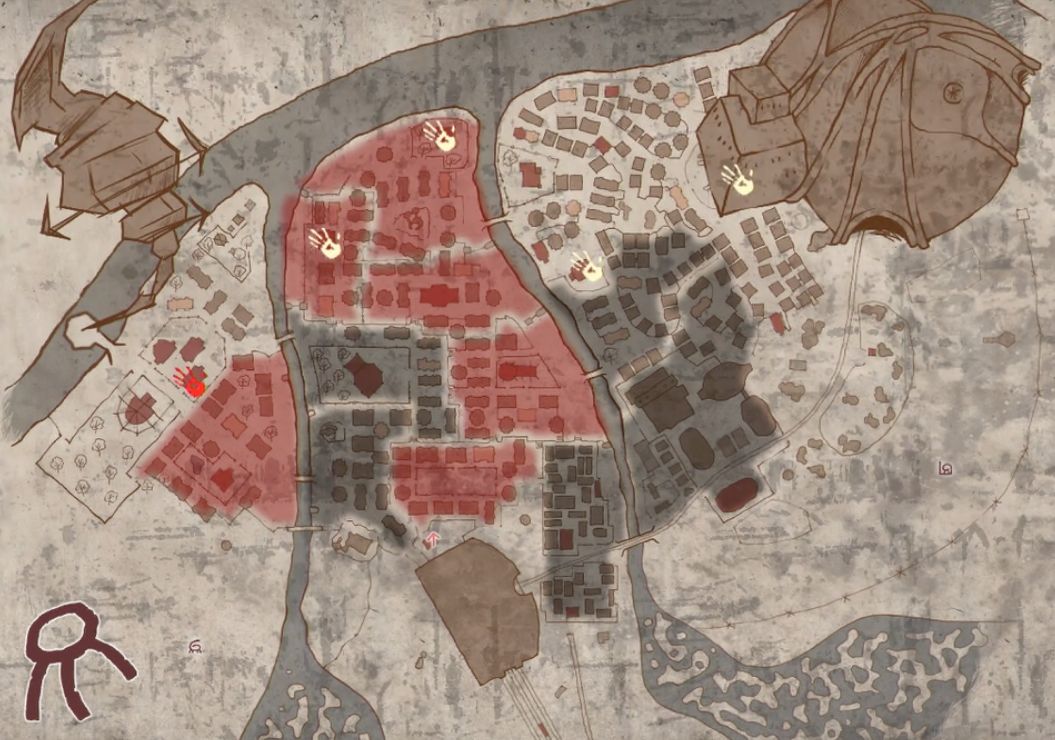
Today's Map - Note the infection is EVERYWHERE I HAVE TO WALK
I find myself safe in General Blok’s office. It’s already 2pm, I’ve gotten no sleep, and I somehow have five individual letters to answer.

When was there ever enough sun to have actual shadows?
While I’m relieved the General saved my life, his presence is unsettling. Rather than the old guards, we’ve got soldiers with rifles, and gas-masked juggernauts wielding massive flamethrowers. The General is paranoid of the Inquisitor—he thinks she’s manipulating everyone—and he wants to know I’m on his side. Of course, I’m on everybody’s side. And nobody’s side. This town is beyond “saving”. Victory is just a concept. Everyone is going to die, including me. Catherina Saburov, lying sick in her manor, foretold my death the moment I met her. Of course, I’m playing the pessimist.

Three Parks
The three leading ladies of the town are worried. Lara Ravel (“House of the Living” girl) wants a pistol for “self defense”. I go to Julia and she tells me Lara wants to kill the General; she’s convinced the military will overrun the town. Julia doesn’t want to see Lara kill the General (she’s got no chance anyway), so she offers herself up in exchange. I lie to General Blok that Julia is planning on killing him (at her request), so he puts her under house arrest.

Before I report back to Julia, I head to Anna Angel’s house—she tells me cryptically to give a small gun to Lara. I pocket the gun, head to Julia’s house to find five angry soldiers all hell-bent on killing me. I gun each one down (for some reason they decide not to open fire with their rifles) and take three fresh military grade rifles and rations from their corpses, then go inside and collect my reward from Julia: one of the precious few panaceas given out by Young Vlad. I head to Lara’s house, give her the gun (there’s no way she will kill the general), collect a second, then a third panacea from Anna. Mission accomplished.

I imagine something will go wrong, but it’s not my problem. If the general dies, my life is much less complicated. And Anna is ripe for blame, after all she’s done in the past. I’m covered.

Executors
The guards and exterminators are ruthless in their efficiency—if anything plagued moves past them, they turn the torch to it. And if my infection is past a quarter length, I become a target as well. I can’t properly relate exactly how frustrating getting around the town is, especially because the plague is mostly situated in the center, near General Blok.

These guys should have gotten here a long time ago.
In the past two days, executors have begun to appear outside the houses of different townsfolk. None of them are my adherents; I’ve kept in step with all the quests so far. These are the adherents of the Haruspicus and the Devotress. I’ve gotten passive aggressive notes from both of them asking me to take care of their list of adherents, though keeping track of every sick townsperson is out of the question. I simply don’t have time.

I feel as though I am fighting for my survival every moment of the day. I eat coffee beans to stave off exhaustion which depletes my health meter. And then, because my health is so low, I can't destroy my infection or strengthen my immunity, because taking pills shaves off a significant portion of my health. So, while running every errand, I have to do whatever I can to keep infection down, health up, all the while avoiding plague clouds and flamethrower-toting soldiers.

The Clot, Fat Vlad's manor, is locked up. It seems that, burdened with the weight of his guilt, he tossed himself to the angry masses in the Apiary. The executor taunts me, tells me I could have prevented it, then laughs in my face.

But what does it matter? He was a corrupt, fat old man. And, more importantly, he wasn’t my Adherent.

Miracle of Children
Victor Kain tells me his family will die from the plague after all this is over. He needs someone to preserve his legacy. That person will be Maria Kain. So much of this depends on the Polyhedron, though. So I climb the impossible steps and find Khan Kain, Victor’s son, down the Agate Hole. I need to investigate the Polyhedron, I tell him; I need to find out what’s really going on, and why everyone is so focused on the seemingly miraculous potential of this structure.

Tweens don't need codpieces. Just saying.
He says he’ll let me in, but I have to get him guns. He needs to be able to intimidate the General’s men. There are over a thousand children inside; all they will need to do is fire a few shots and scare them off. Of course, his entire idea is ridiculous. General Blok purportedly destroyed an entire fortress with minimal losses. There’s no way a tower of children could stop him.

However, I indulge him. I tramp back to Blok’s outpost, ask for a rifle, then give Khan the three soldiers’ rifles from earlier, my own, and Blok’s. Khan lets me inside the inner room.


I feel like I’m in a dream. The interior is gorgeous—rich velvet and light, and all the impossible stairs, writing all around. There are paper cranes hanging from the ceiling, stairways that lead to nothing: it’s fascinating. There are children, too, but nowhere near the thousand of which Khan spoke.

So if this whole place is made of paper, like they say, it's kinda like a huge origami, isn't it?
A few more things begin to make sense. Khan tells me the interior is a place of dreams. He talks about rooms of mirrors—and when I tell him I didn’t see any of this, that all I saw was stairs and walls, he scoffs. I’m too old to understand or to see, he says. When the kids grow up, they stop seeing it too.

Speculation
As I said earlier, there was talk of the Polyhedron being a place of eternal youth. There was talk of the Kains’ “Inner Chamber”—in fact, it was in this Inner Chamber where Simon Kain was found at the beginning, infected with the Sand Plague. Is it possible that the Polyhedron, an anaesthetized and cold needle of a structure, could have injected the Sand Plague into the town, much like a syringe?


After discussing a few things with Kevin, I’ve learned that there are actually aged midgets wandering around town; in fact, one of his first quests was to kill a midget out on the steppe. According to the Dualsouls, these “midgets” are actually rejects from the Dogheads in the Polyhedron. With all the talk about eternal youth, and the sort of static atmosphere provided within the Polyhedron, is it possible that the children of the structure are actually older than they appear? That, if they leave the Polyhedron for long enough, they age rapidly?

There is one other facet: Khan. My impression of him (which has been conveyed by others as well) is that he is a child beyond his years. He looks like a young teenager, but he speaks as a grown man. The Kains have been very secretive throughout all of this. A few whispered hints of “reincarnation” and “rebirth”. Do they hope to be reborn in the innermost chamber of the Polyhedron?

And all of this becomes much more dire when I consider the town: in order to give dreams, perhaps youth, the Polyhedron needs fuel. Where does this energy come from? And more importantly, how can I harness it? 

Sunday, October 9, 2011

Pathologic: Day Seven, on which the Bachelor will be able to reveal the truth and obtain a priceless ally

At 7am:

The morning of the seventh day has come.
Infected in the past 24 hours: 209 ppl.
Died in the past 24 hours: 342 ppl.
Gone missing: 19 ppl.
Number of dead at the moment: 2394
Number of infected: 437 ppl.

Even together with the Inquisitor you will not defeat this enemy. Less than six days remain.

Today's Map
As soon as I step out of Eve Yahn’s house a cinematic plays. It’s the Inquisitor—a slim, severe woman—ordering executions, followed by an image of the gallows. At this, I start to worry a bit. I have nothing to show for yesterday—no culpable source for the disease. I can only hope she’ll understand.

Tough . . . love?
Also, today is the day when everyone starts calling me oinon. I did a double-take at first; I thought they were calling me onion.

Truth, Lies, and Some More In Between
Not only is the Inquisitor understanding: she’s an admirer of my research. Three years ago, we met at an exhibition in which I resurrected dead tissue. Aglaja is confident in my abilities; moreover, she says I’ve been manipulated. “They” have sent me here on false pretenses in an effort to destroy my work and me. I can only assume she means the higher authorities, academia—all of them jealous of my brilliance. How convenient it was, she tells me, that the town’s sole medic would die on the first day (an almost negligible detail to me on Day 1). I was set up to fail in my fight against this enemy from the very beginning.

Don't let the cowering lackeys or blood-red throne confuse you: she's a teddy bear.
There have been three spectators in town disguised as Executors. They have been feeding rumors of the Shabnak, false information to the masses that has spread faster than the plague. I have to find them and collect their ledgers for Aglaja. This is not terribly difficult to do—each is situated in the heart of the three main districts.

One of the spectators has something interesting to say. He tells me not to trust the Inquisitor; she would like nothing more than to burn this town to the ground. She's wanted, convicted, and this is her last act as Inquisitor, and she would like nothing more than to bring ruin and shame to the higher powers. I take note of this as I grab his ledger.

Eve is Gone
As I scurry around town, I receive a disturbing note from Eve Yahn (my landlady-with-benefits). She says she can’t take any more of this—that she needs a sign of a miracle. Minutes later, I receive a letter from the Devotress blaming me for my mistakes; Eve has jumped from the highest parapet of the Cathedral, expecting to be saved by some miracle.

Andrey Stamatin, who owns the pub in the eastern district (which I frequent for coffee and roses) has some woes. I find from his entourage that he has gone to the swamps in search of Eve; he doesn’t know she’s died. Instead he’s gotten it into his head that the smooth-headed Worms have stolen her to become a “Bride of the Worms”—perhaps for sacrifice or something worse.

Cursing under my breath, I tramp down to the swamps. It’s not to far a detour on my way back to the Inquisitor. I arrive at a rust-red yurt to find a large posse of high-cheekboned butchers and worms, all of them thirsty for blood. After several failed engagements, I adopt a stealthier approach, draw my adversaries out to the swamp to wander after me, and rush to the yurt to speak to Andrei, who has discovered the horrible truth. Yes, Eve has died. There’s no getting her back, no hoax, no trickery. If I want comfort from now on, I’ll need to visit the tavern.

We should seriously check into whether or not this game has ever induced Seasonal-Affective Disorder. 
Andrey says one rather unsettling thing before we part ways. He tells me Eve jumped because she wanted to become “The Soul of the Cathedral”. Something about an Inner Chamber. I’m reminded of the Kain family’s talk of the “Inner Chamber” in which the late Simon Kain, the first diseased, died on Day 1 and 2 (another seemingly unimportant detail to me back then). At this point, however, I still don’t understand.

Truth, Lies, etc. (continued)
The Inquisitor is frustrated with the ledgers I collected. They are false. The numbers have been stacked; the information collected is off, somehow, though we don’t know which of the three is wrong. She tells me that I must arrest one of the three spectators. One tells the truth, one always lies, and the other one vacillates between the two. Right, Wrong, Neutral. I can’t help but think, as she sends me to discern which is which, that I’m being put through an elaborate test. She wants to see how trustworthy I am.

She said he did it of his own free will but . . . uh . . .
Look carefully at the hollow--there's a strange face etched into the roof of the Cathedral.
The details of the rest are inconsequential, of course. I find the traitor, take him back to the Inquisitor, and she orders him to jump from the top balustrade of the Cathedral to his death. She tells me afterwards that I made the right decision, and she’ll have more for me to do tomorrow.

A new "map"?
When I’ve finished, I look at my map to see a second drawing on the back. It’s the town from the side—a large, awkward hump on a hill. I don’t understand the meaning at all. The etchings at the bottom are like traced veins. I’m certain this will make more sense in the days to come.

Mask & Overall
I receive a letter from the Haruspicus asking for an executor’s mask and suit and spend much of the rest of the afternoon scouring the town and countryside for something, but nothing turns up. I must have missed something earlier. However, my wandering turns up two interesting things.

The culture of this place disgusts me. The townsfolk built their awkward little houses, now brimming with plague, when they ought to have stayed in their yurts. As I head north through the Tanner’s District, I come upon a Worm standing outside an empty pen. Curious, I ask him what he’s doing. He tells me the earth needs blood, and that by performing a special ritual we can nourish it. I want to know more, and he hints that I might be able to participate. I accept, and moments later I find myself hemmed in the pen, facing a bloodthirsty butcher with nothing but my fists to defend myself.

I panic, then relax and step forward. He delivers a crushing blow, nearly killing me, and so I step back, then forward, timing my punches just so. After a few minutes, he goes down. The worm, looking rather glum, tells me I didn’t shed enough blood, but he would give me the fellow’s pancreas as a reward. I take a sample of blood instead. It may prove useful.


Kevin constantly berates me for being “so prissy” but I just killed a man with my bare hands. There’s nothing prissy about that. That’s what this town is—it’s designed to make animals of men.

Horns. Everywhere.
The other image that interests me is in the cemetery. I hadn’t noticed it before, but most every tombstone has some sort of image of bulls upon it—in the form of horns. Bull horns everywhere. It’s a strange anthropomorphism. There’s so much talk about the Abattoir—the bulls in the fields and the infections—and now rather than cows in the pens, there are hundreds of human carcasses, stacked and canvassed. The people of this town are mere livestock on their way to the slaughter.