Showing posts with label Epiphany. Show all posts

Thursday, December 1, 2011

Pathologic: Day Twelve—Endgame (Part 1)

(or, in which the game shows Kevin what a REAL existential crisis looks like)

The morning of the twelfth day has come.

Infected in the past 24 hours: 337 people
Died in the past 24 hours: 635 people
Gone missing: 133 people
Number of dead at the moment: 7620 people
Number of infected: 535 people

This day is the last. Less than fourteen hours remain to make a worthy decision.


I have no idea what to expect when the game clock ticks over to midnight on Day 12. I've been getting letters from General Blok and the Inquisitor, who both tell me that I will be responsible for deciding the town's fate by the end of the day. All the backbiting and power plays and lying have resulted in a stalemate, and it's up to me to break it before the Sand Plague surges permanently out of control. The final council convenes at 7 pm in the Cathedral. By then I will have to have sorted out what, if anything, needs to be destroyed to save the town.

Until yesterday, this would have been an easy choice for me. But after hearing that my father was involved with the work on the Polyhedron and after discussing it with Duke, I'm no longer quite so sure that Petr Stamatin's architectural marvel is the root cause of the epidemic. I'm simultaneously eager and apprehensive about what will happen before this evening: eager because I'm finally going to get some answers, apprehensive because I don't know what ordeals await me before then.

Nothing could have surprised me more than what I see when I finally set foot outside my door in the morning.


The streets are utterly, eerily deserted. No children, no thugs, no infected—even the soldiers have vanished, with the exception of a couple of sentries who have inexplicably remained at their posts. I wander around for an hour, searching for any sign of life, but the only sound I hear is my own footsteps on the cobblestones. Even the Sand Plague is mysteriously absent. What's going on? When I talk to the Bachelor about it, he reacts almost with a shrug. He plans to tell General Blok to destroy the town. Don't you care that that will kill everyone? I ask. "Look around you!" he counters. "Everyone is already dead. The two of us is all that's left."

That's not entirely true, of course—there is the matter of the still-living Adherents, mine and the Bachelor's and the Devotress's. It seems that now is the time to cure everyone I can with the panacea I've been hoarding. I visit all 18 Adherents, curing the six who had fallen ill in the last few days. When I've finished, I have one flask of panacea remaining, and I finally allow myself the luxury of drinking it and purging the Plague from my body. After over a week of worrying and slowly hemorrhaging blood, I can hardly believe the sight of a completely empty infection meter.

This final journey through the town also affords me the chance to speak one last time with my Adherents. It's a goodbye of sorts. Whatever happens tonight, I probably won't see them again, and the eleven days I've spent helping them and worrying about them has forged a bond between us. I'm not exaggerating when I say that I'll kind of miss them when this is all over. They're already preparing themselves for the future. With Kapella coming into her powers as a seer, she's told them what their lives will be like if the town survives today, and they're eager to share this information with me. Notkin will manage the warehouses and forage for supplies out in the steppe. Spichka will grow up to be a savvy leader and merchant. Mother Keeper will act as my right hand among the butchers of the Order. And poor damp Mishka says she will move out of her cramped railcar and blossom into a tall, raven-haired beauty. As I move from one child to another, hearing their hopeful stories, I'm touched. Surrounded as they are by the relentless despair of the rest of the game, these moments are startlingly, charmingly bittersweet.

Of course, this being Pathologic, nothing goes untempered by hints of darkness. Khan and Notkin persist in their feud and are already plotting intrigues against each other. Spichka sees this and plans on using their conflict to his own advantage. Mother Keeper says that part of her role as my right hand will be keeping the nobles-to-be from tearing each other apart. If I choose to destroy the Polyhedron and save the town, the children will raise civilization from the ashes, but it won't take much for them to return to the backstabbing ways of their forebears. In this place, nothing ever truly heals.

The exact spot in the trainyard where I woke up bleeding twelve days ago. I've come a long way since then, but some places look the same as they ever did.
After I finish with my Adherents, I don't know what to do other than wait for the meeting at the Cathedral to start. Then at 6 pm I receive a mysterious letter from "the Authorities" summoning me to the Inner Sanctum of the Polyhedron. Eager to see the interior of this building for the first time in the game (and find out who "the Authorities" are), I rush inside and am greeted with the same amazing sights that Duke saw on Day Nine: warm colors, strange decorations, vertiginous stairways. I descend to the very bottom, with crowds of children silently watching me. I step onto a complex design etched into the floor. Abruptly, I am transported to a courtyard in the middle of a featureless void, lit only by a single lamppost. Two children stand beside a sandbox, staring at me. I strike up a conversation with the boy, and that's when the bottom falls out of reality.

Note the subtle change in scale: These "children" are as big as I am.
All of this—the Sand Plague, the slaughter, people dying agonizing deaths in blood-spattered houses—has been nothing more than a children's game, two kids playing with dolls in a sandbox. The boy is amazed to see me standing before him, for of course the Haruspicus also was a doll, a prop moved from place to place within the model town. "You came to life!" the boy exclaims. "You have been doing whatever you want lately. It's impossible! You are spoiling the game!"

I read the words with a dizzy feeling. Is that all this was? All the things I was forced to do to stay alive, all the dark places I had to visit, all the random catastrophes that occurred day after day—it was just a charade, pointless. To these kids, they were just ripping the wings off flies and smashing sandcastles for kicks, but down there in their creation, people scrambled for salvation. And I have only been their tool, playing the part they wanted me to play. I open my journal to find a new entry scrawled there:
It seems that all this time he had been thinking that he was a living man, saving living people. That feeling, without doubt, added to his aspiration, helped him reach the endgame and even triumph.


In vain, all this is in vain ... He is a puppet, saving dolls in a drawn town.
Everything I've done, then, has been meaningless. I feel like a door has softly clicked shut behind me, stranding me in a dark room. (Duke, who was sitting near me at the time, can tell you that I kept saying "No. Oh, no" over and over.) My struggles to save the town only felt real because of the magic of the Polyhedron, which the boy tells me "brings things to life." "We only made the town," he says, "but it became a wonder all by itself. We put the dolls we didn't care for in it ... They were handicapped anyway."

"I'm not a doll. I am a human being!" I reply. It seems to be less a protest than a futile whimper.

The girl beside the boy agrees with him. "You were never loved, really. You have always been a scary doll, and playing with you wasn't much fun."

Not to be overly dramatic, but I imagine that this is what losing my faith might feel like: God is capricious and sadistic, and he doesn't give a shit about you. I turn to leave the courtyard.


Outside the Polyhedron, I am surprised to find that I feel defiant rather than listless or hopeless. When I receive a letter from "the Developers" calling me to the Theater, I immediately march off in that direction, passing the Cathedral, where the council is beginning. I don't know what awaits me at the Theater, but I'm already steeling myself against it. I still have a decision to make, and I am going to make it even if it does mean nothing.

I am surprised yet again. Inside the Theater, an Executor and a Tragedian are waiting for me. When I speak to the Tragedian, his tone is sad. We have the following exchange, in which I experience one of the most electrifying moments I've ever had as a gamer.

Tragedian: You see how sad our fate is. We are poor actors, who hoped you'd be the director of a new pantomime, because the old one is so boring. But you turned out to be a doll ...
Haruspicus: But I am not a doll.
Tragedian: Did I hear correctly? Who is speaking?
Haruspicus: It's me—the player.

The conversation that changes everything.
Up till now I was merely playing through the Haruspicus, pretending to be him, having my in-game avatar do and say the same things that I would do and say if I were there. In one swift movement, that slight remove is swept away. It is now I, the player, Kevin, who is talking to characters and deciding the town's fate. People talk about breaking the fourth wall, but even that is passive for the audience—they are still observers only. What if, instead of merely addressing the audience at the end of a play, an actor pulled a spectator on stage and he became the play's main character? It's no coincidence that I'm having this conversation inside a theater.

The Executor, meanwhile, speaks to me of free will. It all comes down to choices, he says. Why are you here? To stop the evil of the Sand Plague from spreading, I answer. But was the Plague the real enemy? "It's just as much a weapon for evil as a scalpel is for you," the Executor says. "The disease will leave, it'll devour itself. War will come instead, famine will come after war, heresy will come after famine." It's impossible to truly save the town from anything. The true evil is apathy, resignation to fate. I may be a plaything of the Authorities, but I am no slave. The Executor tells me that it's the difference between predestination and prophecy. Predestined, I have no choice in the matter; I move and speak the way I must. When I fulfill a prophecy, I have absolute freedom. I simply choose to walk along the road that has been laid before me. My path to the Cathedral for my judgment has already been set by the Authorities, but I, the player, Kevin, am the one who will enter and decide.

Clicking through the conversation, I feel thrilled, liberated in a way. Yes, I am responsible for him [the Haruspicus], I say. I will stay with him till the end. His words shall be my words. His deeds shall be my deeds.

While my meeting with the Authorities made me feel abandoned and powerless, my meeting with the Developers has filled me with a grim sense of purpose. I walk back to the Cathedral, noticing that the clouds have finally lifted and the sun is shining. Without the Plague-scarred buildings and the ever-present brown haze in the air, the town is startlingly pretty. For the first time in the game, it looks like a place that might be worth saving.


At the Cathedral, I tell another Executor guarding the doors to let me in. The Executor stands aside. "Enter, Haruspicus," he says. "The meeting awaits your decision. The Queens have paralyzed each other. A tragic stalemate is threatening the game at the moment. You are a pawn that's become a queen. Finish it, it is endgame!"

Tuesday, November 8, 2011

Pathologic: Day Ten, which informs the Haruspicus of the fact that he stands before a choice that will determine his victory

(or, in which Kevin is forced to participate in the Pathologic Iditarod)

The morning of the tenth day has come.

Infected in the past 24 hours: 340 people
Died in the past 24 hours: 623 people
Gone missing: 139 people
Number of dead total: 6230 people
Number of infected: 516 people

Less than three days remain.


I wake up early on the tenth day, hardly able to believe that I survived the night. To my immense relief, the health-draining effects of Elder Oyun's potion from yesterday seem to have worn off—my health is dangerously low, but stable. The death toll, on the other hand, is rather disturbing: up by over 2000 in a single day. According to the rest of the casualty report, only 600 of those people actually perished from infection, which means that over a thousand people have died of other causes. As I walk through the lamplit streets, filled with murderous arsonists and trigger-happy soldiers, it's not hard to guess what those causes were. And there are two more days to go.

I know that I'm going to be facing Elder Oyun's second trial today, so I stock up on first-aid supplies and choke down another revolting dead porridge before making my way to the Abattoir. I make a couple of detours into the deserted districts where the plague has burnt itself out, searching the abandoned homes for food and emptying the last of my shotgun ammo into the looters who get in my way. I luck out and find a loaf of stale bread in a kitchen, which I immediately wolf down to stay conscious.

Elder Oyun greets me with the news that he's found the butchers responsible for stealing the auroch blood from the Abattoir. Well, "found" isn't exactly accurate. He knows who they are, but they have gone into hiding. It falls to me to locate them as part of my second trial. Oyun gives me another potion to drink, though this time I have the good sense to ask him what it does before taking it. It will make me ravenously hungry, he replies, which will help because "if you are hungry, you will find the scent of blood better." He tells me to visit the sacrificial mound south of town to consult with the spirits of the steppe, warning me not to eat anything until I have located the offending butchers. Remembering yesterday's ordeal, I make sure to listen. I fight down the panic when I see my hunger meter skyrocket and my health meter plummet. If I made it through the first trial, I can make it through this one.

The hill of sacrifice is empty when I reach it just before midday. I lie down on the stone slab at the top and wait for the spirits to do their thing.


Scenes like this are why I no longer play Pathologic right before bed.
When I awaken, I find the locations of the fugitives marked on my map. All three are hiding out in the marshes with the Worms. I use up another first-aid kit (having already spent the first to survive the trek south to the hill) and strike out for the first location.

The butchers are defiant when I confront them. Each of them tells me the same thing—that I can't get the panacea blood I need from underground, that I need to gouge out the tumor that's been growing on the land and harvest the blood from the wound. It sounds suspiciously like the scorched-earth policy that the Bachelor has been advocating, and I'm in no mood for it. I duel each of them to the death (again, reloading the game every time they land a blow and sap my ebbing health) and return to the Elder with the news. This time he gives me the antidote to the potion, presumably because I didn't try to artificially fix my hunger/exhaustion meters as I did yesterday. When I bring up what the butchers told me before I killed them, he says something about how I can't trust anything they or the Bachelor say about the Polyhedron. The Kains are trying to use it to achieve immortality through reincarnation, to "pour old blood into new veins," Oyun says, an idea as blasphemous as it is unnatural. He will say no more, dismissing me until tomorrow.

Before I have time to be surprised at how straightforward (relatively speaking) this all was, I receive a letter from the last person I would expect: Fat Vlad. It seems he's been granted a temporary reprieve by the mob in the Apiary, and he wants to speak with me before he is marched away to that forbidden room to face his horrible fate. I find him in Mother Keeper's torchlit sanctuary, surrounded by guards but otherwise looking much the same as always.

He has two final pieces of information for me. First, there is an auroch dying at the "Bone Pillar" near my late father's abandoned home, which Vlad recommends that I check out before any of the other powers-that-be find it. Second, Vlad cautions me to beware of his former underling, Elder Oyun. The Elder is fighting a battle with me, Vlad says, and he is not to be trusted.

Watching Fat Vlad in the flickering light, I feel a pang of remorse. For the first time in the game, I believe he's telling the truth. With his execution fast approaching, all lies seem to have gone out of him, and he decided to help me with what little time he had left. He has nothing else to say to me. I feel worse than ever about my part in his death.


He was definitely telling the truth about the bull at the Bone Pillar, in any case. The poor animal lies impaled on a spike and surrounded by shifty-looking Worms. According to them, this is an auroch, and what happens to it is up to me. I am to ask my Adherents—the children who stand to inherit the town—what I should do with it. I'd better hurry, though. It's already late afternoon.

Once again, the issue of my character's walking speed returns to bedevil me. My Adherents are scattered all over town—most of them at the far edges—such that there's no efficient way to visit them all. Add to that the hellishness of the sprawling infected zones, and I'm going to be pressed for time even without having to deal with the health issues from yesterday. I talk to Spichka first, since he's close by, then make the laborious trek to meet with Notkin on the south side of town. Both of them seem horrified by what I tell them and say that the bull needs to be removed from the spike immediately.

Mishka: "I have got wet and faded."
Mishka agrees, but she seems bothered more by something else. A few words about Mishka: she is easily the most pathetic character in the game. Sad-eyed and sickly, she leads a lonely life in her damp, claustrophobic railcar. Her parents died a long time ago, presumably during the first outbreak of the Sand Plague, and now she treasures the only memento she has of them: an ugly little doll made of burlap. Mishka hints that the Devotress took her doll out to the marshes because it was "hungry" and wanted to graze, but she never got it back. I feel so sorry for her (and so creeped out by the thought of the Devotress using her doll for who knows what) that I promptly agree to find it for her despite the time pressure I'm under.

I find the doll sitting out in the marshes, eerily alone. I don't have time to return it yet, not with nighttime approaching, so I stash it in my inventory and move on to the graveyard to meet with Laska. By now I have covered almost every area on the map and have to resort to chewing coffee beans to avoid keeling over from exhaustion.

To my dismay, Laska's not in the mausoleum that she apparently calls home. General Blok has arrested her for not allowing his soldiers to desecrate (or as he would put it, "sterilize") the graveyard. A teenage girl informs me that she's being held at the Town Hall, all the way up on the north side. (Haruspicus: "My legs are failing me!") Yet when I storm inside to confront him, it's not Laska standing next to him, but the Devotress.

What is she doing here?
Blok is losing it. He rambles on about duty and safety, pausing every now and then for little asides to the Devotress, asking if she agrees and if she thinks he's doing the right thing. He can't seem to keep his mind on our conversation and claims ignorance when I demand to know his reasons for placing a little girl under arrest. The Devotress is silent the entire time; she merely stands behind the general, watching.

Finally, Blok points me south again, where the army keeps its reserves of weaponry. I retrace my steps for the third time as I make the painfully slow journey, darkness falling around me. With the amount of distance I've covered today, I feel like I've run the Tour de France without a bicycle. (At this point, my notes for the day simply read, "THIS IS RIDICULOUS!! Running back and forth across town! AAAGH!!!") I pop the last of my coffee beans into my mouth as I stumble along, ignoring the hit to my health.

I find Laska locked up in a boxcar under armed guard. I order her released, by the general's authority, then ask about the auroch at the Bone Pillar. She adds her voice to the chorus calling for it to be released, and I make a beeline for the Bone Pillar in the northeast, hoping I'm not too late.

I arrive just before the bell tolls for 11:00. The Worms say that the auroch will be removed from the spike tomorrow morning, and each one hands me a vial of its blood: four panaceas' worth. I pocket them and head south one last time, to deliver Mishka's doll to her. Before I do, I take a short break to read the letter I received from the Bachelor this morning, who is still trying to convince me that the Polyhedron needs to be saved. The Kains have discovered the secret to eternal life, he says. I snort and disregard his argument.

Mishka is, of course, happy to see her doll. As a reward for my efforts, she hands me ... a vial of auroch blood? Where did you get this? I demand. From the base of the Polyhedron, she answers. Every now and then pools of blood will appear at the bottom, though nobody can say where it comes from.

Then my map changes.


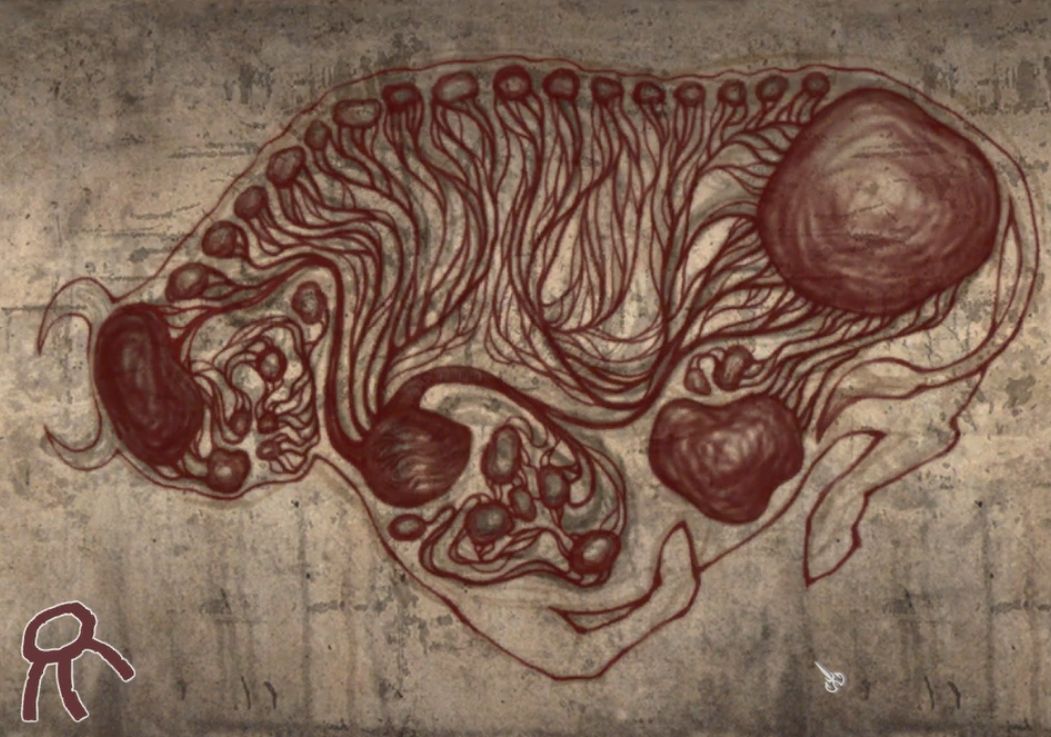
My eyes move from right to left over the picture—from the veins of sacrificial blood from the Abattoir, to the sharpened stem that plunges down to meet it, then up to that blackened horror incubating within the Polyhedron. Suddenly, it all clicks into place. The Bachelor's letter, the blood at the base of the Polyhedron, the urgency of removing the spike from the suffering auroch at the Bone Pillar: everything is united. Maybe the Kains have discovered how to be reborn in the Polyhedron, but in order to achieve this they need fuel, nourishment for the soul within. In the words of Elder Oyun, they need to pour old blood into new veins.

The Polyhedron siphons the lifeblood from the earth, the earth sickens, the Sand Plague comes. A syllogism, deadly in its simplicity.

I hurry over to the Polyhedron as a thin drizzle begins to fall. Just as Mishka said, blood is pooled at the base of the stairs leading up to the Inner Chamber. I collect a sample, and it's exactly the same as the blood I received from the Worms at the Bone Pillar.

If I had any doubts before, they're gone now. I don't care what the Bachelor says or whom he's been talking to. If we want to eradicate the Plague once and for all, the Polyhedron—and that thing growing inside it—must be destroyed.

Wednesday, October 12, 2011

Pathologic: Day Eight, by the end of which the Bachelor will be convinced not to expect anything good from the Earth.

At 7am:

The morning of the eighth day has come.
Infected in the past 24 hours: 249 ppl
Died in the past 24 hours: 391 ppl
Gone missing: 59 ppl
Number of dead at the moment: 3128
Number of infected: 570

Less than five days remain. Tomorrow the sanitary army will arrive.

Today's Map
It’s a fundamental law of physics: Each action demands an equal and opposite reaction.

Ice Pick Lodge labeled this game as a prototype of an epidemic simulator. If I pull back for a moment and assess what has happened—and where I’ve just found myself—I couldn’t be more horrified. I’m controlling a pixeled avatar, a stuck up researcher from the city, whose shoes I have easily filled. If I were to answer to friends for what I’ve said and done in this virtual sphere right now, I’d be ashamed. I’ve killed men in barbaric combat—just to try to understand the primitives of this godforsaken place. I’ve dodged murders, taken down roomfuls of muggers, and lied to everyone in this entire town, in exchange for the numerous lies that have been told to me.

If Ice Pick were to assess my decisions, I’ve failed. I came into this town as a representative of civility and objective truth, and I mucked the whole thing up. Rubin has disappeared. Hundreds are dead in the Cathedral, and my first reaction when I spoke to the townsfolk was relief that all this wouldn’t be blamed on me. Of course, this is human nature. In the end, we’re all meat—heat—desire, and we all want to survive.

I’ll explain the day as quickly as I can.

Black Market of Panacea
The Haruspicus and I have created a panacea, through my research and his alchemy. Several worms, holed up in the now-open Apiary, have begun to produce a false elixir and sell it for an exorbitant sum. When I confront them, they point a finger of blame to Young Vlad Olgimskiy and say he has bought all of the true panacea and is hording it for personal gain. When I visit him, he tells me that yes, this is true: he used the vast funds at his disposal to buy it all up, but only so that he could sell it for (basically) nothing to the women of the town—Lara, Julia and Anna. It seems that he’s had a genuine change of heart.

I hope those large bags are just full of dead cow meat.
Kevin has already written about the Apiary—he took a visit to that harrowing place yesterday—but I’d like to share some impressions. I enter the asylum greeted by the cries of madmen. Butchers and worms run to and fro on strange errands, and massive bags of rotting meat hang from the ceiling. Bodies litter the floors, and there are strange experiments going on in back rooms. This place is filled with the refuse of the human race.

I assume this is a painting of the Apiary--otherwise it's gotta be a communist propaganda poster.
Underground Decay
The panacea is not enough to stave off infection. Yes, it cures the infection completely, yet it’s not enough. The fact is that as long as the source persists, this infection will come back again and again, and eventually spread beyond this microcosm. There’s something—either from the Abattoir, the Polyhedron, the water source—that will continue to fuel the outbreak. There is a dry rot in the infrastructure, and we need to search it out.

The difficulty of each errand today will be exacerbated by the plague: it has truly reached its peak. To enter an infected zone today is almost certain death. Plague clouds materialize all at once, hemming me in, as brown-swathed infected pursue with a reckless abandon, knowing they will die. The remaining arsonists patrol the streets accompanied by knife-wielding maniacs, all of them ready and capable of ending me with one strike.

I investigate the water source first. Young Vlad has filled in the well in his place, rendering any research utterly useless. My only recourse is to investigate the Abattoir: something there is poisoning the ground itself, the Inquisitor is certain. To this end, I ask Taya (the “Mother Keeper” girl in the Apiary) to order open the gates. She tells me she might, but only if Big Vlad offers himself as a sacrifice for his crimes. He was singlehandedly responsible for the shut-in at the Apiary which allowed the asylum to become a breeding ground for the disease and killed hundreds. I’m convinced I still need Big Vlad, however, so the Mother Keeper gives me another task: I need to break into her old house (the same one Lara picked to be a “House of the Living” on Day 2) and recover her favorite rocking horse toy.

That's not soot on my nose. It's Sand Plague.
The mission is difficult; not only do I need to procure a lockpick, but the former “House of the Living” is impossible to navigate, filled to the brim with miasmic plague clouds. Choking, I rush up the stairs, grab the rocking horse and run back to Taya who says she’ll open the Abattoir for my inspection just before midnight tonight.

At half past eleven, I make my way to the Apiary, find the gaping tunnel before me and run through to the Abattoir. After wandering for a bit, I come upon a large room, where half a dozen butchers circle me and proceed to beat me up. In just the nick of time, a wave of soldiers rush in, gun down the barbarians and take me to the town center. On my way there, I’m treated to a cinematic showing lines of soldiers marching in formation—a stern-faced general at their fore. The army has arrived.

This is me about to get lynched.
Aglaja and Young Vlad
From my conversations with these two, I have come to an unsettling conclusion. Simply put, the town must be destroyed.

So much of this town is unnatural. After researching the Polyhedron (the dogheads—the gang of children who live there—came to my house) I have learned several interesting points. First: it is something entirely synthetic. None of the children who live there have been infected. People say it is a place of magical energy, that time is static. Some say it grants eternal youth. Some say that only the youthful can benefit from its strange magic. The Kain family talks of the inner sanctum as a chamber where a spirit can choose its path—this has something to do with Eve’s suicide, attempting to become “part of the Cathedral”. The Cathedral is so close to the Polyhedron—perhaps they are linked.

So yes: the Polyhedron is a miracle, a strange healing instrument of sorts. Yet it is an artificial, unliving thing, and it has paralyzed the earth. I zoomed out from my map today to see the town overlaid with the image of a bull—organs, intestines, spine, everything. And at the tip—the head—is the jagged, pointed, impossible Polyhedron.

I yelped when this came up instead of my map.
This was all steppe at one point—there were wanderers in yurts, moving across the surface of the land, briefly drawing from the resources, then moving on. Like symbiotes, they fed from the land in life, and with their death (and blood) proceeded to feed the land. Yet the town has changed everything. Trains arrived from far away bringing the oafish townsfolk, who built their structures piece by piece, attaching themselves to the land like melanoma.

The Haruspicus experienced the tunnels beneath the town as a sort of ventricle—as blood vessels through an abdomen. There are hundreds more beneath each house, beneath each manhole I pass on each street, all of them burrowed deep with cold, sharp trowels by greedy townsfolk. These aren’t blood vessels: they are carved wounds. We call the disease the Sand Plague because it comes from the earth, when in reality it is not a plague at all. The plague is the antibodies of the earth, and we are all parasites, sucking the life from the ground, poisoning its blood and flesh gradually.

The people of this blighted town are corrupt, squabbling animals, and they are only getting their just payment for the ways they have grossly abused the earth. Even the steppe folk have been corrupted, drawing inward into myopic ramblings of cultish earth gods and goddesses, upholding traditions that no longer have meaning, that will not shield them from the judgment. As I walk through the outskirts of the town, I can occasionally make out the remaining yurts covered in rust-colored scabs. No one is safe. Everyone is judged.

The Inquisitor describes this microcosm as a carefully wound and intricate mechanism, and something is throwing it off. The Polyhedron, with its odd stasis, has wound the clock to a halt, left the earth vulnerable and incapable of repair, while the Abattoir has gummed up the inner workings with whatever the Butchers are dumping into the system.

The Bachelor is a doctor. I am playing the role of surgeon. The true blight here is not the Sand Plague, but the cancerous growth of this town. The most logical recourse is to excise this tumor before it can spread. I don’t know what will make this possible, but I am assured the tools will present themselves in the days to come.