Having finished the game, Duke and Kevin
(Bachelor and Haruspicus, respectively) ask some questions and try to
unpack Pathologic. Add your thoughts / questions in the comments
section!
For those new to the blog, go here.
Duke: As much as Pathologic gives
players a stake in the lives of the townsfolk, it also works hard to drive home
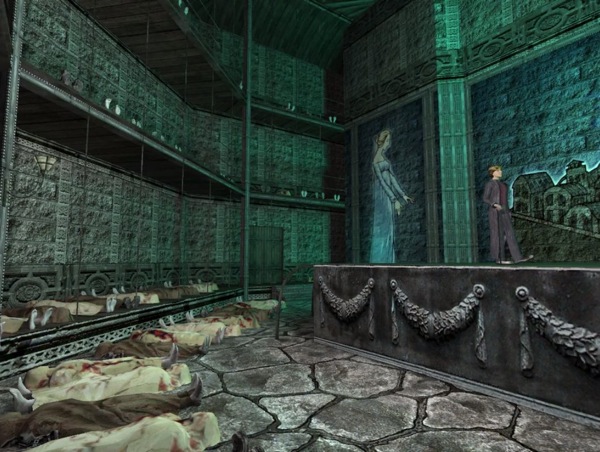
the worthlessness of the human animal. Bodies stacked in cattle corrals, the plague-ridden burned alive, the moans
drowned out by gunfire: the game not only brings out the worst in the
townsfolk, but in the players as well. The Apiary (a word for a collection of
beehives) is teaming with men, expendable, soulless men. Bodies are so much
meat lying on the ground, waiting to be burned off in the morning. As if to
drive home their point, the Authorities appear on the last day to remind the
player of their puppetry. We are mocked for how seriously we have taken the
whole thing.
It's probably better to avoid the whole
Problem Of Evil, and perhaps religion in general, but Pathologic is full of
sacrifice. The Haruspicus performs sanctified murder. The Bachelor desecrates
Kain's body in the hopes of finding a cure. Three of the endings are focused on exchange, as well. Destroy the Polyhedron
for the children, he pleads. Burn the town for a new world. Or let things play
out: sacrifice everyone to restore balance to nature.

Yet every large and small sacrifice is never
enough to stop the evil in the Settlement. The bull at the Bone Pillar, which would have yielded panacea, is
burned to a black hunk. The witch hunt on Day 6 leads nowhere. The succession
of Bachelor to Inquisitor to General Blok: everyone wants someone to blame, a
scapegoat, yet in the end the freedom of choice is given only to one person,
much like in Dostoevsky's The
Grand Inquisitor. The meat shouldn't be allowed to decide. It falls to the
Bachelor, the Haruspicus, or the Devotress.
Kevin: Ah, now we're getting into deep waters.
What do "good" and "evil" mean in games? This is going to
be fun. Or perplexing. Probably both.
Here's the thing: Videogames take place
entirely in abstraction. That is, the narratives, images, and mechanics are all
just computer code being processed in the electrical depths of a machine. The
significance we attach to these processes is entirely imaginative, similar to
the imaginative ways we engage with the flickering pictures that a projector
beams onto a screen at the cinema. Unlike movies, though, videogames give us an
active hand in how this imaginative process unfolds. So the game's events are abstract—they
are not literally happening in the real world to real individuals—yet at the
same time they are being influenced by a real player who is situated in the real world. We're
not just spectators—we're accomplices. So how much do the rules and morality of
the real world apply to what we do in videogames?
Before I (try to) answer that, it might be
helpful to think about what "playing a game" really means. In order
to play a game, you must first learn the rules. In the case of videogames, you
do this by figuring out how to interact with the programmed world around you.
Click the left mouse button and X happens. Two items combine to allow your
character to do Y. The A.I. of other characters reacts in a certain way when
you do Z. Most videogames start off with a tutorial section, designed
specifically by the programmers to teach you these rules. By the end of these
sections, you have gotten your sea legs. You've learned how you can and cannot
affect the world around you, and you probably have a good idea of the game's
tone and atmosphere as well.

But Pathologic didn't do this for me. There was no
tutorial, no attempt by the designers to communicate to me the consequences of
this or that action. After the brief opening cinematic, I was dropped in the
middle of the game world and left to fend for myself. I had to construct my
impressions about the town and my purpose in it from the ground up, without any
outside force to contextualize what I experienced. Everything felt alien, right down to
the labored, barely comprehensible dialogue translation.
Essentially, Pathologic started me with a clean slate and left
it up to me to determine what "normal" and "good" meant in
this world.
I needed to have some orienting principles
in order to make decisions, so I ended up extrapolating my own system of
morality as I muddled through the first few days. I was tasked with fighting
the Sand Plague, so I decided that my highest good was the salvation of the
town and its residents. I was told that keeping my Adherents alive was
important, so I prioritized their safety and wishes above others'. I discovered
that my family was affiliated with the Cult of Bulls, so I sided with the
people of the Abattoir against the supporters of the Polyhedron.
By the standards of my own in-game
constructs, I made a moral choice (though perhaps not the best choice—acquiescing to the Devotress's
suggestion at the Cathedral apparently offers true victory and healing for the
town). I saved the children and allowed them to rebuild the town; my religious
order jettisoned the corrupt influence of Fat Vlad and Elder Oyun; I frustrated
the Kains' hubristic attempt to play God using the Polyhedron. To the
Haruspicus, this was a righteous victory.
Does that mean it was truly the right thing
to do—that, if I were faced with an analogous choice in my real life, I would
confidently make the same decision? At the time, I thought so. In my Day 12 writeup, I went on at some length
about how the lives of the townspeople were valuable regardless of how evil
they were—sure, they were small minded and selfish, but isn't everyone, to some
extent? After reading what you wrote above, Duke, I'm not so sure. These
weren't just people with everyday foibles, after all. They stole and lied and
murdered without shame; they fastened like leeches onto the earth around them.
Maybe I was working in service of a modern-day Sodom and Gomorrah, so
irredeemably wicked that the only true cure for its sickness would be total
annihilation.

The town rubbed off on me. Because the game
designers forced me to adapt myself to the town instead of outright telling me
how to behave, I conformed to the dog-eat-dog world around me. When in Rome, do as the Romans do—even if
the Romans are okay with killing people, ripping out their kidneys, and trading
them to cult members for healing herbs.
Pathologic conditions the player to treat life seriously. It does
this by making survival and cure the primary motives for the three main
characters. On the bright side, this suggests to me that the game designers
want us to be shocked by the game's treatment of people as (in your words,
Duke) "so much meat lying on the ground." On the dark side, this
makes it all the more damning that I killed people to further my
"moral" goal of stopping the Plague. Was I acting normally—even
morally—within the context of the twisted world created inside the computer?
Yes. But that doesn't necessarily make it right.
So what was "good" and
"evil" for you while you were playing? Or did your experience as the
Bachelor cause you to view everything in a more detached, calculating manner?
Put another way: What was going through your mind as you played?
Duke: Pathologic wore
me away. My compassion, my good will, made no difference in the world Ice Pick
Lodge had fashioned. After a few days, I came to the conclusion that the
moronic people of the Settlement were not worthy of
my compassion. They didn't deserve what
I as a moral human and a moral character had to offer. Organic
reason--humanity--was the first thing to die in Pathologic.
I came to Pathologic with
a set of principles, the same principles I apply in most every game. Save every
little sister in Bioshock and you will ultimately be
rewarded. Deliver something in Zelda and
you'll get something good at the end. I didn't think I needed to learn the
rules of Pathologic's game
world in order to survive, and I ended up being used by everyone in the town
with very little to show for it. There was no room for a Dudley Do-Right or a
Christ figure in the Settlement. Many argue that there isn't room enough for
them in the real world, either.
In this world, logic--not mysticism or
morality--made the most sense. And that was what I came to prize most: logic,
and the ability to make my own decisions.
Knowing I was being manipulated by the major
families of the Settlement killed off any sense of "good" or
"evil" and replaced it with a dichotomy of independence and slavery.
That's the whole nature of a game, I guess--the designers, the programmers, the
authorities, put you into a controlled sandbox, choose what you see, don't see,
what you can and can't do, and then set an objective for you, the player. Pathologic asks a question. In the
Bachelor's scenario, the question is "What constitutes true victory?" True victory become
independence: not synergy, not blind faith. There's a reason the Polyhedron is
completely outside, grafted on to the Authorities' model of the town: it
represents the freedom of man, the objectivity of reason, the power of
innovation. It is independence incarnate.

Isn't so much of Pathologic driving home
the notion that we, as human animals, don't have true agency? That the only
chance to live is to give up our independence for peace, to sacrifice
innovation for stability? Isn't this the story of every natural disaster, too?
When the chips are down, when Katrina is coming or Vesuvius erupting, humans
either A) run and pillage or B) huddle and wait. This is human nature. This is
exactly the response of the Settlement to the plague, as well. The nobles
strategize from within their homes, the townsfolk curl up and die, and the
bandits loot and murder.
Where I was content to accept the world, to
euthanize my better half and turn bitter, you, Kevin, decided to hope against
reason. You chose to accept the townsfolk for who they were--yes, petty
squabbling myopics--and you wanted to give them a future. Maybe not the best future—as you said,
the "true victory" is the unification of progress and stability,
keeping the Polyhedron and the
Settlement. But you kept them alive.
Me? Even with grandiose logic,
self-assurance and no small measure of pride, I made my decision for myself. I
survived the Sand Plague, but by no means can I claim any measure of moral high
ground. Pathologic illuminated
the worst in me.
We're working on Part III for next week. Stay tuned.
We're working on Part III for next week. Stay tuned.