Showing posts with label Abattoir. Show all posts

Thursday, May 17, 2012

The Pathologic Dialogues - Part II


Having finished the game, Duke and Kevin (Bachelor and Haruspicus, respectively) ask some questions and try to unpack Pathologic. Add your thoughts / questions in the comments section!

For those new to the blog, go here.

For Part I, go here.

Duke: As much as Pathologic gives players a stake in the lives of the townsfolk, it also works hard to drive home the worthlessness of the human animal. Bodies stacked in cattle corrals, the plague-ridden burned alive, the moans drowned out by gunfire: the game not only brings out the worst in the townsfolk, but in the players as well. The Apiary (a word for a collection of beehives) is teaming with men, expendable, soulless men. Bodies are so much meat lying on the ground, waiting to be burned off in the morning. As if to drive home their point, the Authorities appear on the last day to remind the player of their puppetry. We are mocked for how seriously we have taken the whole thing.

It's probably better to avoid the whole Problem Of Evil, and perhaps religion in general, but Pathologic is full of sacrifice. The Haruspicus performs sanctified murder. The Bachelor desecrates Kain's body in the hopes of finding a cure. Three of the endings are focused on exchange, as well. Destroy the Polyhedron for the children, he pleads. Burn the town for a new world. Or let things play out: sacrifice everyone to restore balance to nature.


Yet every large and small sacrifice is never enough to stop the evil in the Settlement. The bull at the Bone Pillar, which would have yielded panacea, is burned to a black hunk. The witch hunt on Day 6 leads nowhere. The succession of Bachelor to Inquisitor to General Blok: everyone wants someone to blame, a scapegoat, yet in the end the freedom of choice is given only to one person, much like in Dostoevsky's The Grand Inquisitor. The meat shouldn't be allowed to decide. It falls to the Bachelor, the Haruspicus, or the Devotress.

Kevin: Ah, now we're getting into deep waters. What do "good" and "evil" mean in games? This is going to be fun. Or perplexing. Probably both.

Here's the thing: Videogames take place entirely in abstraction. That is, the narratives, images, and mechanics are all just computer code being processed in the electrical depths of a machine. The significance we attach to these processes is entirely imaginative, similar to the imaginative ways we engage with the flickering pictures that a projector beams onto a screen at the cinema. Unlike movies, though, videogames give us an active hand in how this imaginative process unfolds. So the game's events are abstract—they are not literally happening in the real world to real individuals—yet at the same time they are being influenced by a real player who is situated in the real world. We're not just spectators—we're accomplices. So how much do the rules and morality of the real world apply to what we do in videogames? 

Before I (try to) answer that, it might be helpful to think about what "playing a game" really means. In order to play a game, you must first learn the rules. In the case of videogames, you do this by figuring out how to interact with the programmed world around you. Click the left mouse button and X happens. Two items combine to allow your character to do Y. The A.I. of other characters reacts in a certain way when you do Z. Most videogames start off with a tutorial section, designed specifically by the programmers to teach you these rules. By the end of these sections, you have gotten your sea legs. You've learned how you can and cannot affect the world around you, and you probably have a good idea of the game's tone and atmosphere as well.


But Pathologic didn't do this for me. There was no tutorial, no attempt by the designers to communicate to me the consequences of this or that action. After the brief opening cinematic, I was dropped in the middle of the game world and left to fend for myself. I had to construct my impressions about the town and my purpose in it from the ground up, without any outside force to contextualize what I experienced. Everything felt alien, right down to the labored, barely comprehensible dialogue translation. Essentially, Pathologic started me with a clean slate and left it up to me to determine what "normal" and "good" meant in this world.

I needed to have some orienting principles in order to make decisions, so I ended up extrapolating my own system of morality as I muddled through the first few days. I was tasked with fighting the Sand Plague, so I decided that my highest good was the salvation of the town and its residents. I was told that keeping my Adherents alive was important, so I prioritized their safety and wishes above others'. I discovered that my family was affiliated with the Cult of Bulls, so I sided with the people of the Abattoir against the supporters of the Polyhedron.

By the standards of my own in-game constructs, I made a moral choice (though perhaps not the best choice—acquiescing to the Devotress's suggestion at the Cathedral apparently offers true victory and healing for the town). I saved the children and allowed them to rebuild the town; my religious order jettisoned the corrupt influence of Fat Vlad and Elder Oyun; I frustrated the Kains' hubristic attempt to play God using the Polyhedron. To the Haruspicus, this was a righteous victory. 

Does that mean it was truly the right thing to do—that, if I were faced with an analogous choice in my real life, I would confidently make the same decision? At the time, I thought so. In my Day 12 writeup, I went on at some length about how the lives of the townspeople were valuable regardless of how evil they were—sure, they were small minded and selfish, but isn't everyone, to some extent? After reading what you wrote above, Duke, I'm not so sure. These weren't just people with everyday foibles, after all. They stole and lied and murdered without shame; they fastened like leeches onto the earth around them. Maybe I was working in service of a modern-day Sodom and Gomorrah, so irredeemably wicked that the only true cure for its sickness would be total annihilation. 


The town rubbed off on me. Because the game designers forced me to adapt myself to the town instead of outright telling me how to behave, I conformed to the dog-eat-dog world around me. When in Rome, do as the Romans do—even if the Romans are okay with killing people, ripping out their kidneys, and trading them to cult members for healing herbs. 

Pathologic conditions the player to treat life seriously. It does this by making survival and cure the primary motives for the three main characters. On the bright side, this suggests to me that the game designers want us to be shocked by the game's treatment of people as (in your words, Duke) "so much meat lying on the ground." On the dark side, this makes it all the more damning that I killed people to further my "moral" goal of stopping the Plague. Was I acting normally—even morally—within the context of the twisted world created inside the computer? Yes. But that doesn't necessarily make it right.

So what was "good" and "evil" for you while you were playing? Or did your experience as the Bachelor cause you to view everything in a more detached, calculating manner? Put another way: What was going through your mind as you played?

Duke: Pathologic wore me away. My compassion, my good will, made no difference in the world Ice Pick Lodge had fashioned. After a few days, I came to the conclusion that the moronic people of the Settlement were not worthy of my compassion. They didn't deserve what I as a moral human and a moral character had to offer. Organic reason--humanity--was the first thing to die in Pathologic.

I came to Pathologic with a set of principles, the same principles I apply in most every game. Save every little sister in Bioshock and you will ultimately be rewarded. Deliver something in Zelda and you'll get something good at the end. I didn't think I needed to learn the rules of Pathologic's game world in order to survive, and I ended up being used by everyone in the town with very little to show for it. There was no room for a Dudley Do-Right or a Christ figure in the Settlement. Many argue that there isn't room enough for them in the real world, either.

In this world, logic--not mysticism or morality--made the most sense. And that was what I came to prize most: logic, and the ability to make my own decisions.

Knowing I was being manipulated by the major families of the Settlement killed off any sense of "good" or "evil" and replaced it with a dichotomy of independence and slavery. That's the whole nature of a game, I guess--the designers, the programmers, the authorities, put you into a controlled sandbox, choose what you see, don't see, what you can and can't do, and then set an objective for you, the player. Pathologic asks a question. In the Bachelor's scenario, the question is "What constitutes true victory?" True victory become independence: not synergy, not blind faith. There's a reason the Polyhedron is completely outside, grafted on to the Authorities' model of the town: it represents the freedom of man, the objectivity of reason, the power of innovation. It is independence incarnate.


Isn't so much of Pathologic driving home the notion that we, as human animals, don't have true agency? That the only chance to live is to give up our independence for peace, to sacrifice innovation for stability? Isn't this the story of every natural disaster, too? When the chips are down, when Katrina is coming or Vesuvius erupting, humans either A) run and pillage or B) huddle and wait. This is human nature. This is exactly the response of the Settlement to the plague, as well. The nobles strategize from within their homes, the townsfolk curl up and die, and the bandits loot and murder.

Where I was content to accept the world, to euthanize my better half and turn bitter, you, Kevin, decided to hope against reason. You chose to accept the townsfolk for who they were--yes, petty squabbling myopics--and you wanted to give them a future. Maybe not the best future—as you said, the "true victory" is the unification of progress and stability, keeping the Polyhedron and the Settlement. But you kept them alive.

Me? Even with grandiose logic, self-assurance and no small measure of pride, I made my decision for myself. I survived the Sand Plague, but by no means can I claim any measure of moral high ground. Pathologic illuminated the worst in me.

We're working on Part III for next week. Stay tuned.

Thursday, November 17, 2011

Pathologic: Day Eleven, in which the Haruspicus falls into a trap, discovering that his dilemma connects two incompatible truths

(or, in which Kevin learns that he really needs to stop making assumptions)

The morning of the eleventh day has come.

Infected in the past 24 hours: 334 people
Died in the past 24 hours: 621 people
Gone missing: 127 people
Number of dead total: 6831 people
Number of infected: 570 people

Tomorrow everything will be over


Welcome to "Martha Stewart Living," Pathologic edition. Up next, we prepare a lovely quiche made
from spider eggs that hatch inside your mouth.
"Tomorrow everything will be over." Ominous words, but I can't help but feel relief when I read them. By now I, the player, have spent at least 40 hours in this hellhole of a town, struggling not to let the game wear me down. I have teetered on the brink of irrational frustration with it more than once. And I have been at the controls as my character has done the unthinkable. I've killed the guilty and the innocent. I've dragged myself in threadbare clothing through neighborhoods buzzing with the Plague. Frankly, I am exhausted. If one of Ice Pick Lodge's goals was to evoke in me a physical and emotional response analogous to what my in-game avatar is feeling, they have succeeded with flying colors. No other game has ever made me feel this hopeless.

I am determined to save this town, no matter the cost. The Haruspicus does not compromise. Yet the Bachelor, with his talk of wiping the town off the map, is not crazy. He too has witnessed the Sand Plague's devastation. Whether tomorrow brings salvation or annihilation, it will be a mercy.

The town is in the final stages of collapse, with the Sand Plague saturating every district. Even the thin veneer of civilization has fallen away. Food and medicine prices are astronomical; starving citizens on the street beg me for money, but I literally have none to give them. The infected seem to sense that society is crumbling and now attack other people with abandon, often in groups. Near the theater I witness a soldier running from a pack of infected. They chase him down and overwhelm him. Military discipline is breaking down—everywhere I see soldiers breaking ranks and fleeing from their guard posts. General Blok has finally lost control of his army.

... which means I get treated to the following sight when I arrive at the Bone Pillar to save the bull that was there yesterday.


Nothing but a blackened hunk of charcoal remains of it. I can't believe my eyes. Do these imbeciles have any idea how much panacea I could have made from that bull's blood? The nearest disinfector, impassive in his haz-mat suit, tells me to take it up with a low-ranking officer called "Captain Patroclus," who commands a mutinous band of soldiers that has taken control of the military's armory near the trainyards. Patroclus, in turn, says that he was only following orders to destroy whatever possible vectors of infection he found. Whose orders? I ask. Not the General's, surely. No, Patroclus says. The Bachelor gave the instructions.

Of course he would. Seething, I confront him about it, only to hear the same old routine about the importance of the Polyhedron. Apparently the Kains have convinced him that Simon Kain is not even dead but has transferred his soul into the Polyhedron. At best, this is superstition—I've seen the body, and he looked pretty dead to me. At worst—given my epiphany from last night—this is an abomination against nature. The Bachelor won't budge, though. The panacea doesn't seem to matter anymore to him. The Polyhedron is our only hope, he says.

Sure, whatever. I leave him with his microscope and misconceptions and strike out to pay my daily doctor's visits.

More Executors have appeared around town, holding vigil over ill Adherents. Fortunately, they are all the Bachelor's and Devotress's, not mine, but I still feel responsible for them. They are people, after all, and deserve to live. For the past two days I've been giving them antibiotics to keep them alive, making the rounds every day. With time running out, my supplies getting short, and my fatigue increasing, I decide to start healing some of them outright. I don't want to spend any of my precious panaceas in case I need them for some dire emergency on the final day, but I do have a couple of medicinal powders made by the town's children. Even the Executors seems shocked when I propose giving doses to the Adherents. It will destroy the patient, they warn. The medicine will burn the Plague right out of their veins, but it will take some of the veins along with it.

I shrug. Petr Stamatin, the Polyhedron's creator, should count himself lucky to make it out of this epidemic as a cripple. I feel a small stab of pity as I dose him with the powder, but only a small one.

While making my rounds, I begin hearing rumors surrounding Elder Oyun and the trial he has planned for me. First I receive a letter from the Devotress, who calls me to the cemetery to meet with her. She warns me that the Elder is going to try to kill me with this final task. Honestly, this doesn't seem like such a big deal to me; he's practically killed me with the last two trials too. The Devotress seems to think this time will be different, though, and she offers to help me out—in return for a favor on the final day. I immediately turn down her offer. Whatever favor she might want from me, I think, it can't be anything good. She accepts my refusal coolly, making me wonder briefly if I should not have been so hasty.

After this, I call on Young Vlad to make sure he's not bleeding from his eyes or something. He seems agitated to hear that I'm meeting with Elder Oyun later. He says I should be careful. After all, Oyun is the one who murdered my father.

Wait, what? I thought he died of the Plague! Young Vlad just shakes his head and tells me to ask the Elder myself. Then he, too, advises me to watch my back during the third task.

Back in the Abattoir, Elder Oyun tells me that it's time to enter "the belly of Suok"—that is, descend into the depths of the earth—and indicates the deep pit outside his personal chamber. Once I know the secrets of the earth, I will ascend to the status of hierophant within the Order. Despite my simmering anger at the Elder, I have to admit that I'm madly curious to discover what happens down there. On Day Five I saw some crazy things just by climbing down a 15-foot-deep well. What's going on in the darkness beneath the Abattoir?


Here I must apologize to you, faithful readers. Because I never find out.

Seriously, doesn't anyone in this town know what a rope is?
Apparently my paranoia in refusing the Devotress's assistance screwed me over. I die instantly when I jump down the hole, and no amount of creative thinking can reveal an alternate path. The belly of Suok, the strange place where the living earth feeds on the Order's sacrificial blood, will be a mystery to me forever.

Suddenly enraged, I return to the Elder's chamber. I'm sick of his arrogance and his murderously impossible quests. This guy has been a thorn in my side for long enough. It's time for a reckoning. You are responsible for my father's death, I tell him. Explain yourself.

Oyun doesn't try to lie. He admits to killing Isidor Burakh, having stabbed him to death with the sharpened horn of a bull. He's not sorry, either. Isidor Burakh was colluding with the Kains in their Polyhedron project, trying to pour old blood into new veins. He was betraying the Order. Oyun says he would do it again without hesitation. I coldly tell him to put up his fists and prepare to die, but a small grain of misgiving has settled into the back of my mind. My father was involved with the Polyhedron, too? Why?

The scene suddenly changes, and I find myself in a part of the Abattoir I've never seen before. In the center of the room is a bull, and torches line the walls. My weapons have vanished, leaving me with only my fists to defend myself. Then the Elder storms into the chamber, and the fight is on.


He looks pretty intimidating, what with his sheer size and the bull's-head helm, but I'm surprised to find that he's not terribly challenging. Maybe I shouldn't be: after all, I've spent the last week and a half scrabbling to survive among infected citizens, lunatics, and murderers in the world beyond the Abattoir's doors. Compared to that ordeal, it's practically therapeutic to vent a little righteous rage on a single target. It's the first time in this game that I've faced a straightforward videogame trope: the one-on-one boss battle.


The Elder, with his long reach and crushing strength, beats me down a few times, but I eventually succeed in exacting my revenge. I have to admit, it feels pretty good. I ignore the new entry in my diary that says that the Elder's death is "a disproportionate sacrifice." By now I've killed dozens of people in this town, with fists, guns, and knives. One more hardly seems to matter at this point, especially considering the sorts of things of which the Elder is guilty.

I spend the rest of the day running minor errands for Kapella, who is solidifying alliances with the other children in preparation for their forging of a new society birthed from the ashes. On a whim I check in with Ospina (one of the Devotress's Adherents) to make sure she hasn't fallen ill. When she hears that I've eliminated Elder Oyun, she hails me as the new Elder of the Abattoir. "I, Us-Pae-Nah, bend my knee to you," she says, apparently using her real name for the first time. I have finally come into my birthright as the head of the Order of Bulls. I have blood on my hands, but perhaps that is fitting. In that moment I feel unabashedly victorious.

My sense of triumph wears off as night falls. Brewing up the last of my panacea in my father's old laboratory, I remember what Oyun told me about Isidor Burakh's complicity in the creation of the Polyhedron. Where once I was so sure of my path, I now have a seed of doubt. Even my father seems to have been convinced of the Polyhedron's importance. How could he do that, though, with the knowledge of what it does? Were the Kains manipulating him in their pursuit of "utopia"? Was the Elder lying to me? Or did my father—the most respected member in the Order—know something that I don't?

Monday, October 31, 2011

Pathologic: Day Nine, which informs the Haruspicus that there is a battle for the Order and ancestral lands ahead of him

(or, in which Kevin imbibes a potent cocktail of madness and despair)

The morning of the ninth day has come.

Infected in the past 24 hours: 356 people
Died in the past 24 hours: 454 people
Gone missing: 58 people
Number of dead at the moment: 4086 people
Number of infected total: 539 people

The town is dying. Less than four days remain.


Duke and I are beginning to argue. Not as our characters, but in real life. He can't believe that I am so naive as to trust anything I learn about the Plague from the barbaric Cult of Bulls. Look at the things they do, Duke tells me. Look at the things they make you do: ripping out people's organs so you can make antibiotics; delivering up the defenseless Vlad Olgimskiy to be cannibalized. It's rituals like those, Duke says, that are sickening the earth and bringing the Sand Plague on us. And you are helping them.

For my part, I am disgusted by Duke's sudden turn for the fatalistic. Unexpectedly, I find that I'm the one clinging to some last vestiges of hope. The town may be twisted and corrupt, but we can still save it. We can still beat this thing. I can't believe that after all we have gone through, after fighting tooth and nail to save the people of this wretched little town, Duke is ready to sacrifice everybody just to win. To me, it looks like he's giving up because it's easier to nuke the Sand Plague rather than cure it. But these people deserve life, if nothing else. Gesticulating wildly in my kitchen, I call him a fascist.

The thing is, neither of us is completely sure who's right. It's impossible to tell which of the townspeople are lying to us, but they can't all be telling the truth. Ever-shifting loyalties and agendas make it impossible even to determine who would have a reason to lie. Essentially, Duke's and my conflict is a case of the blind fighting with the blind. I'm fairly sure I'm doing the right thing, but Duke's arguments stick in my mind. Every time I complete a task for the Order, I feel a small twinge of anxiety. What if he's right?


If there's one thing I don't have, though, it's time to sort through the tangle of questions and worries. The game relentlessly draws me on as people keep dying and resources get scarcer. The proverbial cavalry has arrived, though their notion of keeping the peace involves shooting first and asking questions later.1 A summons arrives with the dawn, telling me to report immediately to the army's commanding officer, General Blok. He wants to know where I got the panacea.

On my way there, I pass the Clot, former home of Fat Vlad. It's dark and empty, and an Executor has been posted outside the door. When I talk to him, he refuses to let me inside. "This house belongs to the dead. You could have prevented this," he states flatly.

Thanks.

At the Town Hall, General Blok imperiously asks about my method of producing the panacea. He knows that the key ingredient is scarce, and he wants to get more for me—by whatever means possible. I don't like his tone and refuse to reveal my secrets. I have seen the way he operates. I can only imagine what would happen if he were to send his troops into the Abattoir to get me the auroch blood by force. He might destroy the only source of the precious blood. This oaf could ruin everything. Livid at my refusal to cooperate, Blok tells me to go to hell and kicks me out of the Town Hall. Unconcerned, I dust myself off and head toward the Abattoir to meet with Elder Oyun.

What does Blok think he's going to do with this thing? Shoot the Sand Plague?
Today I will have the first of my three trials to determine if I'm worthy to be a leader in the Order. I will also get a good, long look into the swirling abyss of madness that awaits me when Pathologic finally decides to play real hardball.

Oyun is as proud and truculent as ever when I catch up with him. Some auroch blood went missing from the Abattoir last night, and he wants me to track down the thieves. He suspects the Bachelor, of course. I am doubtful about that, but I need that blood even more than the Elder does. I agree to look into it, and Oyun tells me not to rest until I find the truth. He then has me drink a potion before I leave, saying something about how I will get really tired.

I'm almost out of the Abattoir before I notice that my exhaustion meter seems to be filling up unnaturally fast. By the time I'm halfway to the Bachelor's house, it's full. Panicked, I eat the lemons in my inventory (which decrease exhaustion at the expense of increasing hunger), only to see any positive effects nullified in a matter of minutes. Whatever the Elder gave me to drink, it's screwing with my body. I don't keel over immediately once my exhaustion maxes out, which is what normally would happen; instead, my health starts to plummet. I use up every healing item I have just to stay alive long enough to reach the Bachelor's.

The Abattoir is on the eastern edge of town, the Bachelor's house is on the western edge, and there's plenty of
plague in between.
But he's not there. The woman who lives with him tells me that he has been taken captive by the Dogheads of the Polyhedron. For some reason the Bachelor decided to help the children get their hands on some guns, then idiotically tried to double-cross them by giving them blanks instead of live ammunition. The Dogheads are keeping him in a cell in the factory district, just a short distance from the Abattoir. My heart sinking, I start retracing my steps east, but not before vainly trying to fix my exhaustion/health problem with a one-hour nap (it does no good). I cough up the last of my money to buy some thousand-dollar tourniquets at the nearest pharmacy. I hope they'll keep me on my feet long enough to get to the bottom of all this, even as I try to ignore the fact that I'm practically fainting with hunger.

The Bachelor's guards—are they actually adults, or just prematurely wizened children? Rumor has it that
this is what happens to Dogheads who leave the Polyhedron.
At the jail, the Bachelor's guards refuse to be talked into releasing their ward. Khan, leader of the Dogheads, wants his rifle ammunition, and the Bachelor stays put until he gets it. The guards say that the live ammunition is probably back at the Bachelor's house: again, on the other side of town. Upon hearing this, I become almost frantic. I don't have time for this. Pausing the game, I agonize for about two minutes, trying to think of a way out of this predicament. The tourniquets in my inventory won't keep me alive for long, and my health bar is shrinking so fast that I can actually watch it tick down, little by little. Even if my strength will hold out for the trip to and from the Bachelor's house, I'm going to have to start selling off inventory to buy more healing items, and then I don't know where the money to buy food will come from.

I just can't do it. I can see only one way out of this. I whip out my knife and pounce on the little guards, stabbing them to death almost before they can react. Then, out of habit more than anything else, I harvest their hearts, livers, and kidneys. My conscience protests that I've just done a terrible thing, but I can only give a weary internal shrug. I can't be virtuous anymore. I have to survive.

Despite the grisly scene, the Bachelor is grateful for my assistance. We don't have time to waste, he says—General Blok and his men are volatile, and we need to figure out the source of the Sand Plague before Blok just starts torching everything. The general has a personal grudge against the Inquisitor, and nothing would please him more than to see her die as a result of her failure to save the town.

It's an interesting revelation, but I have more pressing questions. Who took the auroch blood from the Abattoir? According to the Bachelor, it was a splinter group of Worms and butchers, perhaps hoping to brew their own panacea with it. Hoping that will be enough to satisfy Elder Oyun and earn some relief from whatever toxin he gave me to drink, I hare off to the Abattoir with the news.

Oyun doesn't take it well. He starts ranting about the other people in the town, about how they are messing with forces they don't understand. Oddly, even though the Worms have nothing to do with the Polyhedron, he starts railing against it and the Kains, saying that it's totally unnatural, an abomination on the face of the earth. It's the Polyhedron, with its impossible architecture and rumored mystical power, that has messed up the natural order and awakened the Sand Plague. If Oyun is to be believed, the Bachelor is placing all his hopes on the very thing that has caused the epidemic.

The updated version of my map. The Polyhedron is actually a spike cruelly plunged into the earth,
and it looks like it may be interfering with the flow of sacrificial blood from the Abattoir.
This concludes my first trial, but Oyun does not give me any antidote. Whether it was my decision to kill the Bachelor's guards or my panicked attempts to reduce my exhaustion level, I screwed up somewhere, and my constantly draining health looks to be a problem for the foreseeable future. I sell some ammunition, then some medication, to purchase a health kit. Then I trudge on. Grimly, I suppose that I should be thankful that I treated my infection level before taking the trial.

Everything seems to be going to hell. I receive a letter from the Devotress telling me that she's found out about my white lie to her on Day Six. She knows that I think she's the avatar of the Sand Plague, and she doesn't care. "Saints and miracle makers are always stained with mud and blood," her note reads. She includes a list of her Adherents, saying that I have to care for them in addition to my own if I want her help in the next few days. I also receive a plea for help from Kapella, who says that my Adherent Spichka is in danger and, oh yeah, the quarantine fires on the town's outskirts have been extinguished mysteriously. If we want travelers to be warned away from our plague-infested hamlet, somebody needs to get them lit again.

The Dogheads, apparently growing bolder as the Plague escalates, wait in ambush inside Spichka's darkened house.
The rest of the day is a waking nightmare. As you can see from these screenshots, my hunger level is perilously high, but I can't do much about it because I have to sink all my money into tourniquets and health kits. This is also the first day where Pathologic's game design—specifically, my character's walking speed—begins actively chipping away at my sanity. I feel like I'm moving at a crawl as I walk to the outskirts to take care of the quarantine fires. I can see my health bar slowly ebb as my character ambles along with no way to move faster. And when I finally confront the outlaws responsible for the fires going out, any wound I incur necessitates a reload from the beginning because I have only enough healing items to compensate for the slow health drain—nothing else. I must have attempted to finish the day's final hours literally dozens upon dozens of times, growing more frazzled and irrational with each attempt.

When I finally succeed in killing the outlaws—among whom are Worms, regular townspeople, and the aged midgets—I feel almost no sense of accomplishment but merely a tired acceptance. By now I've been playing for at least five hours and, like my character, want nothing more than to go to sleep. When I report my success back to Kapella, I'm surprised to find both Spichka and the Inquisitor in her little room. The Inquisitor thanks me for relighting the watch-fires, darkly hinting that it was all a twisted ploy by General Blok to make her look bad. Spichka and Kapella also thank me, this time for keeping Spichka out of the clutches of his enemies. And here's where I learn what the children of the town are truly up to.

Kapella is setting the foundation for a new town, with new rulers. I had to save Spichka because he's going to ascend to the nobility someday. The town's children are not fools; they can see the toll that the Sand Plague is taking, and they are preparing to rebuild. Fat Vlad may be dead, the Kains may be going off the deep end, and adults everywhere are dying, but the children will pick up the pieces and avoid their elders' mistakes once the catastrophe has passed. If, that is, any of them are left alive by the end of it all.

I mull this over as I head over to the Bachelor's house to crash for the night. At least I have the ghost of a hope that I'm not struggling against these horrible difficulties for nothing. Once there, I talk to the Bachelor's landlady on a whim, and she suddenly hands over the rifle ammunition that the Dogheads had requested earlier in the day. Though I have no immediate use for 40 rifle rounds, I hold on to them tightly and avoid thinking about the guards that I killed. I don't have any money. These bullets are going to feed me in the days to come. And I am going to save this wretched little town if it kills me.


1 In the middle of the night, as I trudged back to my laboratory after doing some trading with a Worm out in the marshes, I ran into one of Blok's hulking, flamethrower-toting men. He flambéd me without hesitation before I got too close. Either the troops are terrible at following Blok's orders, or else they're a little too good at it.

Tuesday, October 18, 2011

Pathologic: Day Eight, on which the Haruspicus will discover who is the bearer of the secret mark

(or, in which Kevin gets a tour of the sausage factory)

The morning of the eighth day has come.

Infected in the past 24 hours: 244 people
Died in the past 24 hours: 417 people
Gone missing: 40 people
Number of dead at the moment: 3336
Number of infected: 503 people

Less than five days remain. The sanitary army will arrive tomorrow.


As always, the devil is in the details. My successful creation of the panacea yesterday came as a complete surprise, albeit a pleasant one; I had assumed that, with nearly a week to go, I would face a long struggle to find the cure if I found one at all. To have created the panacea so relatively early struck me as curiously easy, at least by Pathologic's standards. As the eighth day progresses, however, I realize that the worst part is yet to come. The blood that I use to create the serum is extremely rare (thanks mostly to the obstinacy of the people of the Abattoir), and a single flask of panacea is no cure at all when an entire town is clamoring for it. The Inquisitor predicts that the town will tear itself apart as citizens vie for a dose of the serum, of which there is not enough to go around. The question is no longer "can I find a cure in time?" It's "which people get to be cured?"

It seems that the game is going to make me choose who lives and who dies.

Ashes, Ashes, We All Fall Down

Each day I find myself writing something about how the Sand Plague has gotten almost unbearable, only to discover that things have somehow gotten even worse on the next day. Day Eight is no exception. Nearly every district in town now is either crawling with the Plague or convulsing in its wake. On previous days I could usually pass safely through an infected zone with some fleet footwork and a bit of luck, but now it is impossible for me to come out unscathed on the other side of an infected zone. Multiple plague clouds converge on me from different directions; arsonists, bandits, and the infected attack me on sight; rats chase me even into healthy districts until I stab them or seek refuge indoors. My gloves, boots, and facemask have all degraded to the point where they hardly shield me from the Plague at all (yes, in Pathologic even your clothing wears out, requiring expensive mending). I can't properly convey the deep, weary feeling of relief that sweeps over me whenever the green-hued air of an infected zone gives way to the normal browns and tans of a healthy area.

Oh MAN, we are screwed.
Even the buildings are diseased. This has been going on for a while, but today is the first day that I notice just how awful everything looks. Nearly every structure is covered in bloody sores, leading the Inquisitor to theorize that this isn't just some nasty bug. It's something elemental, a force of nature. Maybe it comes from the earth itself. She has already tasked the Bachelor with testing soil samples.

The Bachelor, for his part, thinks the inhabitants of the Abattoir are to blame. Whatever sacrifices they're making in there, whatever blood they're pouring into the earth, it's poisoning everything. Unsurprisingly, the Cult of Bulls isn't going to admit someone with such opinions into their inner sanctum, which means that once again he needs my help. I agree, though less from a desire to help him than from a desire to talk with Elder Oyun again. The Bachelor is beginning to worry me; in our conversations he seems increasingly detached from our battle with the Sand Plague. I sense that our goals and loyalties are gradually diverging from one another.

Perhaps sensing the Inquisitor's scrutiny, the Abattoir has closed its entrance, which means that once again I must do a favor for Mother Keeper to open it. This quest isn't as difficult as the last one I had to complete for her, but it's more disturbing in its implications. It seems that, despite my encouraging words to her on Day Six, the timid, soft-hearted Klara has disappeared, leaving only her cunning doppelganger to quietly spread fear around town. (Or maybe the Devotress everyone has been seeing is actually Klara, and my well-intentioned white lie did no good. Maybe the "doppelganger" is just some trick. Trying to pin down exactly what this game is doing with the Devotress character is a maddening exercise in confusion.) The Devotress has been appearing solely to the children of the town—my Adherents—and telling them frightening stories and riddles. Mother Keeper is scared of her, which does not bode well considering that Mother Keeper does not seem to be scared by anyone or anything else. She wants me to get the Devotress to tell her the end of the story that the Devotress has been telling to all the kids. There is an urgency to the request that suggests there's more behind it than merely a child's curiosity.

I finally track her down in the trainyard, interrupting a strange tête-a-tête between her and bedraggled orphan Mishka. The story she tells has something to do with a crystal flower that parasitically grows in a garden, killing all the normal flowers around it until nothing remains but crystal flowers. There's obviously a connection between the crystal flower and the Sand Plague, but it's hard to tell whether the Devotress intends her story as a cautionary tale, a fable to be emulated, or a glimpse of some unavoidable future. In any case, what I've heard will satisfy Mother Keeper, though I worry about leaving Mishka alone in that railcar with the Devotress. Why is she focusing so much attention on my Adherents?

Burakh Vs. the Elder

Ever since I received my inheritance on Day Two, I have had two goals for my time in town. The first was to find a cure for the Sand Plague and produce a panacea. The second and more enigmatic goal was to figure out the identity of the "Betrothed," the one to whom belongs a strange symbol that I found in my heritage box. Why exactly this is so important is a question that I have been unable to answer so far, though from today's title I have a feeling that I'm going to find out today. The Elder supposedly is the one who can tell me who the Betrothed is and why I should care.

This assumption hits a snag almost immediately. Elder Oyun seems to have decided overnight that he doesn't trust me, and he refuses to cooperate with my requests for more information and more panacea-producing auroch blood. When I protest that my heritage entitles me to those things, he scoffs that I haven't grown into my father's legacy yet. Whoever handed over my inheritance has been keeping things from me, including another special object without which I don't deserve so much as a cup of water from the Order.

When I confront Ospina about this, she says that she did it only because she's in love with me (?) and didn't want me getting mixed up with the Elder before I was ready. Leaving aside the sudden declaration of love (which might be a translation issue, her attempt to manipulate me, or both—I have no idea which), I'm furious that she kept something from me that hurt my position with the Elder. She claims she was doing it for my own good—there was apparently bad blood (no pun intended) between Oyun and my father, and things might have gone badly for me if Oyun had thought I was making a power play for his position as head of the Order. He is in a precarious position right now, Ospina says. The Oyuns are not a respected family as the Burakhs are, and he's the Elder only because Fat Vlad, who controls the Abattoir's meat-production operations, set him on the proverbial throne (perhaps as a sort of puppet ruler). Now that Oyun's sacrifices are failing to appease whatever force is causing the epidemic, many in the Cult of Bulls are calling him a fraud.

With that, Ospina hands me a talisman made of a bull's horn. This is the last piece of my inheritance, she says. I am still unhappy that she didn't give it to me earlier, but she has convinced me that at least she didn't do it out of malice. Besides, how could you stay mad at a face like this:

OSPINA QUOTE OF THE DAY: "The Inquisitor continues her terrible harvest. Is she at least beautiful?"
Back in the Abattoir, I present the talisman to Elder Oyun. It is not quite enough to convince him that I deserve full access to the Order's secrets, but he grudgingly agrees to reveal the identity of the Betrothed: the earth.

Well, maybe the town, too. Over the generations, the people of the Abattoir have been sacrificing bulls and pouring the blood into that huge pit I saw yesterday. They say that, down there in the darkness, the blood nourishes the earth, which is actually a living being they call an udurg: "a body that contains a world." The stuff I use to create the panacea comes from that underground reservoir. According to the Elder, the Sand Plague has come because something is interfering with the reservoir, either blocking or poisoning it. Contrary to what the Bachelor seems to think, the town and the earth beneath it form a symbiotic relationship. With its nourishment either drying up or becoming corrupted, the world is slowly eating itself, and the town along with it. This would explain why even the town's structures are being ravaged by disease. The only way to reverse this process and save the town, Oyun says, is to present some sort of sacrifice, to provide the udurg once more with untainted blood.

What must I sacrifice, then? I ask. But the Elder has clammed up again.

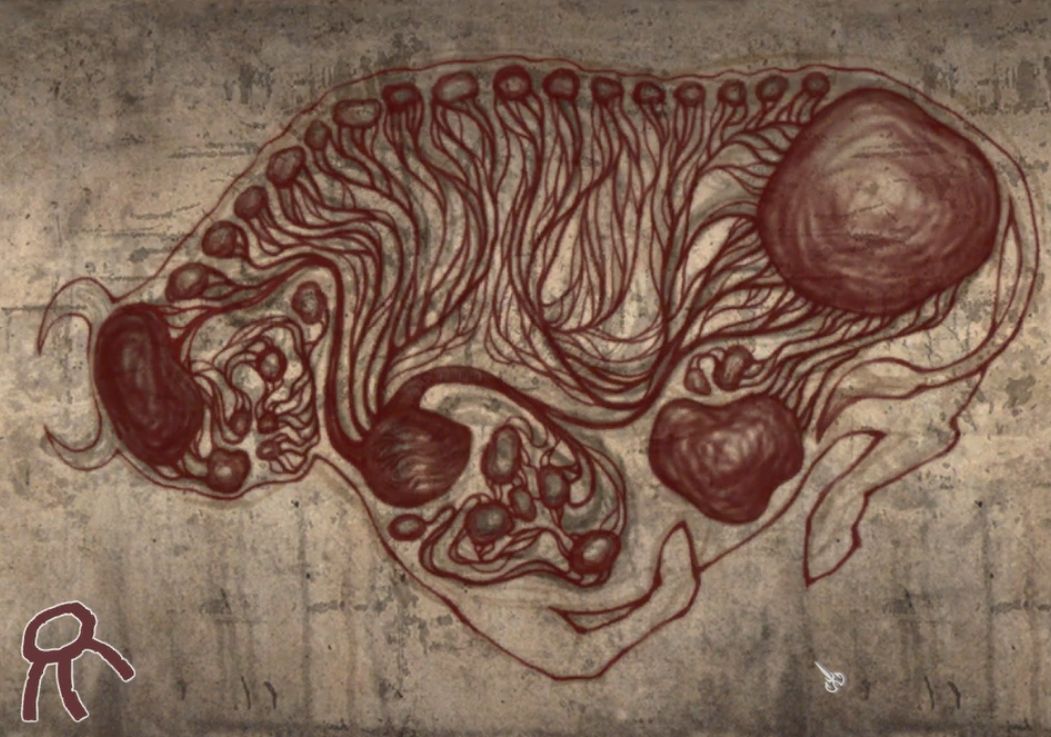
The alternate view of my town map. Notice that the hill on which the town rests
has been revealed to be a bull.
The Life of Fat Vlad

The Inquisitor is pleased with my findings—more than pleased, she seems downright giddy in her fascination with the idea of the udurg—and I settle in for an evening of scrounging for tomorrow's supplies. Funny how the wearying process of scraping together enough cash to meet the 800-dollar price tag on a loaf of bread, so onerous at first, is becoming almost mundane. I guess one gets used to anything after a while.

At around 8 pm, I receive a letter from George Kain containing some unsettling news. Now that the Apiary has been unlocked, its inhabitants have been calling for the head of Fat Vlad Olgimskiy, the man who had locked them up and left them to rot. Fat Vlad, perhaps shaken by the Inquisitor's presence, has decided to surrender himself to the mob. According to George Kain, though, he is not to blame. He's only taking the rap so that his son, Young Vlad—the true mastermind behind the Apiary fiasco—will be spared. Kain tells me that, as the only person with any influence over the butchers of the Apiary, I have a responsibility to go to them and make sure they punish the right guy.

I am at a loss. I've distrusted the elder Olgimskiy from the start, but even I don't think that he deserves whatever horrible fate the denizens of the Apiary have prepared for him. On the other hand, I have no reason to believe that Young Vlad is guilty either, and Kain, as a member of one of the rival families, could have ulterior motives for disposing of the scion of the Olgimskiys. I go to the Inquisitor with the news, telling her to throw the weight of her authority behind an investigation. She callously dismisses my concerns as beneath her and warns me not to tell her how to do her job. I am to handle this "petty" matter on my own.

Not knowing what else to do, I head toward the Apiary on the other side of town, hoping that I'll have an idea of what to do by the time I get there. No such luck. All too quickly, I am standing before Mother Keeper in her torchlit inner sanctum, with her waiting for me to deliver the guilty party into the Order's hands. I have three dialogue options:

1) Fat Vlad is guilty
2) Young Vlad is guilty
3) I refuse to help

I'm afraid to take the third option, which would keep my hands clean but also leave the quest unfulfilled. Failed quests can put my Adherents in danger, and I am also worried about losing whatever favor I've curried with the Order. The quest must be finished. My mouse hovers over Young Vlad's name, but then I remember his helpfulness, his knowledge of the town's secrets, my deep-seated distrust of Fat Vlad, and George Kain's questionable motives. I change my mind and, with a click, condemn Fat Vlad to the butchers' clutches. I feel like a coward.

Before I leave, I ask Mother Keeper exactly what will happen to the man. She replies that the Worms and butchers will take him into a back room that she is forbidden to enter. When they finally leave, Fat Vlad will be gone—vanished without a trace. I feel the hairs on my neck prickle. "Mother, do they eat him?"

The kid looks back at me in the firelight. "I am not allowed to go in that room, Burakh." Her expression does not change.

Wednesday, October 12, 2011

Pathologic: Day Eight, by the end of which the Bachelor will be convinced not to expect anything good from the Earth.

At 7am:

The morning of the eighth day has come.
Infected in the past 24 hours: 249 ppl
Died in the past 24 hours: 391 ppl
Gone missing: 59 ppl
Number of dead at the moment: 3128
Number of infected: 570

Less than five days remain. Tomorrow the sanitary army will arrive.

Today's Map
It’s a fundamental law of physics: Each action demands an equal and opposite reaction.

Ice Pick Lodge labeled this game as a prototype of an epidemic simulator. If I pull back for a moment and assess what has happened—and where I’ve just found myself—I couldn’t be more horrified. I’m controlling a pixeled avatar, a stuck up researcher from the city, whose shoes I have easily filled. If I were to answer to friends for what I’ve said and done in this virtual sphere right now, I’d be ashamed. I’ve killed men in barbaric combat—just to try to understand the primitives of this godforsaken place. I’ve dodged murders, taken down roomfuls of muggers, and lied to everyone in this entire town, in exchange for the numerous lies that have been told to me.

If Ice Pick were to assess my decisions, I’ve failed. I came into this town as a representative of civility and objective truth, and I mucked the whole thing up. Rubin has disappeared. Hundreds are dead in the Cathedral, and my first reaction when I spoke to the townsfolk was relief that all this wouldn’t be blamed on me. Of course, this is human nature. In the end, we’re all meat—heat—desire, and we all want to survive.

I’ll explain the day as quickly as I can.

Black Market of Panacea
The Haruspicus and I have created a panacea, through my research and his alchemy. Several worms, holed up in the now-open Apiary, have begun to produce a false elixir and sell it for an exorbitant sum. When I confront them, they point a finger of blame to Young Vlad Olgimskiy and say he has bought all of the true panacea and is hording it for personal gain. When I visit him, he tells me that yes, this is true: he used the vast funds at his disposal to buy it all up, but only so that he could sell it for (basically) nothing to the women of the town—Lara, Julia and Anna. It seems that he’s had a genuine change of heart.

I hope those large bags are just full of dead cow meat.
Kevin has already written about the Apiary—he took a visit to that harrowing place yesterday—but I’d like to share some impressions. I enter the asylum greeted by the cries of madmen. Butchers and worms run to and fro on strange errands, and massive bags of rotting meat hang from the ceiling. Bodies litter the floors, and there are strange experiments going on in back rooms. This place is filled with the refuse of the human race.

I assume this is a painting of the Apiary--otherwise it's gotta be a communist propaganda poster.
Underground Decay
The panacea is not enough to stave off infection. Yes, it cures the infection completely, yet it’s not enough. The fact is that as long as the source persists, this infection will come back again and again, and eventually spread beyond this microcosm. There’s something—either from the Abattoir, the Polyhedron, the water source—that will continue to fuel the outbreak. There is a dry rot in the infrastructure, and we need to search it out.

The difficulty of each errand today will be exacerbated by the plague: it has truly reached its peak. To enter an infected zone today is almost certain death. Plague clouds materialize all at once, hemming me in, as brown-swathed infected pursue with a reckless abandon, knowing they will die. The remaining arsonists patrol the streets accompanied by knife-wielding maniacs, all of them ready and capable of ending me with one strike.

I investigate the water source first. Young Vlad has filled in the well in his place, rendering any research utterly useless. My only recourse is to investigate the Abattoir: something there is poisoning the ground itself, the Inquisitor is certain. To this end, I ask Taya (the “Mother Keeper” girl in the Apiary) to order open the gates. She tells me she might, but only if Big Vlad offers himself as a sacrifice for his crimes. He was singlehandedly responsible for the shut-in at the Apiary which allowed the asylum to become a breeding ground for the disease and killed hundreds. I’m convinced I still need Big Vlad, however, so the Mother Keeper gives me another task: I need to break into her old house (the same one Lara picked to be a “House of the Living” on Day 2) and recover her favorite rocking horse toy.

That's not soot on my nose. It's Sand Plague.
The mission is difficult; not only do I need to procure a lockpick, but the former “House of the Living” is impossible to navigate, filled to the brim with miasmic plague clouds. Choking, I rush up the stairs, grab the rocking horse and run back to Taya who says she’ll open the Abattoir for my inspection just before midnight tonight.

At half past eleven, I make my way to the Apiary, find the gaping tunnel before me and run through to the Abattoir. After wandering for a bit, I come upon a large room, where half a dozen butchers circle me and proceed to beat me up. In just the nick of time, a wave of soldiers rush in, gun down the barbarians and take me to the town center. On my way there, I’m treated to a cinematic showing lines of soldiers marching in formation—a stern-faced general at their fore. The army has arrived.

This is me about to get lynched.
Aglaja and Young Vlad
From my conversations with these two, I have come to an unsettling conclusion. Simply put, the town must be destroyed.

So much of this town is unnatural. After researching the Polyhedron (the dogheads—the gang of children who live there—came to my house) I have learned several interesting points. First: it is something entirely synthetic. None of the children who live there have been infected. People say it is a place of magical energy, that time is static. Some say it grants eternal youth. Some say that only the youthful can benefit from its strange magic. The Kain family talks of the inner sanctum as a chamber where a spirit can choose its path—this has something to do with Eve’s suicide, attempting to become “part of the Cathedral”. The Cathedral is so close to the Polyhedron—perhaps they are linked.

So yes: the Polyhedron is a miracle, a strange healing instrument of sorts. Yet it is an artificial, unliving thing, and it has paralyzed the earth. I zoomed out from my map today to see the town overlaid with the image of a bull—organs, intestines, spine, everything. And at the tip—the head—is the jagged, pointed, impossible Polyhedron.

I yelped when this came up instead of my map.
This was all steppe at one point—there were wanderers in yurts, moving across the surface of the land, briefly drawing from the resources, then moving on. Like symbiotes, they fed from the land in life, and with their death (and blood) proceeded to feed the land. Yet the town has changed everything. Trains arrived from far away bringing the oafish townsfolk, who built their structures piece by piece, attaching themselves to the land like melanoma.

The Haruspicus experienced the tunnels beneath the town as a sort of ventricle—as blood vessels through an abdomen. There are hundreds more beneath each house, beneath each manhole I pass on each street, all of them burrowed deep with cold, sharp trowels by greedy townsfolk. These aren’t blood vessels: they are carved wounds. We call the disease the Sand Plague because it comes from the earth, when in reality it is not a plague at all. The plague is the antibodies of the earth, and we are all parasites, sucking the life from the ground, poisoning its blood and flesh gradually.

The people of this blighted town are corrupt, squabbling animals, and they are only getting their just payment for the ways they have grossly abused the earth. Even the steppe folk have been corrupted, drawing inward into myopic ramblings of cultish earth gods and goddesses, upholding traditions that no longer have meaning, that will not shield them from the judgment. As I walk through the outskirts of the town, I can occasionally make out the remaining yurts covered in rust-colored scabs. No one is safe. Everyone is judged.

The Inquisitor describes this microcosm as a carefully wound and intricate mechanism, and something is throwing it off. The Polyhedron, with its odd stasis, has wound the clock to a halt, left the earth vulnerable and incapable of repair, while the Abattoir has gummed up the inner workings with whatever the Butchers are dumping into the system.

The Bachelor is a doctor. I am playing the role of surgeon. The true blight here is not the Sand Plague, but the cancerous growth of this town. The most logical recourse is to excise this tumor before it can spread. I don’t know what will make this possible, but I am assured the tools will present themselves in the days to come.

Tuesday, October 11, 2011

Pathologic: Day Seven, a fatal, crucial, and decisive day for the Haruspicus

(or, in which Kevin punches the Sand Plague right in its stupid face)

The morning of the seventh day has come.

Infected in the past 24 hours: 181 people
Died in the past 24 hours: 350 people
Gone missing: 16 people
Number of dead at the moment: 2450 people
Number of infected: 450 people

Even together with the Inquisitor you will not be able to defeat this enemy. Less than six days remain.


Look at those numbers—the death toll has quadrupled from yesterday. It's not exactly an auspicious moment for the government Inquisitor to come calling.

The executors, bowing to the Inquisitor. Not pictured: the town wetting its collective pants.
The Bachelor is worried. As the official leader of the hunt for a cure, he looks really bad now that all our best efforts have failed, and he readies himself for his appointment with the Inquisitor with the funereal air of a condemned man.1

I too am uneasy about the summons that arrives for me. While I know that I have done nothing that warrants execution—a punishment that the Inquisitor freely doles out—I also know that I have enemies in town who would love to put me squarely in her crosshairs. After all, I have been doing things—exacting vigilante justice on looters, consorting with weirdos like Ospina and the Worms, cutting open corpses on the street for their organs—that would look pretty bad when presented in a certain light. Unless I want to take a one-way trip to the gallows, I have to track her down and explain myself before she starts hearing tales. Thus begins a not-so-merry chase around town that takes up the greater part of the day.

The Inquisitor has set up shop in the Cathedral on the town's west side, but she's gone by the time I arrive for our meeting. A cackling executor tells me that she has thrown wide the doors of the Apiary and is there right now, taking note of the horrifying conditions under which Fat Vlad's prisoners have been living. Worried that my association with Vlad in the early days of the epidemic (was that really only a few days ago? it seems like ages) will come back to bite me, I hoof it over there as fast as I can, cursing every delay as plague zones sprawl across my path.


I thought the first section of the Apiary was disturbing, but I'm taken aback by what I find in the main part of the building. The only living Worms I'd seen up to this point were hanging out in the marshes, but there are tons of them in here, quite literally running around. Their frantic dashing back and forth, along with the unhinged, echoing shrieks that occasionally reverberate throughout the building, set me on edge even before I have a chance to explore. When I do, I find that the Apiary is laid out like a maximum-security prison, with multiple levels of cell-like rooms that extend up to the ceiling and are accessible primarily via catwalks. Unlike the rooms in the first section, these cells are not boarded up, probably because they are not occupied by stricken Worms gasping their last breaths into the dusty wooden floor. That does not mean, however, that the rooms are empty:


I also stumble across a larger back room that looks like it was being used for dissection and experiments. Was Stakh Rubin here?


Unfortunately, I've missed the Inquisitor, who has already moved on to the Town Hall to release some unjustly incarcerated citizens. I do however run into the Mother Keeper again, who has parked her adorable five-year-old self in some sort of temple room on the Apiary's third floor. She has resumed her duties as a spiritual leader in the Cult of Bulls, and as further thanks for my help yesterday with the pills, she tells me that I now have permission to enter the Abattoir. I thank her, but it's a privilege that I won't be able to exercise until I catch up with the Inquisitor. I make my way through the throngs of Worms and butchers and step outside into the free air.

Just a reminder: this shrine is presided over by a kindergartner.
By the time I reach the Town Hall, the prisoners have already been freed and the Inquisitor has moved on. It's the same story wherever I go—I'm always one step behind my quarry as she blazes a path through town, righting wrongs and meting out justice. According to George Kain, her zeal is due to the fact that she is facing her own inquisition back at the capital. She's been given one last chance: personally eradicate the epidemic here in town, or else face the hangman when she returns home. She has a very personal stake in what happens here. Interesting—I mentally file that information away before proceeding to the Cathedral, to which the Inquisitor has returned after her sojourn in town.

Our conversation is a little cold at first as we feel each other out; but my knowledge of the Inquisitor's tenuous position has emboldened me, and she seems impressed with my refusal to apologize for my actions. In any case, we both want the same thing (if for different reasons), so there's no sense in her stringing up a potential ally. The Inquisitor is an interesting lady, if a bit abstract in her manner of speaking. She talks a lot about duty and politics and life, which makes for a fascinating if hard-to-follow talk. She seems interested in the town beyond its relevance to her job and is quite knowledgeable about its bull-related nature religion. So knowledgeable, in fact, that she has made a discovery that's eluded the Bachelor and me. The human-bull hybrid (called an "auroch") that we thought a fantasy exists, it's alive, and its blood can be found somewhere in the Abattoir. She sends me to meet with the Elder of the Abattoir, newly returned, to see if I can wrangle some blood out of him.

I've been dying to see the interior of the Abattoir ever since Day 1, so I get over there as fast as I can. To be honest, I was hoping for something a bit more mind-blowing after all the build-up. The part of the Abattoir that I'm able to explore is basically just a gigantic cavern, populated by a mix of butchers and Worms (the latter of which are becoming creepier and creepier by the hour). The town's paltry remaining cattle are penned up inside, their lowing echoing off the dank stone walls. There is one feature of the place that intrigues me, though, and that's a large chamber that looks as if it's used for sacrifices. In the middle of the floor is a seemingly bottomless pit. I wonder what goes into it—or what comes out.

Part of the Abattoir, as viewed from a high platform. It's hard to tell from this shot, but there's a
pit on the right side. I have no idea where it leads.
The Elder of the Abattoir, Oyun, is waiting for me at the end of the system of caverns. It doesn't take long for me to realize that this guy is going to be trouble.

Yes, your neck tendons are very impressive. You can stop flexing now.
Something about the saturnine Oyun doesn't add up. Other members of the Order say that he tried to sacrifice an auroch last night to stop the Plague, but he botched it somehow. The Elder growls that he did everything right but that a couple of Worms sacrificed another bull at the same time and somehow messed everything up. Having been with those Worms last night, though (gathering the blood sample for the Bachelor), I know that this isn't true. Whatever caused Oyun's ritual to fail, it wasn't us. I can't decide whether some greater power was working against him, or he has some secret agenda of his own, or he's just plain incompetent. I file that away, too, and ask for the auroch blood, which Oyun hands over with plenty of dark muttering about how I don't deserve it. He orders me to come back tomorrow so he can test whether I truly am Isidor Burakh's heir. Sure, whatever. I pocket the vial and head for my laboratory.

I have a twyre recipe that I have used only once, to make another disgusting dead porridge and beat back my infection. It involved a few rare herbs, but it also reduced my infection to almost nil. If any recipe should be used with the rare auroch blood, it's that one. I brew it up, add the blood, and press "mix," holding my breath.

A brightly colored flask labeled "panacea" appears in my inventory. I carry it to the Inquisitor, hoping against hope. Evenly, she tells me that, yes, this is indeed the panacea we've been striving for all this time. I've done it. I've found the cure!

... Now what?

1 In Duke's playthrough, as you've read, the Bachelor is on much better terms with the Inquisitor than he is here. Why the difference? I can only speculate that Duke's heroic efforts on Day Five—particularly his costly liberation of the wrongly imprisoned citizens in the Town Hall—actually had a positive effect after all.